

An excerpt from Mac's first book for adults
(it's about books for children)


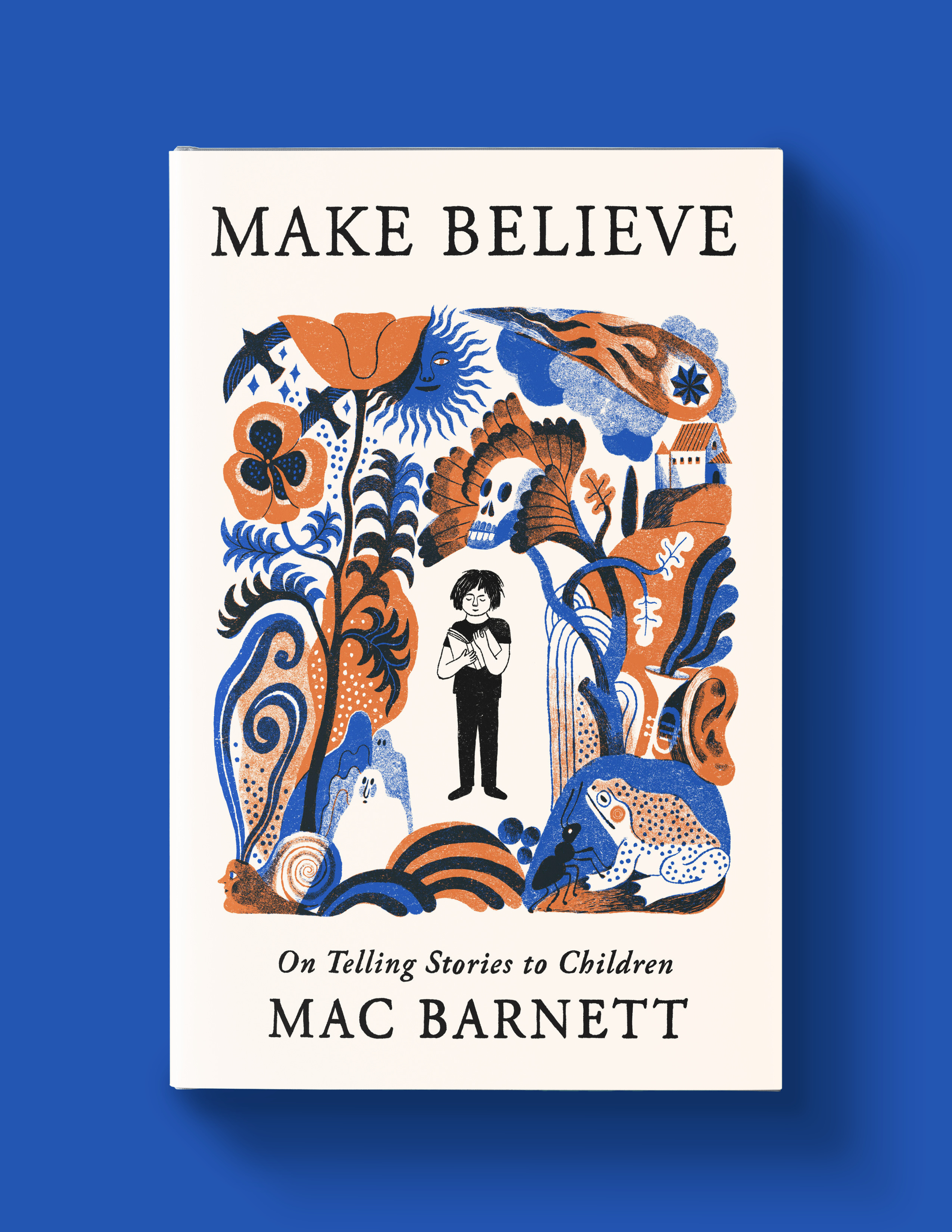
Today, we’re sharing an excerpt from Make Believe, Mac’s forthcoming book of essays on the potential of children’s literature, the role of the children’s writer, and the boundless genius of children. This book will (Mac hopes!) be of particular interest to readers of Looking at Picture Books, as well as anyone else who thinks kids’ books merit grown-up conversations.
Make Believe comes out on May 5. If you’d like a signed copy, you can preorder from East Bay Booksellers.
Make believe. What a wonderful phrase for the active commitment we make to fiction. It’s most commonly used to describe the way kids play. A kind of wholehearted pretending in which a new world is simply spoken into existence: “Let’s play house. I’ll be the mom and you be the dad and Jeff is our dog. The table is our house and that rug is our giant swimming pool. We run a hot dog stand. These forks are hot dogs.” And just like that, it’s true. Identities change. Objects transform. The room rearranges. Reality is altered simply because everyone agrees to make themselves believe it is so.
Fiction is a kind of game, and reading is a way of playing. Each story comes with its own set of rules. Some of those rules are inherited from genre or the novelistic tradition. Others are local to the story. “In this story, animals can talk but no one can do magic.” “In this story, people do magic but animals can’t talk.” “In this story, aliens live undetected among us.” “In this story, the French Revolution never happened.” “In this story, everything that happens is something that could happen in the real world, but you have access to the main character’s thoughts.” “This story is told in unattributed dialogue — the whole thing is people talking, and to understand what’s going on, you have to figure out who’s saying what.” The reader must learn the rules and agree to them in order to play the game.
When we read, we make believe. We aren’t duped or ensorcelled. Deep down we decide. We make ourselves believe. We know the characters in stories aren’t real, but our feelings for them are. We know the things in the stories never happened, but we can’t wait to learn what happens next. It’s make-believe when adults take a photo in front of 221B Baker Street, the London address of Sherlock Holmes, which is marked by a plaque, installed in 1990, between 237 and 241. These people don’t care that Sherlock Holmes is a fake detective or that (and I’ve double-checked my math on this) 221 is not a number between 237 and 241. They’re making believe. So are the people who travel to Dublin on June 16 to follow the path through the city that Leopold Bloom takes in Ulysses. So is the reader who says, about the characters in a favorite series, “I feel like these people are my friends,” or the one who finishes a long novel and keeps saying sadly, “I’m just going to miss living in that world.”
So when adults read, we make believe too. It’s just kids are much better at it. For one thing, they’re more adept at learning new rules — and not just because it’s the way they play. It’s the way kids live. When you’re a child, every room you enter and every encounter you have is governed by a new and unspoken system of protocols that you must quickly divine. Mess up, and the results are disastrous: a tongue-lashing from Mom, or no dessert, or a week without video games. Dinner at home runs on one set of rules, dinner at a restaurant runs on another, and dinner at home with your mom’s new boyfriend runs on a different set altogether. You’ll be telling a story that would be perfectly fine to tell in the first two circumstances when you notice that your mother is glaring at you, horrified and furious: “We don’t tell that story in front of Kevin!” And in that moment you learn how to have dinner with Kevin — and a little bit about your mom and that story too. That’s what literary fiction is: It’s dinner with Kevin.
Children are perceptive, flexible, and open-minded. They have to be. Childhood is a long series of experiments — testing out hypotheses and making adjustments. It seems only right that so much of the best children’s literature is experimental too. Kids read without tightly held notions of what a story can or should be. An unconventional structure or new approach bothers them not a whit. It’s an adult who is much more likely to be bothered. Adults, when we come into contact with something we don’t understand, tend to push it away. Difficult art can make us feel stupid. Literature can be a challenge to our dearly prized sense of mastery, the stability intrinsic to the very concept of being a grown-up. “Grown,” past participle: We have grown up. We are finished growing. But kids are proudly unfinished.
And when they encounter a story that makes demands of the reader — a story that requires thought and feeling and imagination in order to be fully understood — kids do what they do so well, so many times each day: They bravely work to comprehend the new.
Some new (and old) links to comprehend:
Mac is on tour for his new book, Rumpelstiltskin, with his friend Carson Ellis. On Monday in Los Angeles they will be joined by Jon (Klassen.)
The aforementioned Jon Klassen talked about his new board book last week on NPR’s All Things Considered, prompting some reflection on the power of children’s literature from host Andrew Limbong.
Mac’s conversation with Jennifer Garner at the 92nd Street Y, with a surprise appearance from Jon Klassen, is now available to watch on Youtube.
Deep dives on great picture books are here.
We recommend picture books here.
Read posts about the craft of making picture books here.
The Looking at Picture Books Shop is here.
Oh I am very excited about this!
In my studies I read so much about imaginative/pretend play. Was such an advocate for it when working in kindergartens and schools
Lev Vygotsky’s ideas about imaginative play as a shared agreement that temporarily reshapes reality! something I always remember from early years practice ☺️
Yay! I’ve read my Italian edition of this book using Google Translate Camera on my phone so many times already. I’m VERY excited to read the original!