Home Direction
and the time we lost a battle with our publisher


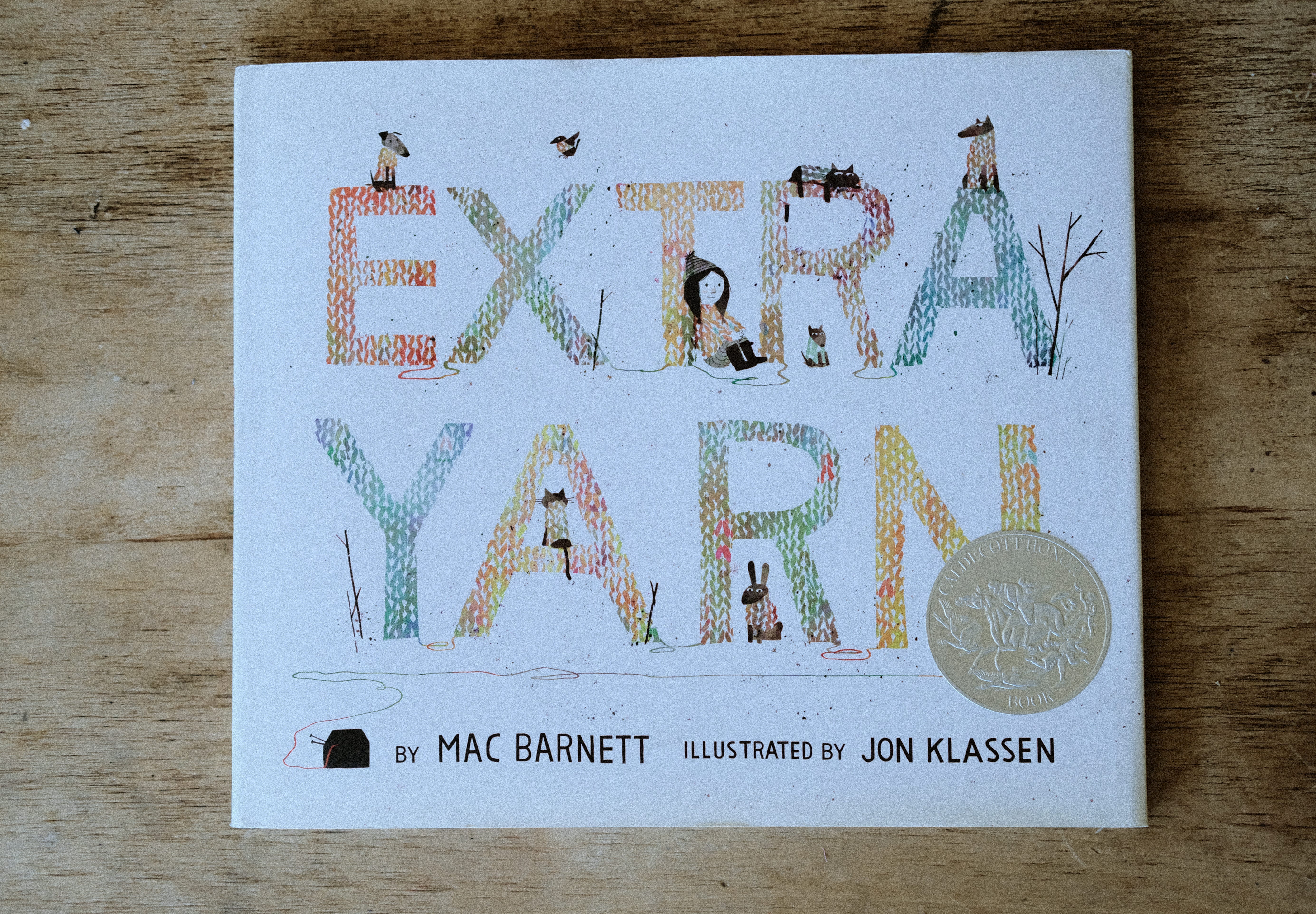
Jon and I had this conversation about our book Extra Yarn over text.
Reminder: Extra Yarn/Looking at Picture Books posters are up in the shop.

Also, I feel like I should note that I am sitting in Denver airport right now. Weird!
—Mac
MAC: Hi Jon.
JON: Hi Mac.
MAC: Jon, I learned the term “Home Direction" from you, fourteen years ago. I was in Denver Airport, talking to you on the phone, and we were very worked up on the call, which we will explain later.
First, let’s get a working definition of Home Direction. In a picture book, if a character starts off on the left side of the book and walks toward the right, this establishes a sort of compass within the book. If that character were to walk back to where they started — back “home” — you would have the character turn around and walk in the opposite direction, toward the left.
JON: Yes! And playing with Home Direction can get interesting. When you want to show a character getting lost, or you're cutting between different non-sequential moments in time, it's useful to BREAK Home Direction. The effect is "they went all over the place." It's disorienting on purpose.
MAC: The very physical form of the book and the mechanics of how it works inform the emotional/psychological experience of reading it.
JON: Yeah, you feel this stuff, emotionally, and you also feel, I think, less satisfied when these rules aren't taken care of or used.
Picture books can use this Home Direction thing in an interesting way because we read (at least here at home) from left to right, so it feels natural that the action move that same way from the start.
But I would go wider than picture books even and say Home Direction concerns any kind of sequential storytelling, so like comics, film, etc. I actually learned it from film, but it comes into this kind of work, too.
MAC: “Hollywood Jon.”
JON: When I was in school for animation and learning about storyboarding, one of the first Home Direction examples I remember was the train chase from the beginning of Indiana Jones and The Last Crusade. The characters move through all sorts of stuff in that sequence — caves, horses, trains, cars — but you always know which way Indy wants to go. It doesn't mean your action ALWAYS goes one way, but if you switch it up you have to do it carefully.
MAC: Just to clarify, you're talking about moving left-to-right or right-to-left, correct?
JON: Yes — in that sequence, if memory serves, Indiana Jones wants to be going right to left. And the bad guys want to stop him, or make him go the other way.
MAC: You can see what Jon is talking about by watching your authorized VHS of The Last Crusade, and definitely not by just streaming the opening sequence on YouTube.
JON: And also if it turns out there is not a hard Home Direction in that sequence, please drop a comment below and I will not read that. NEVERTHELESS, the concept is useful in picture books.
MAC: You know where we know FOR SURE there is Home Direction and it IS crucial to the storytelling? EXTRA YARN. Our first book we made together.