

Brown Bear, Brown Bear, What Do You See?
A definitive read-aloud in (at least) for different versions


Last week, Mac visited the Library of Congress and got to spend some time exploring their expansive picture book collection. Lucky for us, he took some classically Looking at Picture Books shots while there.
Here’s what he saw.
MAC: Hi Jon.
JON: Hi Mac.
MAC: Where are you right now, Jon?
JON: I’m sitting on a folding chair in the middle of a parking lot in Glassell Park, Los Angeles.
Where are you?
MAC: I am at Reagan National Airport in a lounge affiliated with a credit card company I will not name, because Looking at Picture Books is INDEPENDENT MEDIA.
JON: YEAH.
MAC: But yesterday I was at the Library of Congress.
JON: Right. And what did you see?
MAC: Well here is the thing, Jon. Earlier this week we were talking about Brown Bear, Brown Bear, What Do You See? by Bill Martin Jr. and Eric Carle.
Because we had seen some people posting about the fact that there were two different editions, with two different sets of illustrations by Carle.
JON: Yeah. This had been making the rounds a bit, and there was much discussion about which one was seen as “better,” just in terms of the art itself.
MAC: Well, a perk of being the National Ambassador for Young People’s Literature (💪) is that I get some opportunities to explore the collection of the Library of Congress and talk to all the experts who work there.
And weeks ago, I’d asked if I could see a copy of Brown Bear, Brown Bear, What Do You See? the next time I visited (which was yesterday). And get this: Hannah Freece, as if she was listening into our phone conversations, which to be clear I do not think that she was, or even has the ability to do, pulled multiple editions of the book.
Not two.
But four!
Each one of them different!
JON: In both the writing AND the art!
MAC: Hannah pulled an edition from 1967, 1970, 1983, and 2010.
And yeah, the art and text work differently in each one. And in interesting ways.
Can we talk about the words first?
FOR ONCE?????
JON: I guess, since you took all the pictures and everything.
MAC: OK, so let’s look at the 1967 edition.
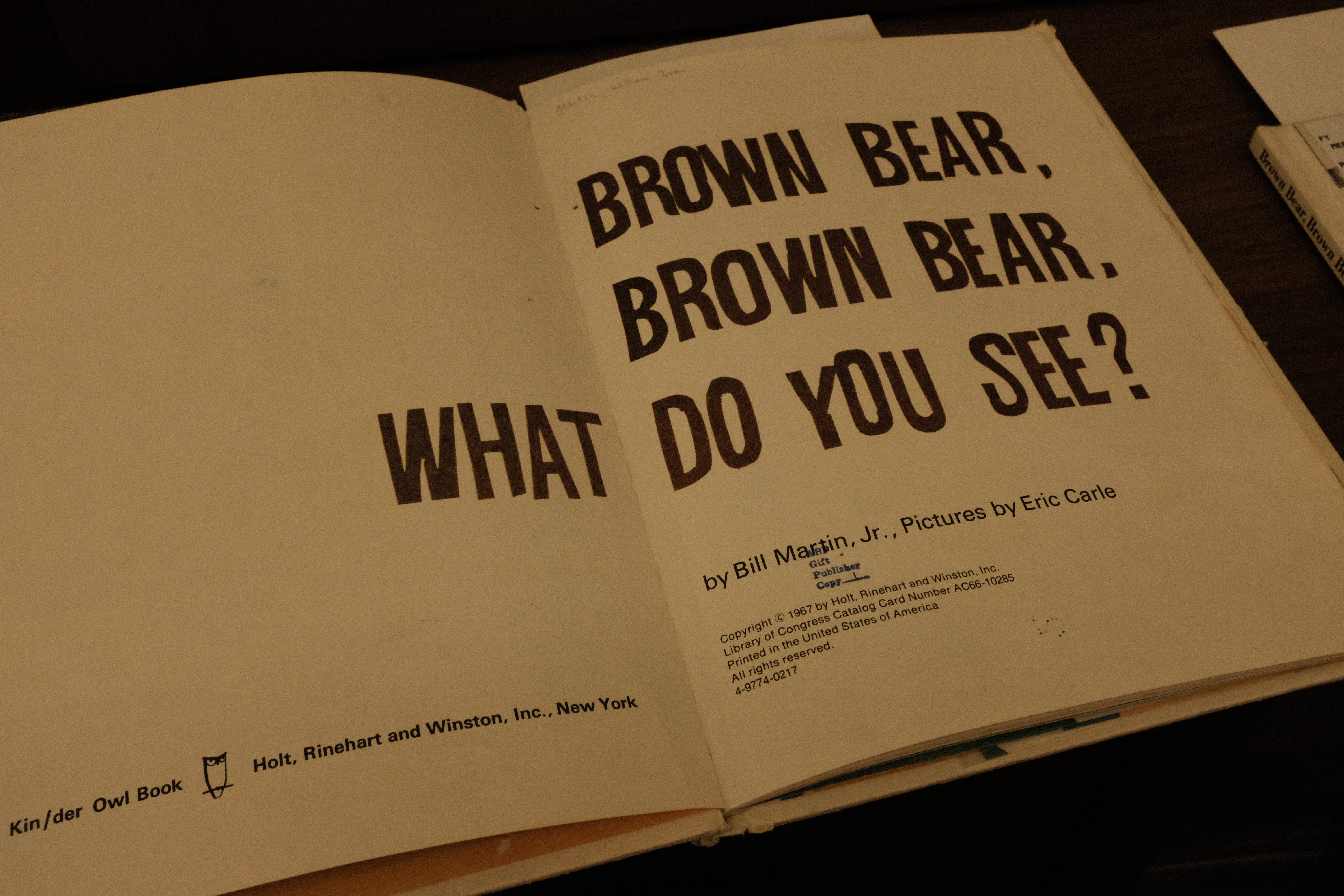
There are these italicized attributions in the text, or possibly instructions:
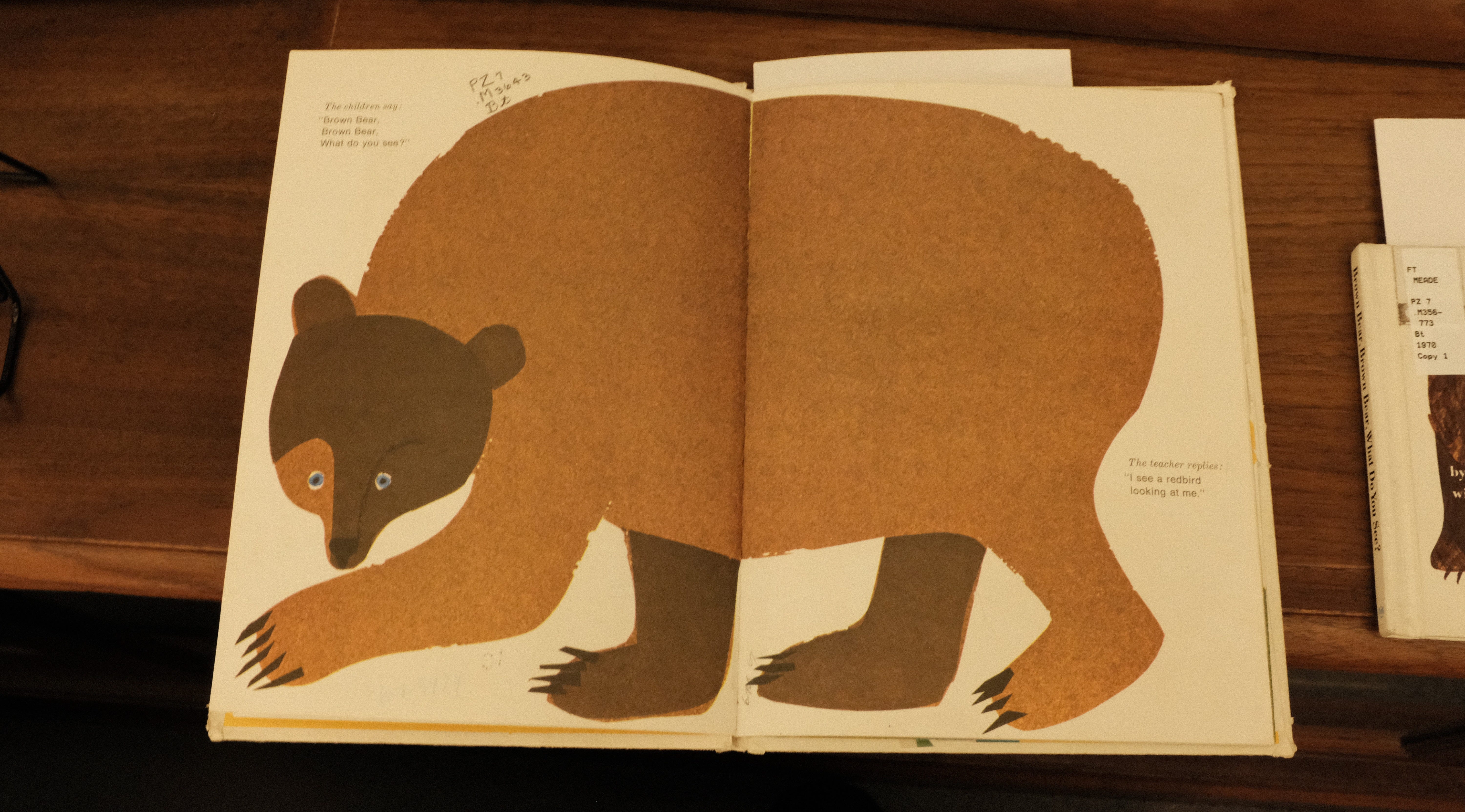
The children say:
“Brown Bear,
Brown Bear,
What do you see?”
The teacher replies:
“I see a redbird looking at me.”
The 1970 version drops the italicized attributions and the quotes.
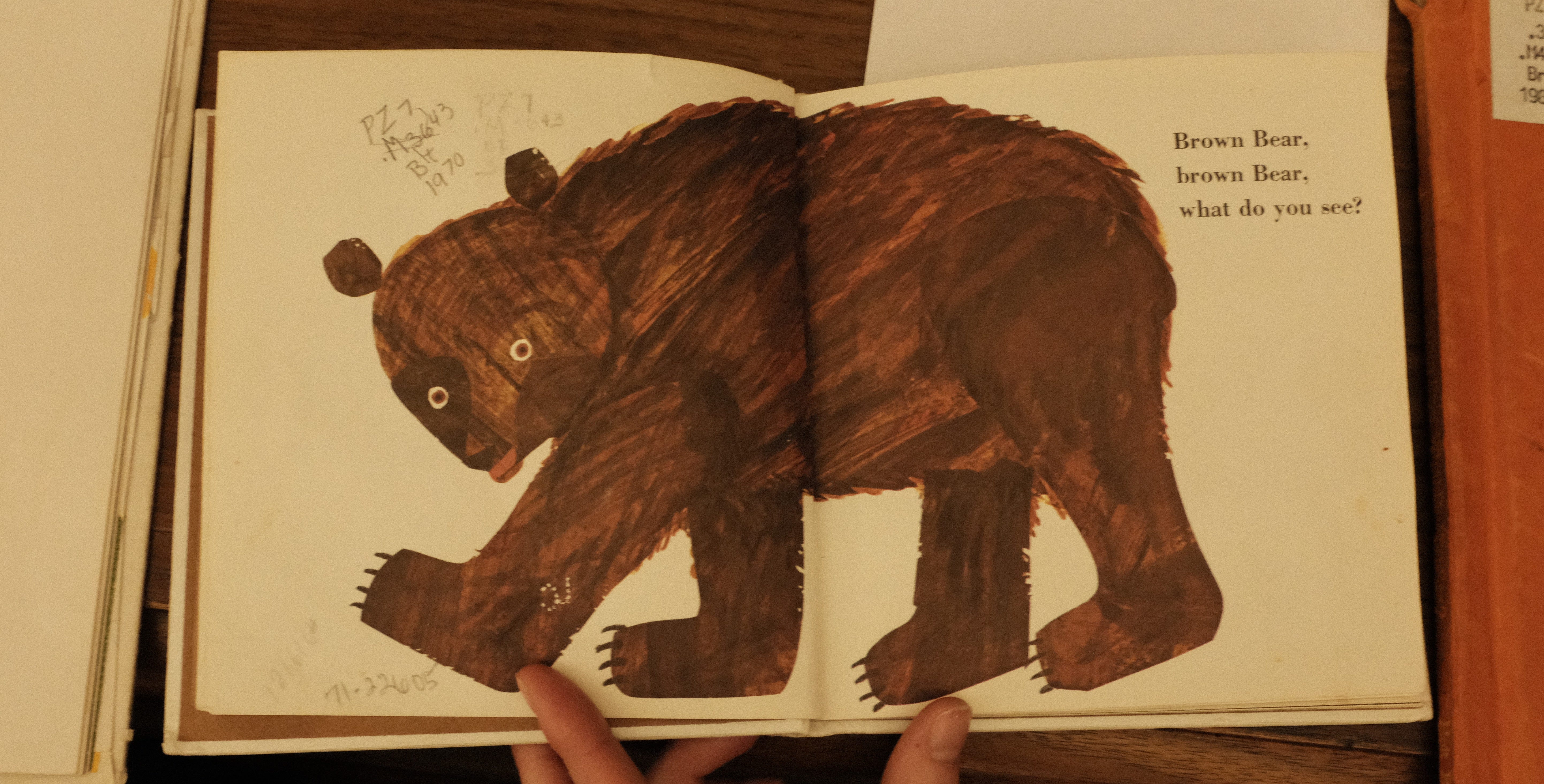
Now let’s stipulate that there are many people who know more about the history of this book, and that some of them even read this Substack, so please tell us if we are wrong.
(We will definitely be wrong.)
But nevertheless it’s an interesting exercise to theorize about this change, even if we are wrong.
(Did I cover our tails?)
JON: (Only one way to find out.)
MAC: I will say that it really feels to me that in the 1967 version we are seeing how Bill Martin Jr. imagined this text being read out loud, with instructions to kids and teachers.
And that three years later, we are seeing a revision based on how the book was actually being used.
JON: Right. It’s kind of funny to picture the book being out, and him doing like a class visit with it, and then everyone reading everything out loud, including the instructions and he’s like “No...no wait...you’re sposta...right, though, I can see where you would think that you had to....crap. I have to make a phone call.”
MAC: Adults reading the italicized instructions out loud even though it disrupts the rhythm, kids not knowing their parts (the first sentence of the book for goodness sake!), even “ideal” readings being prefaced by lengthy explanatory sessions (”Listen up kids, you gotta memorize some stuff, FAST.”)
JON: (”This book has RULES. Fun right?”)
MAC: Yeah, so the 1970 version feels road tested to me.
There’s another big change, too.
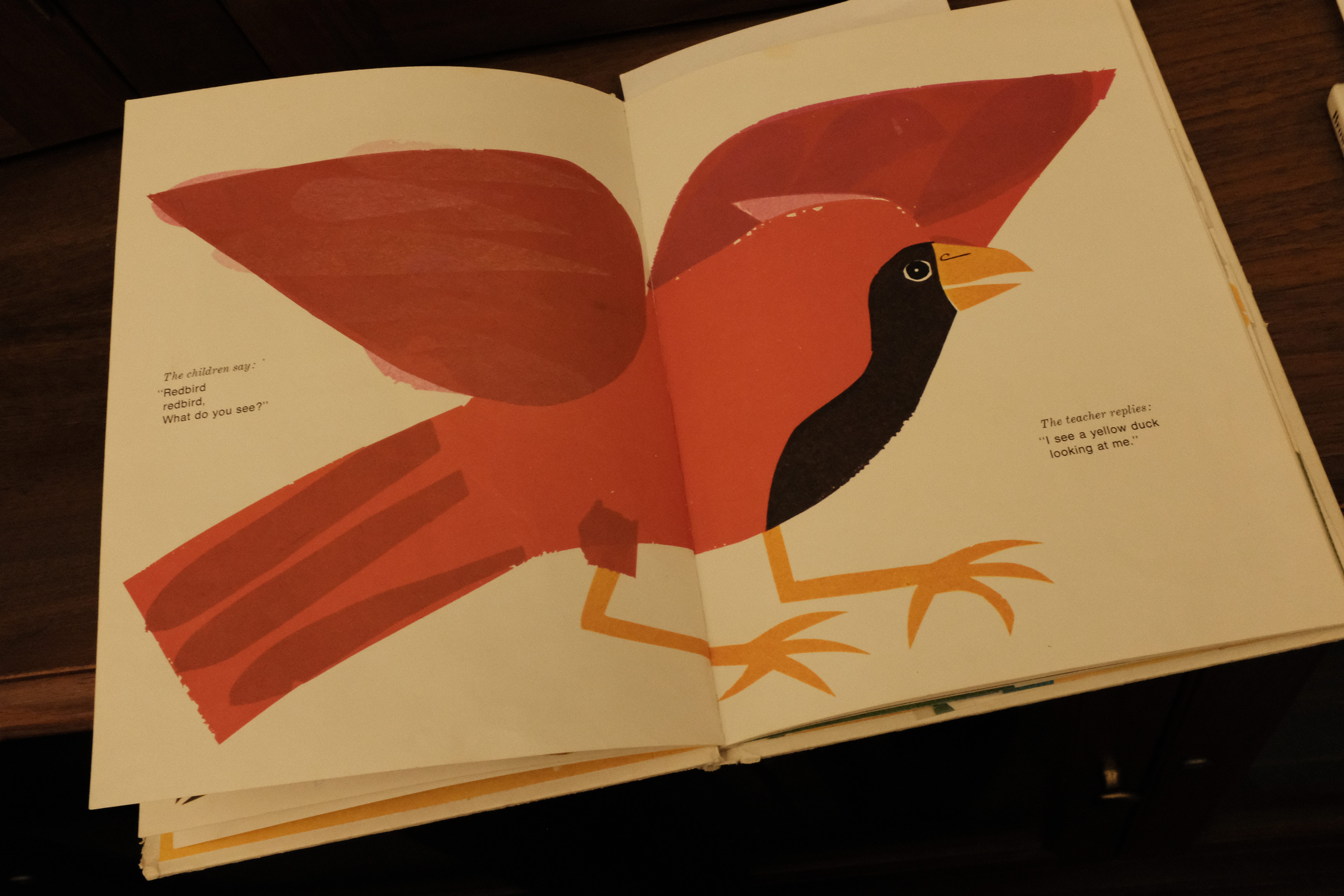
Let’s look at the second spread of each. The 1967 redbird:
And the 1970 redbird:
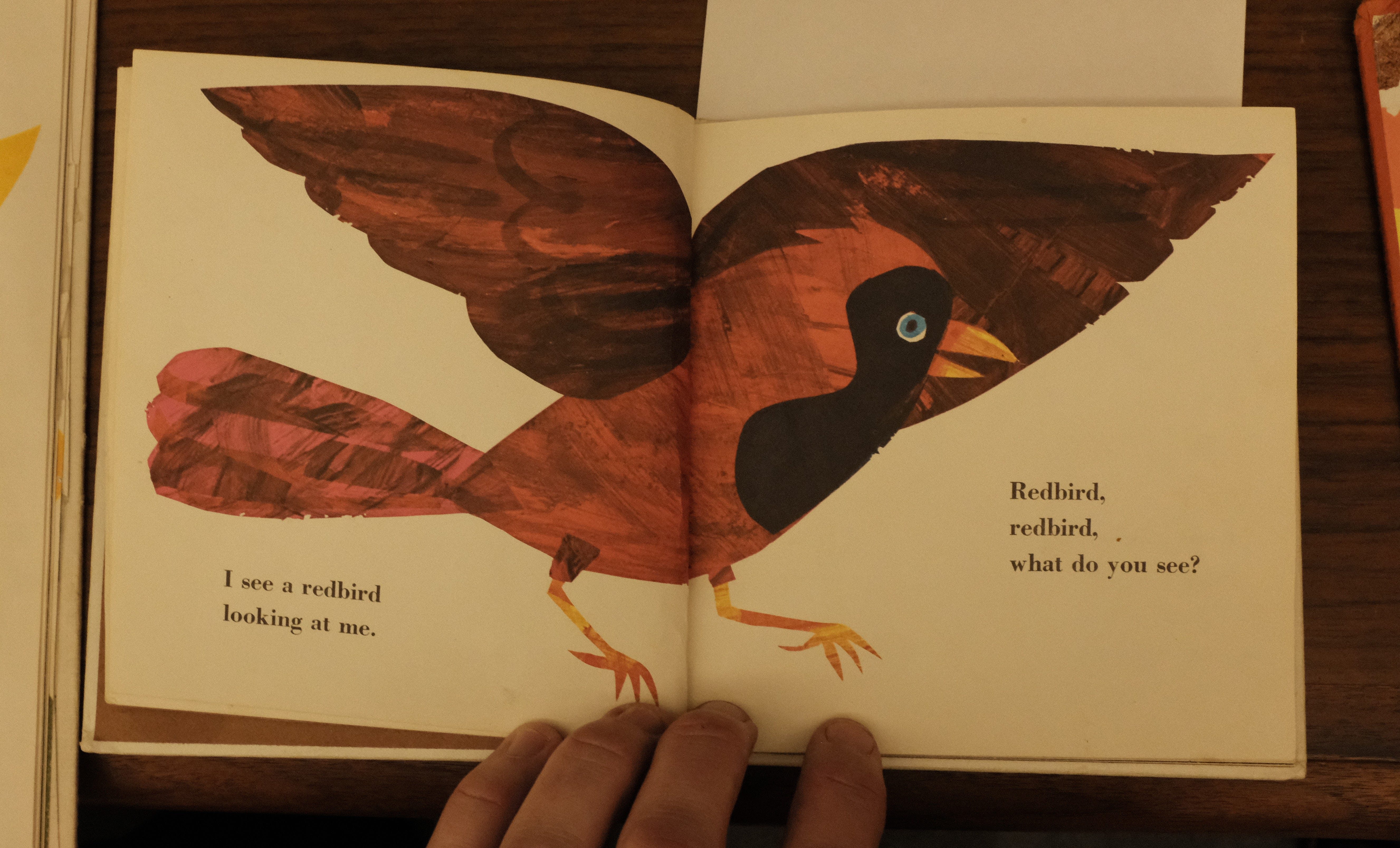
The page turns work differently!
In 1967 we get the question on the verso and the answer of the recto.
So we know the duck is coming before we turn the page.
In 1970, we get the question on the recto and have to turn the page to find out what the animal sees.
The suspense of the unanswered question propels the page turn.
JON: There is still suspense in the 1967 one, but the suspense is left to the illustration. When the red bird says: “I see a yellow duck looking at me,” the suspense is: “Man, I cannot wait to see this yellow duck.”
And then there he is.
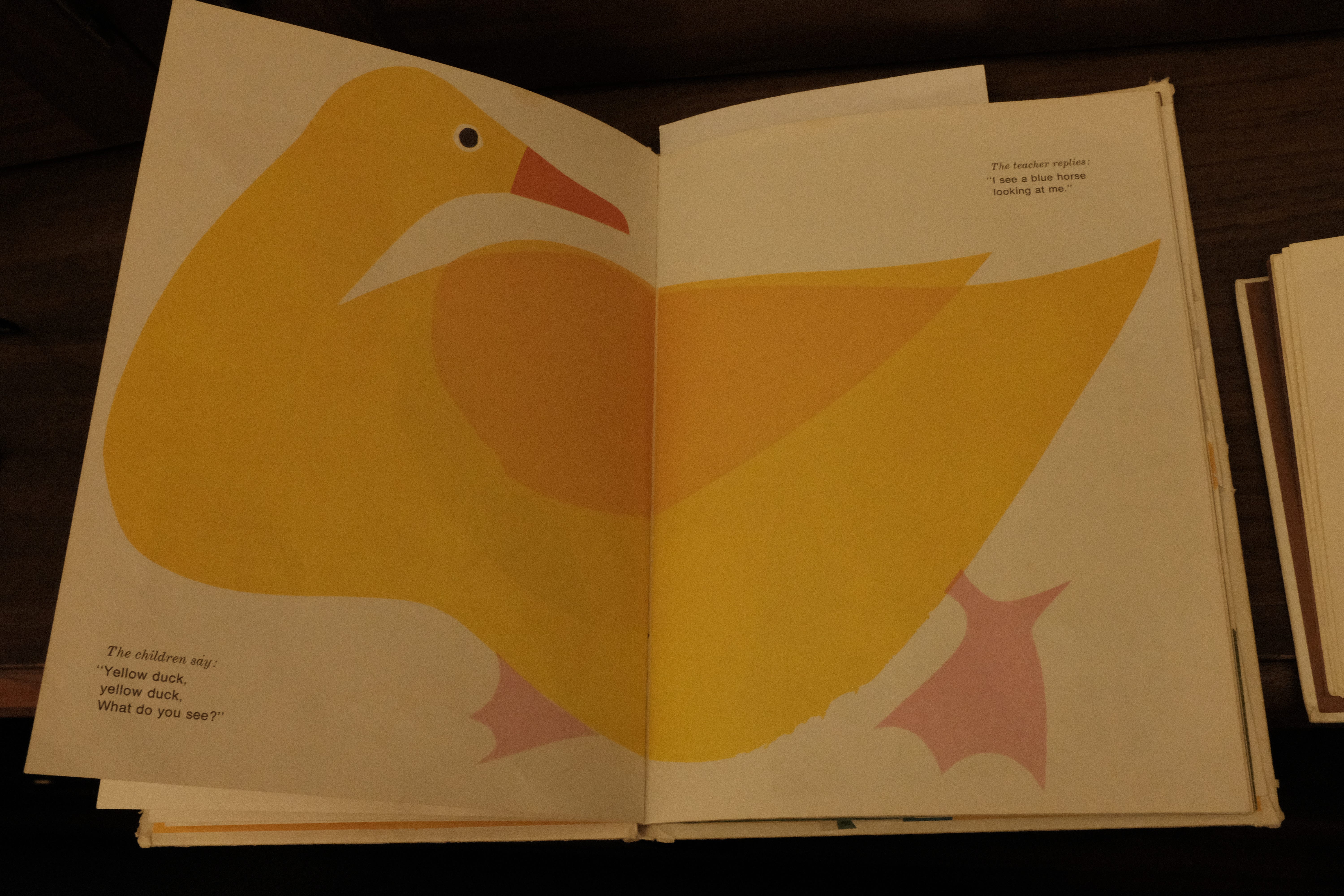
Yellow as all get-out.
Which is satisfying.
MAC: Yes that’s a good point.
Do you like either pagination better?
JON: Ummm, predictably I’m interested in the illustration paying off the suspense I guess. Cause the other way, when you’re finding out both things on the new page, it’s kind of a double beat, right?
MAC: I prefer the 1970.
JON: If you didn’t know what animal was coming next, you’d turn the page, SEE a yellow duck, and then read “I see a yellow duck” and by then you’re like, “Yeah I know.”
“I saw him.”
MAC: So you like the 1967?
You prefer: “Wait for it, there’s going to be a yellow duck.”
PAGE TURN.
JON: Yeah.
MAC: “Wow that duck is yellow.”
All right should we look at two ducks next to each other?
A question I know you’re always ready to say yes to.
No matter the context.
JON: Bring on the ducks.
My epitaph.
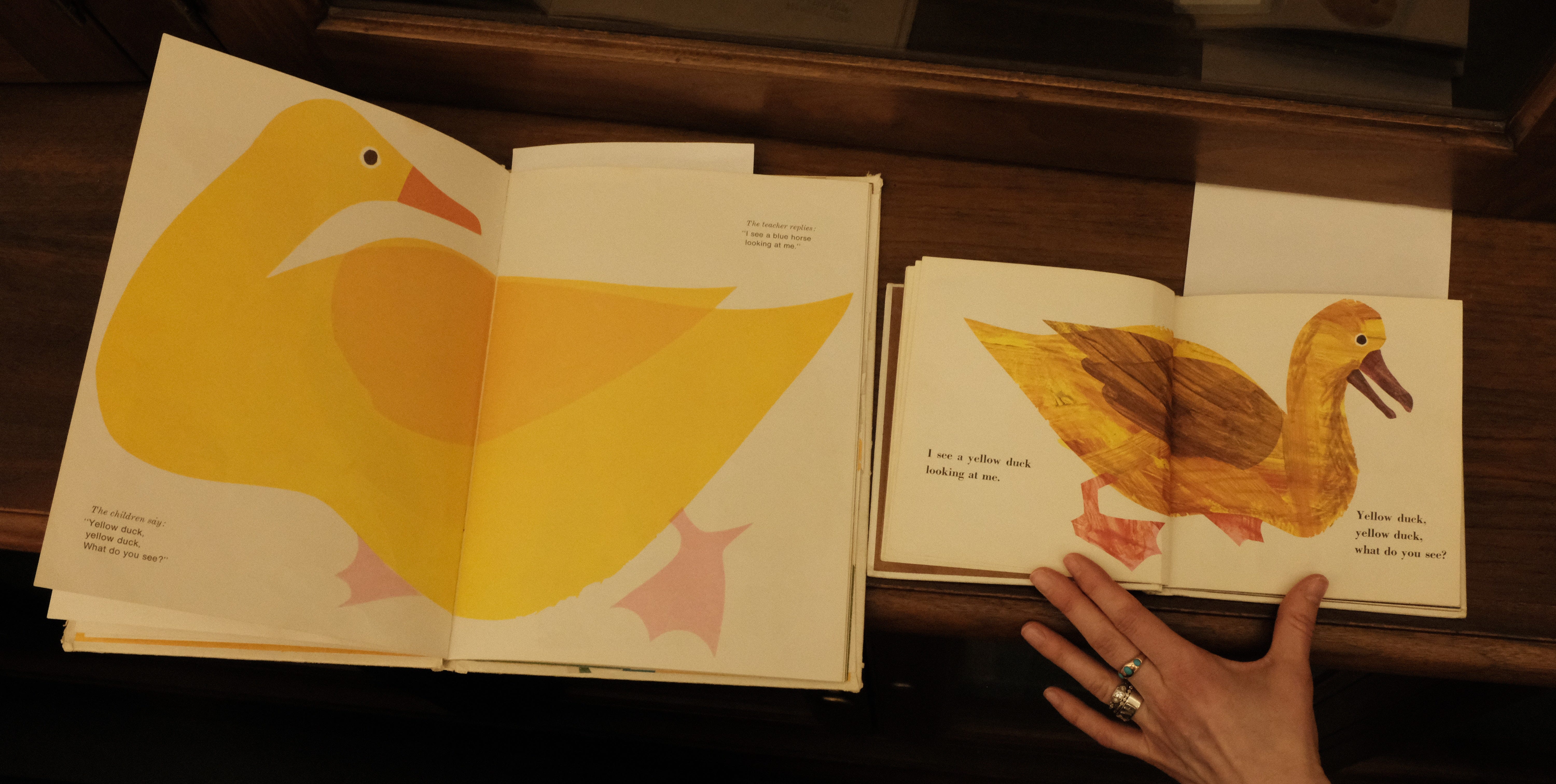
JON: The other reason the 1967 works better for me is that we’re asking the duck a question on his page and he is answering.
The other way, we’re still listening to the animal from the previous page.
Which, I guess, has it’s own kind of interest.
But I want to talk to the duck!
MAC: I like the voice of the redbird being carried in the wind to me from the previous page.
“Ah yes, the redbird, I hear him back there. I remember him.”
JON: Yeah. It does work. It’s neatly laid out that, left to right we haven’t “hit” the duck yet.
We’re about to hit it.
MAC: “He was my friend.”
“My best friend.”
“At least until I met this duck.”
JON: It is, undoubtedly, an upgrade.
MAC: It’s wild that both these ways work.
Because they are two completely different games.
I would argue two completely different books.
JON: On this newsletter and it’s weird obsessive way of looking at these things, yes.
MAC: Yeah only on this newsletter.
If I was talking to a guy in a bar about this I wouldn’t say that.
Because he would have already started looking at his phone 15 minutes ago.
JON:
But none of this means we wouldn’t love to hear about what Bill Martin Jr. really was going through here.
Cause he was going through something.
MAC: Do you want to compare the ducks?
JON: Well yeah, that’s the other thing. Carle is ALSO going through it.
In between these two editions, we have found out, was The Very Hungry Caterpillar.
Carle had found the way of generating his artwork that would stay with him, more or less, for the rest of his life.
And he (obviously) liked it better than what he’d been doing before.
MAC: We found that out using the deep research technique of “looking at years.”
JON: “Comparing year numbers,” I like to say.
MAC: Deep.
So the 1967 animals are B.C.
(Before Caterpillar.)
JON: (Yes.)
(Trying to make “A.D” work but I’m sitting in a parking lot and it’s distracting.)
MAC: (I was also trying to do that.)
(Did you come up with anything you decided not to type?)
(Because I did.)
JON: (Oh yeah a bunch.)
What’s interesting to do, though, is compare these two looks of Carle’s and try to stay objective. A lot of people I’ve talked to about this prefer the B.C look.
And I kind of do, too.
But BUT—
It’s very hard to do this with perspective. Cause the later look — the A.D. look — is so ubiquitous, that of course it’s exciting to see the older one. Besides being so good at texture, Carle was INSANELY good at laying out a page, and those are two different skills. The more opaque 1967 style shows that second skill off so much. All of his use of positive and negative space is on display in those ones, with no texture to pull attention from it.
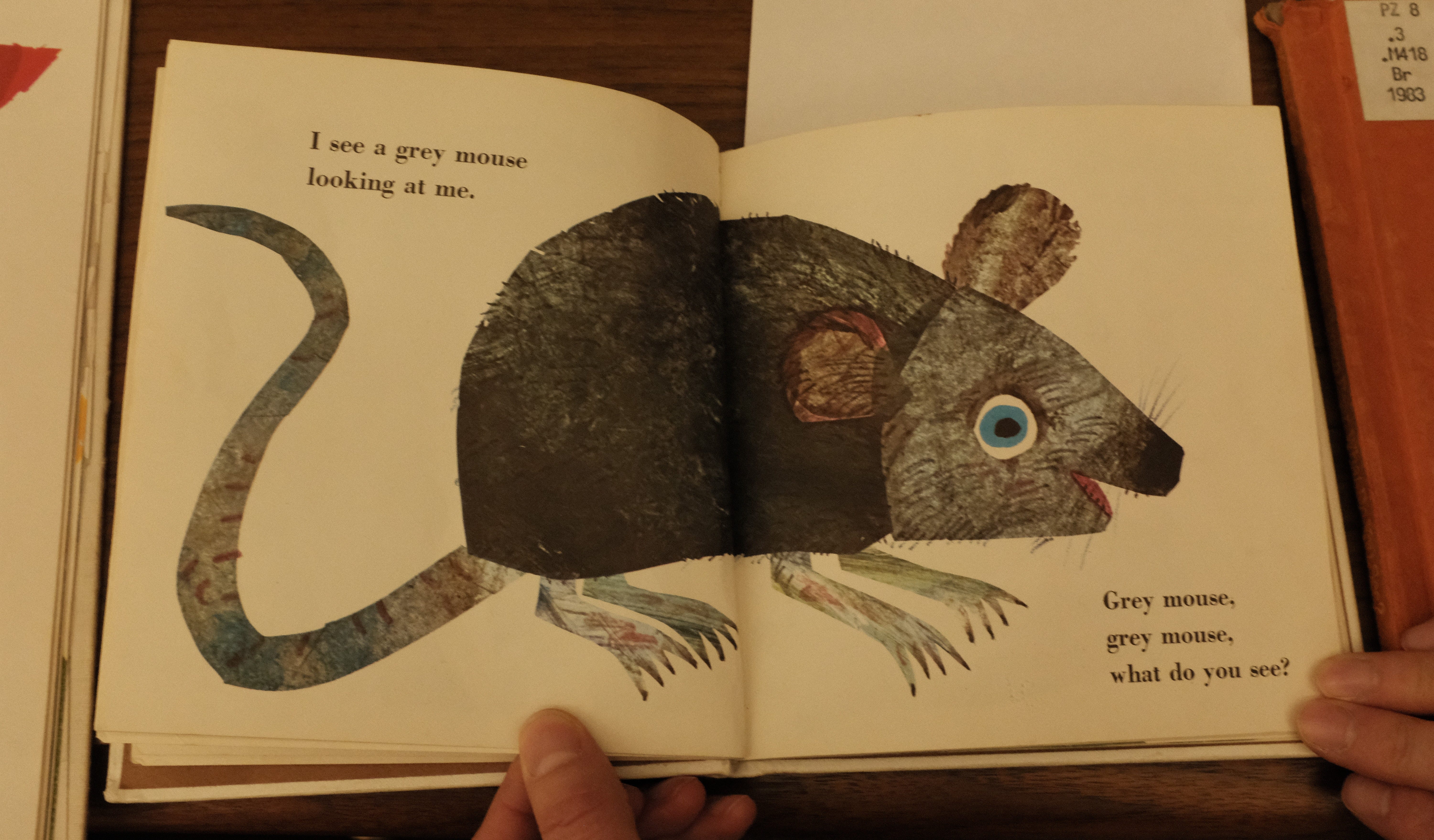
MAC: Also, the 1970 edition has a couple of new animals, animals that then get removed from later editions.
The mouse:
and the pink elephant:
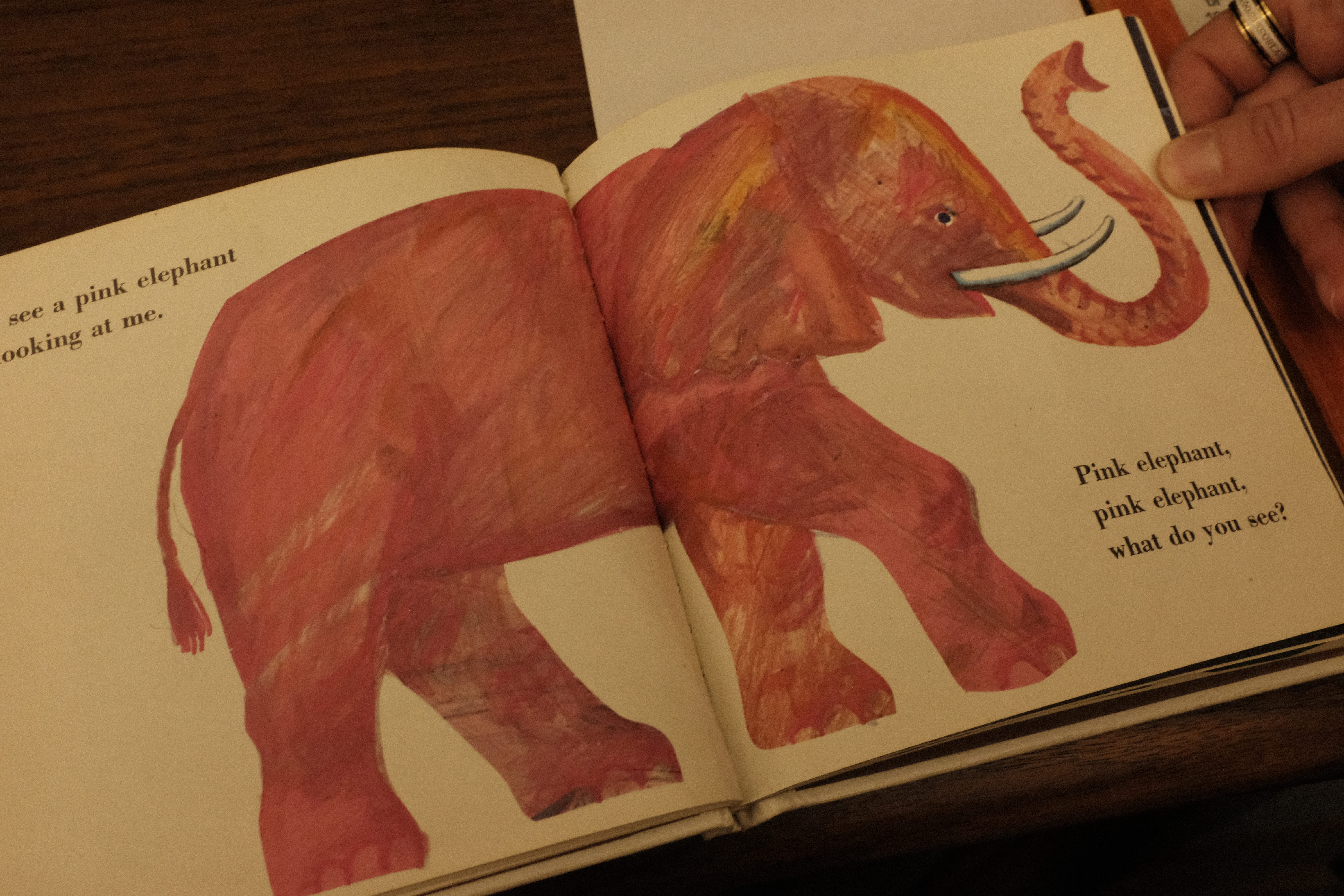
The pink elephant, I think, steps on the blue horse story beat and I see why he gets axed later.
That mouse is really something though.
JON: Yeah. It is sad to see him go.
Another thing to wonder about all this: was one of them, either Carle or Martin Jr., the one prompting these updates? Did Bill do the afore-envisioned class visit and call Eric Carle from a school payphone and say, “We’re gonna go back in and change some stuff FYI,” and Carle said, “Oh sweet, I just changed my whole style so while we’re in there let me redo the pictures too?” Or was it the other way around, where the Caterpillar book just took off so fast, Carle liked how that art went so much that he called Bill and Bill was like, “Oh, sweet, that’s great news cause everyone’s out here reading the text the wrong way anyway.”
“Also I’ve developed a need for a mouse. Please add one in.”
MAC: “School payphone.”
Bill Martin bursts into the office, sweating.
“I’ve solved it! Madam, may I use your phone?”
The school secretary frowns and looks meaningfully at the payphone mounted to the wall.
JON: Bill looks at the payphone, then back at her and says, evenly, “You know, someday I’m going to be a big deal.”
MAC: “I’m sure, Mr. Martin Junior.”
JON: “It takes quarters, your highness.”
MAC: “Your highness junior.”
JON: They get married a year later.
MAC: Again, correct us in the comments if we have any of the details wrong.
JON: She probably subscribes.
MAC: OK, but get this!
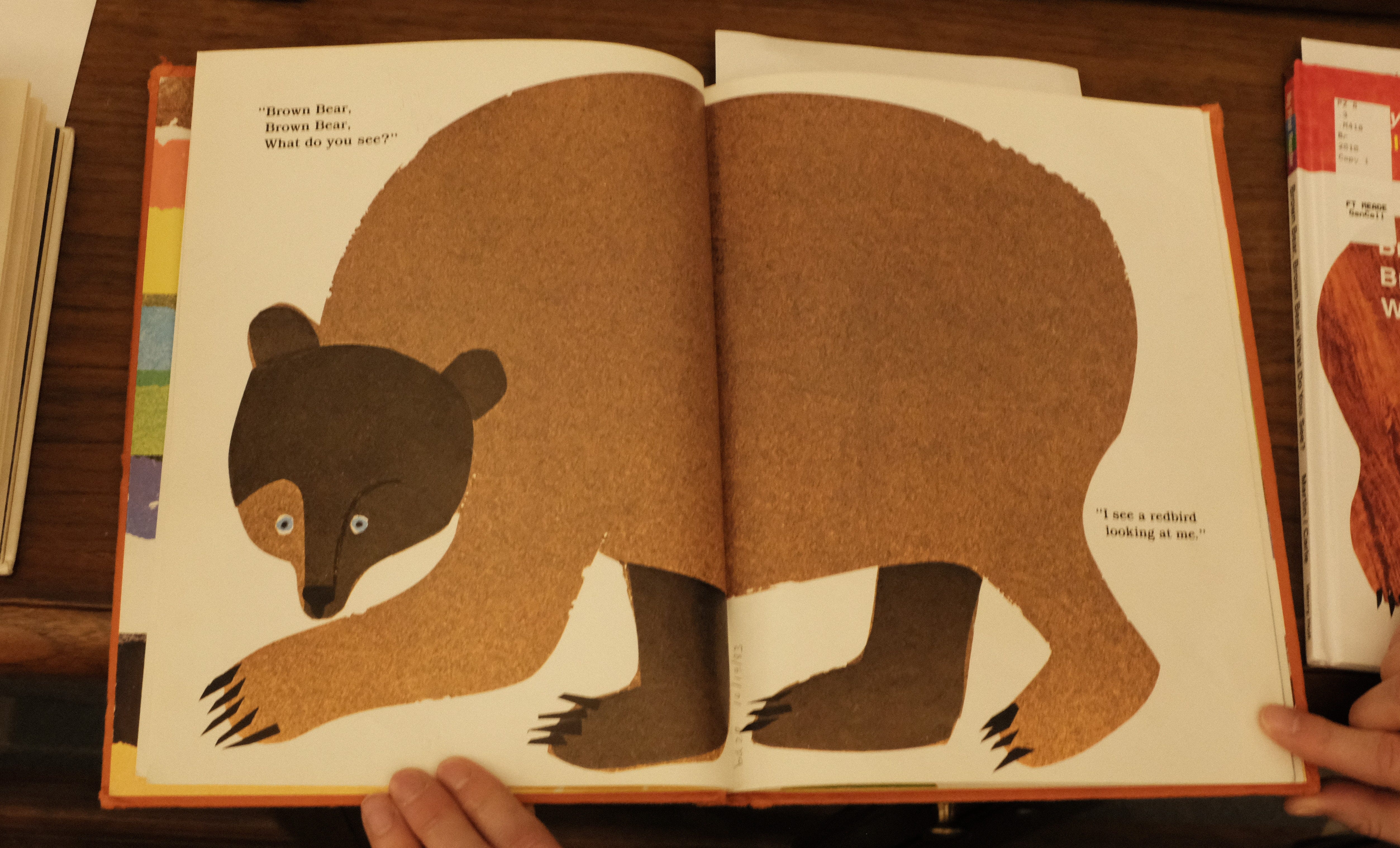
The 1983 edition reverts to the 1967 art!
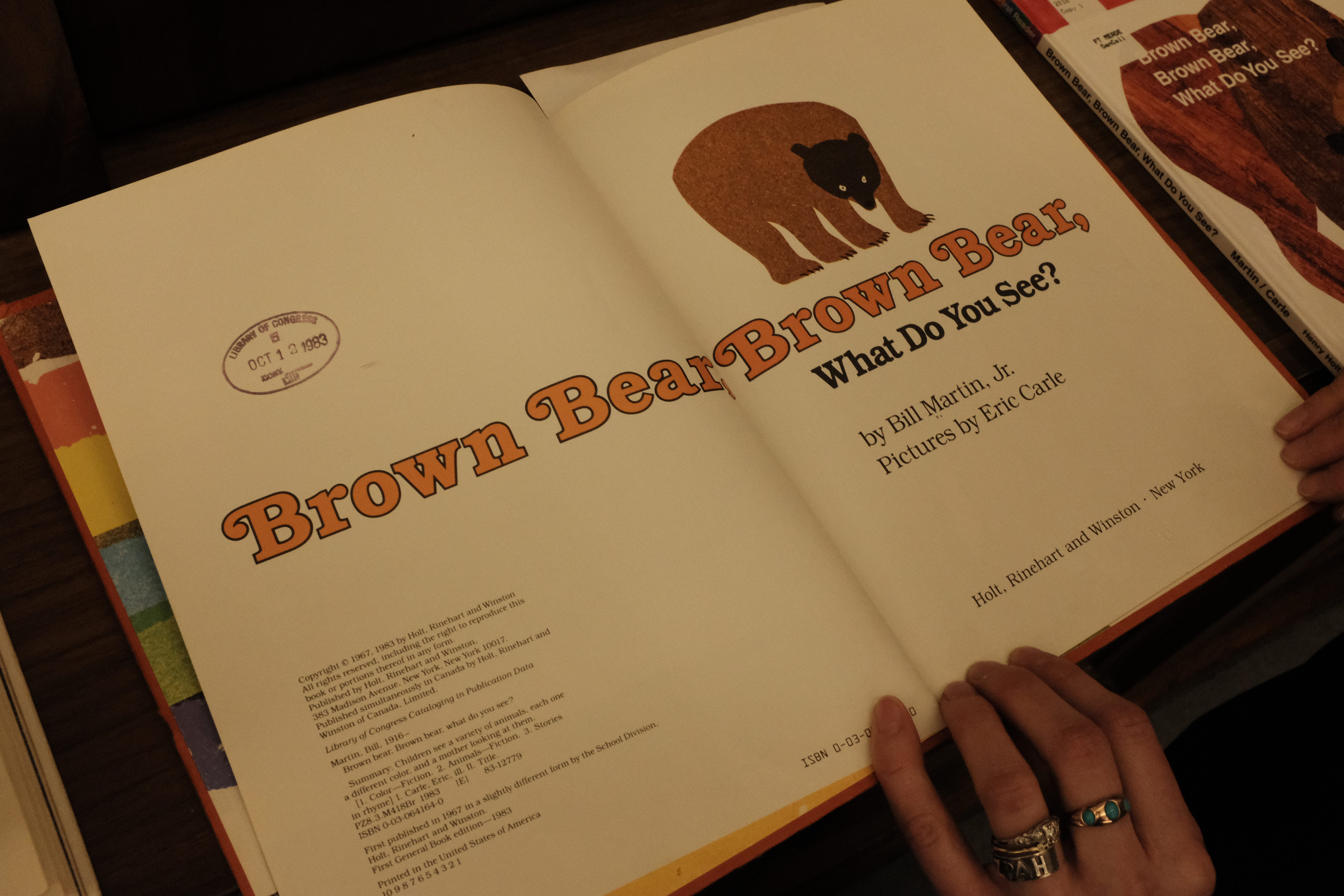
JON: Man, what was going on.
MAC: But now the mouse and pink elephant are gone.
JON: Maybe the first edition art sold real well and then the second edition not as much, at first, so the publisher blinked?
MAC: And it also reverts to the 1967 page turns.
But loses the italicized instructions.
But puts everything in quotes.
JON: I wonder, and, again, veterans sound off, if tweaks and changes like this WERE more common back then, it’s just that this is an especially conspicuous example? Were authors and illustrators just tweaking away back then?
MAC: There’s another big change.
The adult woman who wears glasses, previously a teacher, is, in this edition, a mother.
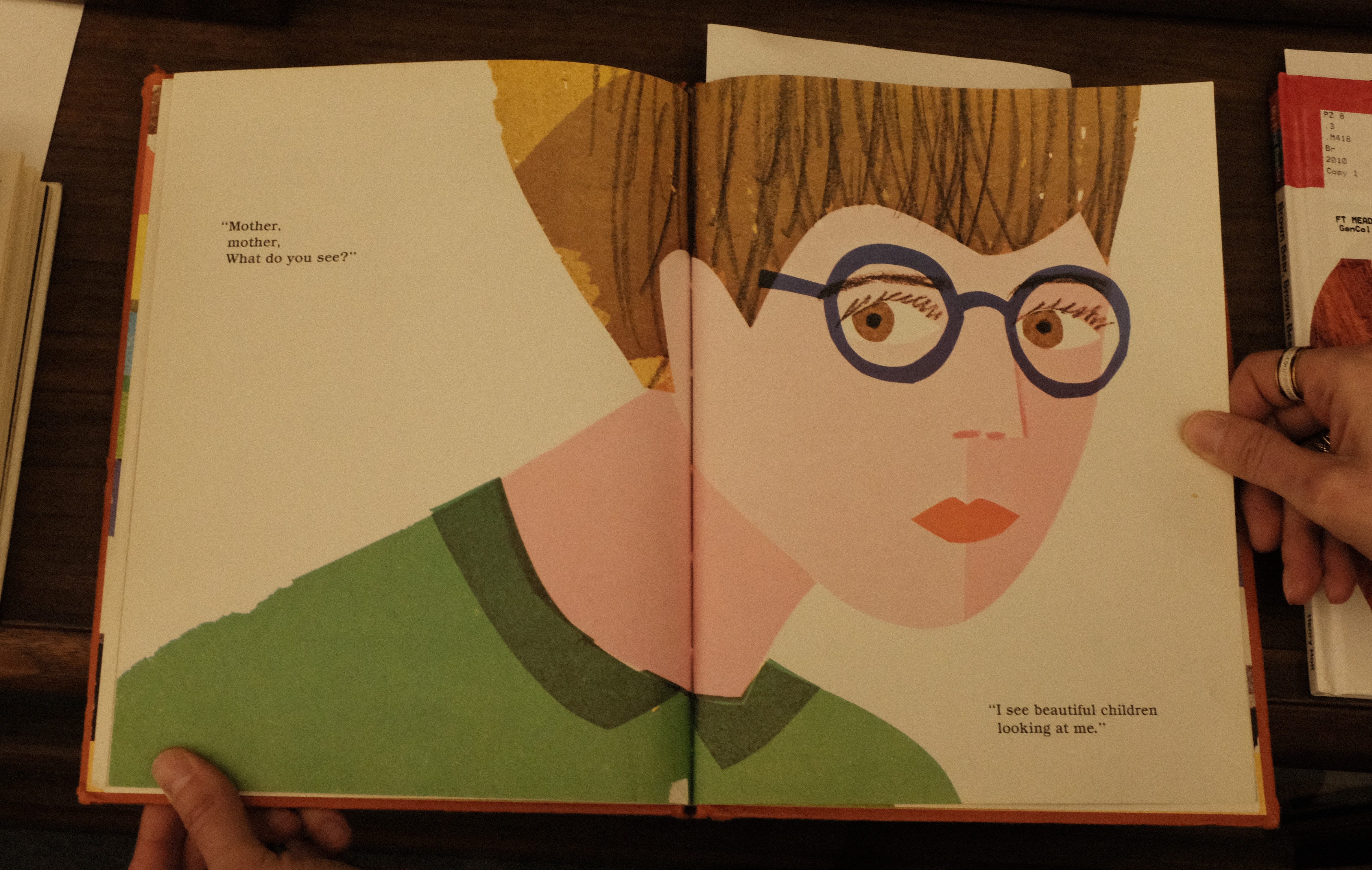
I wonder if this reflects a shift in the market toward retail, and away from schools and libraries, after Nixon axed Johnsonian school library funding.
I say to the man next to me at the bar, who hasn’t made eye contact with me for the last two hours.
JON:
Besides the two styles we have here, the more solid (1967 and 1983) and the more textural (1970), there is a third one, where the art is more opaque, but he’s doing like a shaded scribbly thing on it.
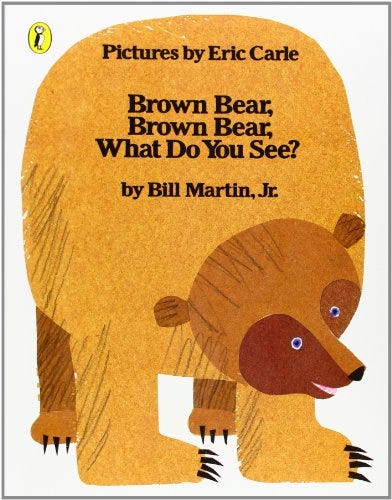
MAC: WAIT IS THERE A FOURTH ONE
JON:
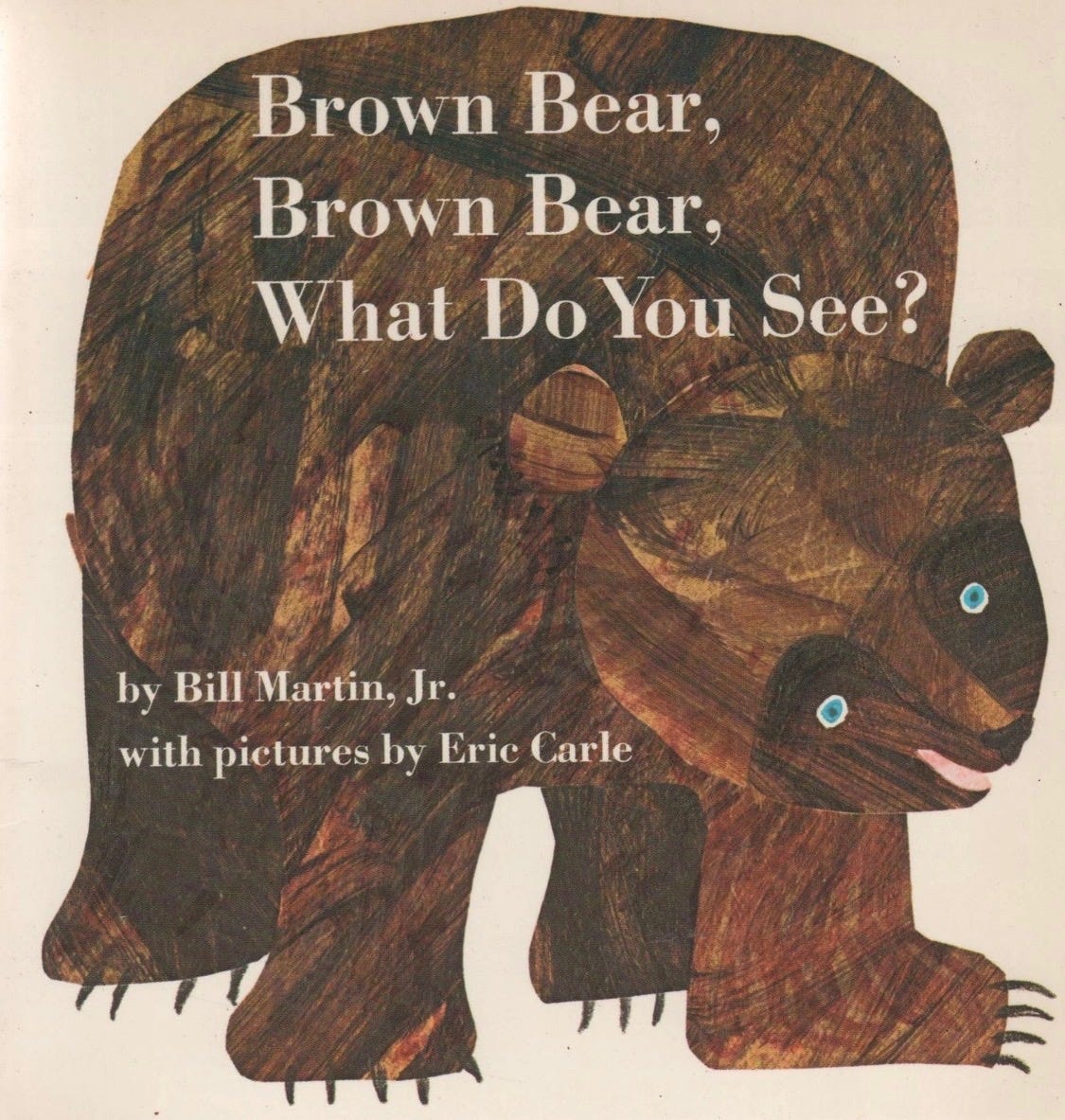
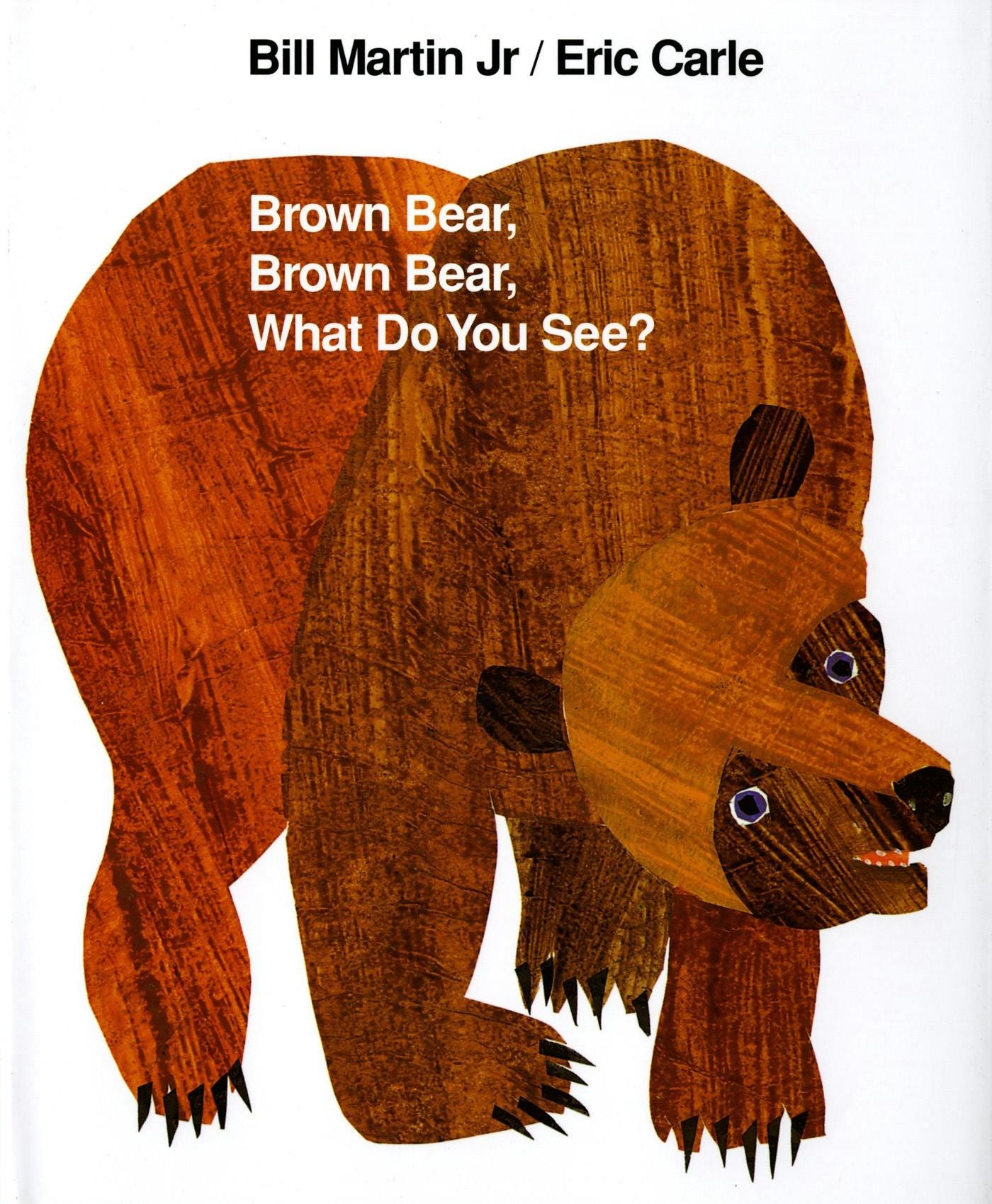
MAC: HOW MANY ARE THERE?
JON:
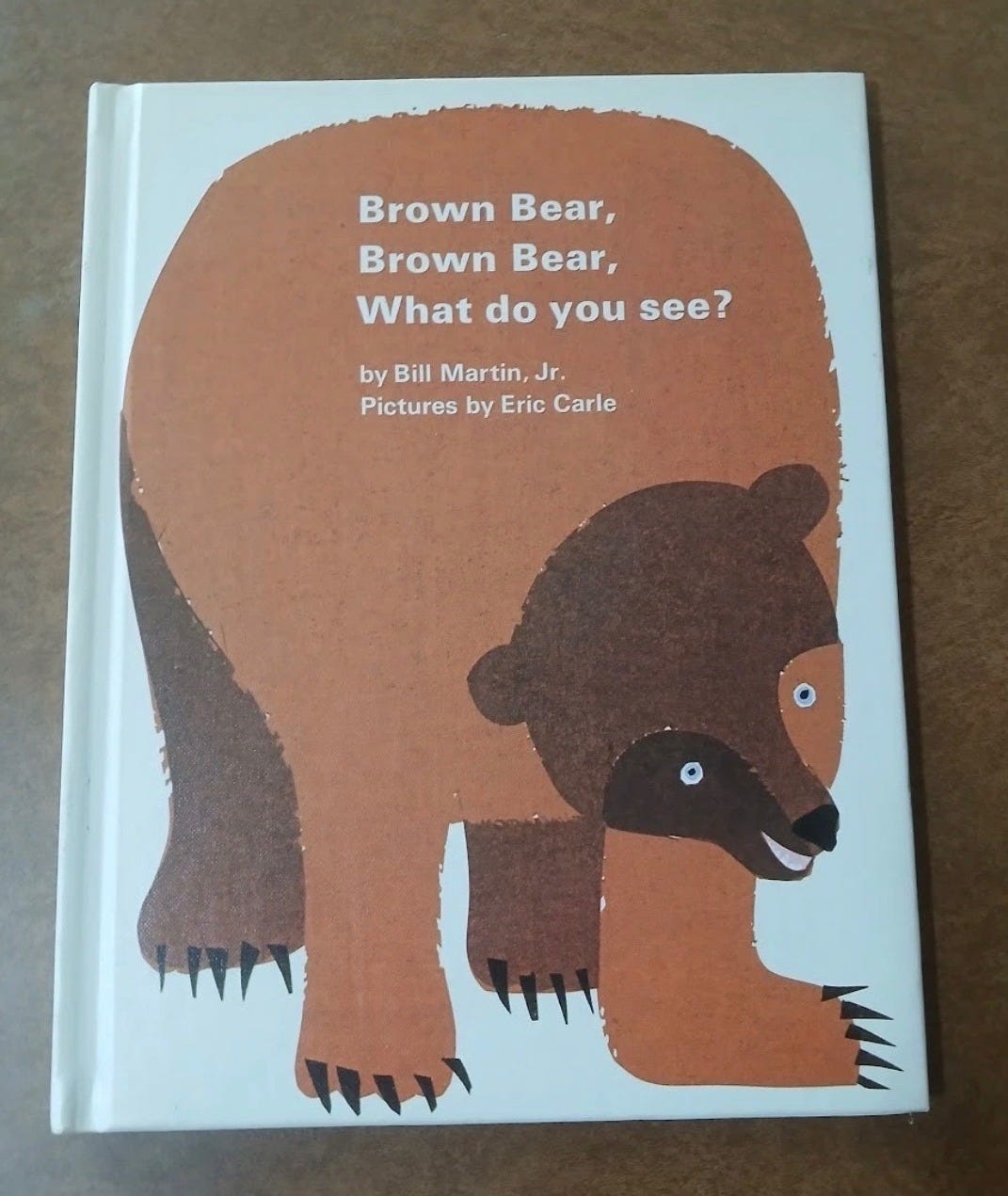
I count four, there.
MAC: AAAAAAAAAAAH.
EVEN THE MAN AT THE BAR IS STARTING TO GET INTERESTED!
JON: Are there more??
MAC: That’s 4!
JON: I want that italicized one pretty bad.
MAC: Well I saw three yesterday at the library. The 1967, the 1970, 1983, and then the 2010, which I believe has been the standard for all editions since, though now we’re up to four and I’m starting to feel like Fox Mulder.
JON: This is the week for feeling like him for sure.
MAC: Here is a question for you, Jon.
Have you ever been tempted to change one of your books after it came out?
JON: Absolutely.
MAC: Me too.
JON: it’s very cathartic to see these guys getting to do it like this.
MAC: Yeah, I’m gonna do it now.
JON: Not even because I think it’s necessarily an improvement every time. I just like that they get to try things out.
There’s a rigor to these iterations that I admire a lot.
MAC: And a pride and confidence in the basic proposition of the book.
JON: Yeah, and it’s thrilling to watch them work. They know they’re onto something, and the basics are so boiled down, it must’ve been so fun to see what would happen when they changed it.
MAC: Is Brown Bear, Brown Bear the picture book equivalent of Leaves of Grass?
JON:
Special thanks to Hannah Freece, Jackie Colburn, Cait Miller, Mark Manivong, Peter Armenti, Anya Creightney, and Sasha Dowdy at the Library of Congress for making this visit possible.
Thrilled to see you guys get into the research! As a research librarian, I did a deep dive here (interlibrary loaned like ten copies) a few months ago, getting into the publishing history, and found out a few other things. So, from what I found, the first edition with the italicized instructions was really for the educational market only, and then they started expanding which is when you get the mother as well as a non-italicized/non-instructional "regular" version.
I wrote about it here: https://childrenslitpilgrim.substack.com/p/teacher-mother-monkey
I'm so glad you talked about how the page turns works! because I've experienced both versions with my child and have a very strong preference (and never thought anyone else besides me would care about such things.)
I very much prefer the 1970s pagination ("Red bird, red bird what do you see?"--page turn--"I see a yellow duck looking at me" with the yellow duck there on the same page.) Because when my 3 year old "reads" this book: she's memorized the rhythm and fills in the animal part based on the picture she sees. She DOESN'T know what the next animal is until she turns the page because she can't actually read the words in the 1967 version. So having the words "yellow duck" before she sees the yellow duck doesn't work. Well, since she's not reading the words either way I suppose it doesn't matter, but I AM reading the words in my head (while she's reciting out loud) so the experience for me listening to her read is more congruent in the 1970s pagination. And I like the suspense of thinking, "What will the red bird see when we turn the page?!"