

The Making of Rumpelstiltskin
Carson Ellis joins us! Mac sings! Like, you can listen to him singing.


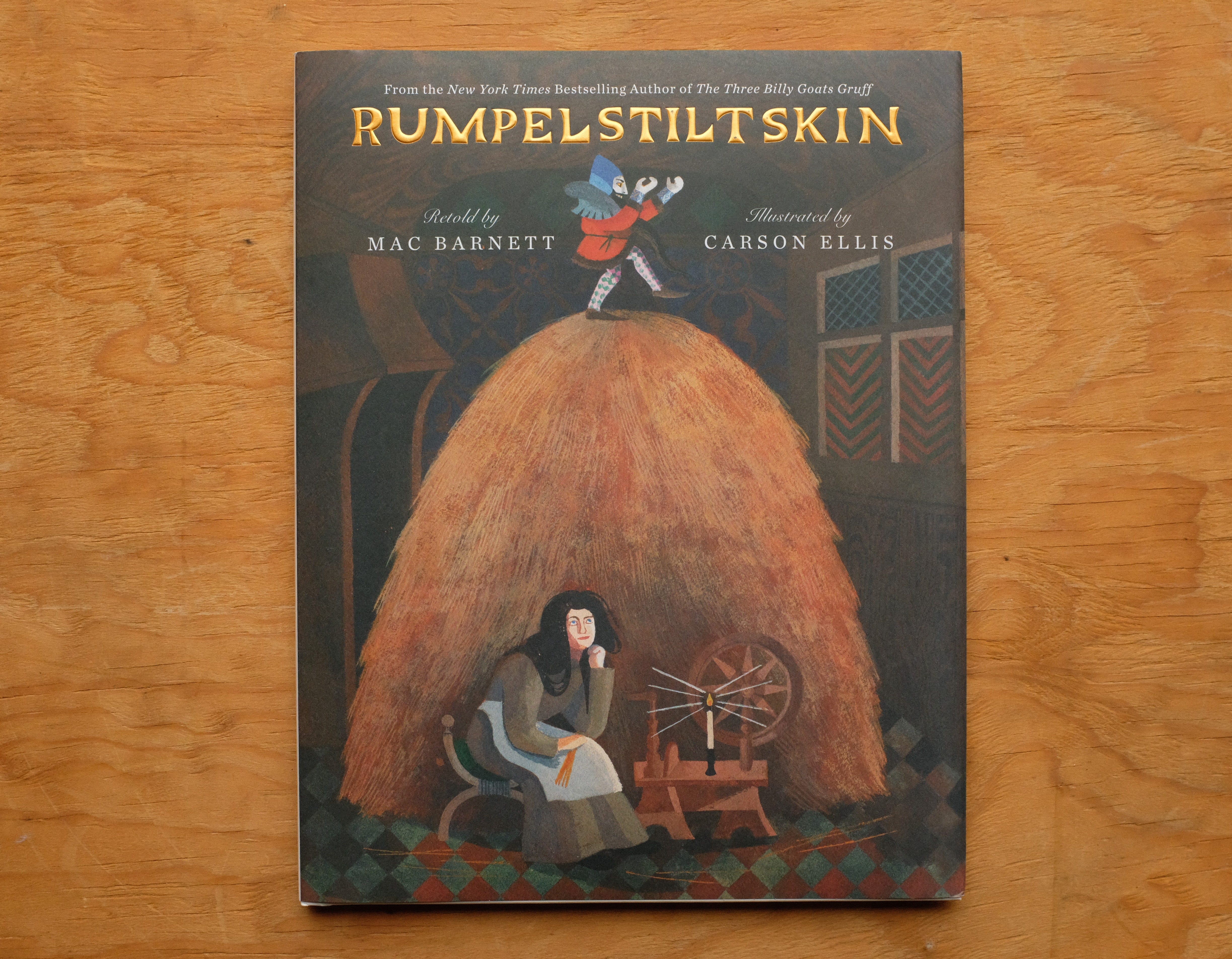
If you’d like a signed copy of Rumpelstiltskin, you can order from Oakland’s own East Bay Booksellers, and Mac will sign it. Personalize it too, if you want. And if you order early enough, Carson Ellis will also sign it, when she rolls through town next week (while supplies last, etc.)
Carson and Mac are on tour for their new book. Lots of the events are adults only, and in Los Angeles they will be joined by Jon (Klassen) (from Looking at Picture Books).
Deep dives on great picture books are here.
We recommend picture books here.
Read posts about the craft of making picture books here.
The Looking at Picture Books Shop is here.
This week, Jon sat down and interviewed Mac and Carson Ellis, who has her own Substack, Slowpoke, about their upcoming picture book, Rumpelstiltskin. It’s the second release in Mac’s fairy tale retelling series with Scholastic. Jon did the first one, The Three Billy Goats Gruff.
The following conversation was had over (group) text.
JON: Hi Mac.
Hi Carson.
CARSON: Hi Jonny.
JON: MAC?
CARSON: HI MAC.
JON: This is what I have to deal with.
(This is actually more what Mac has to deal with.)
MAC: Hi Jon! Hi Carsie!
CARSON: Oh, he finally shows up.
JON: Next I’ll say congrats, truly, sincerely on this book. This book is an incredible book.
CARSON: Thanks! It was a joy to make.
JON: I admire the hell out of it.
CARSON: You know that means a lot coming from you, Jonny.
But tell us more!
JON: You know what’s cool is that probably our two books will sit next to each other, if they shelve them that way.
The goat book and this one.
CARSON: I know. I like that.
Friends forever.
MAC: Oh that’s true! Yeah, I like that too.
I guess maybe we should say that we three are friends, individually, but also, like, “as a trio,” and that we talk about picture books all the time.
CARSON: Yes, let’s say that.
JON: Wait do you want me to say it, as the host?
Or can we use that you said it.
Did we do it.
MAC: We did it.
I did it.
JON: RUMPELSTILSKIN
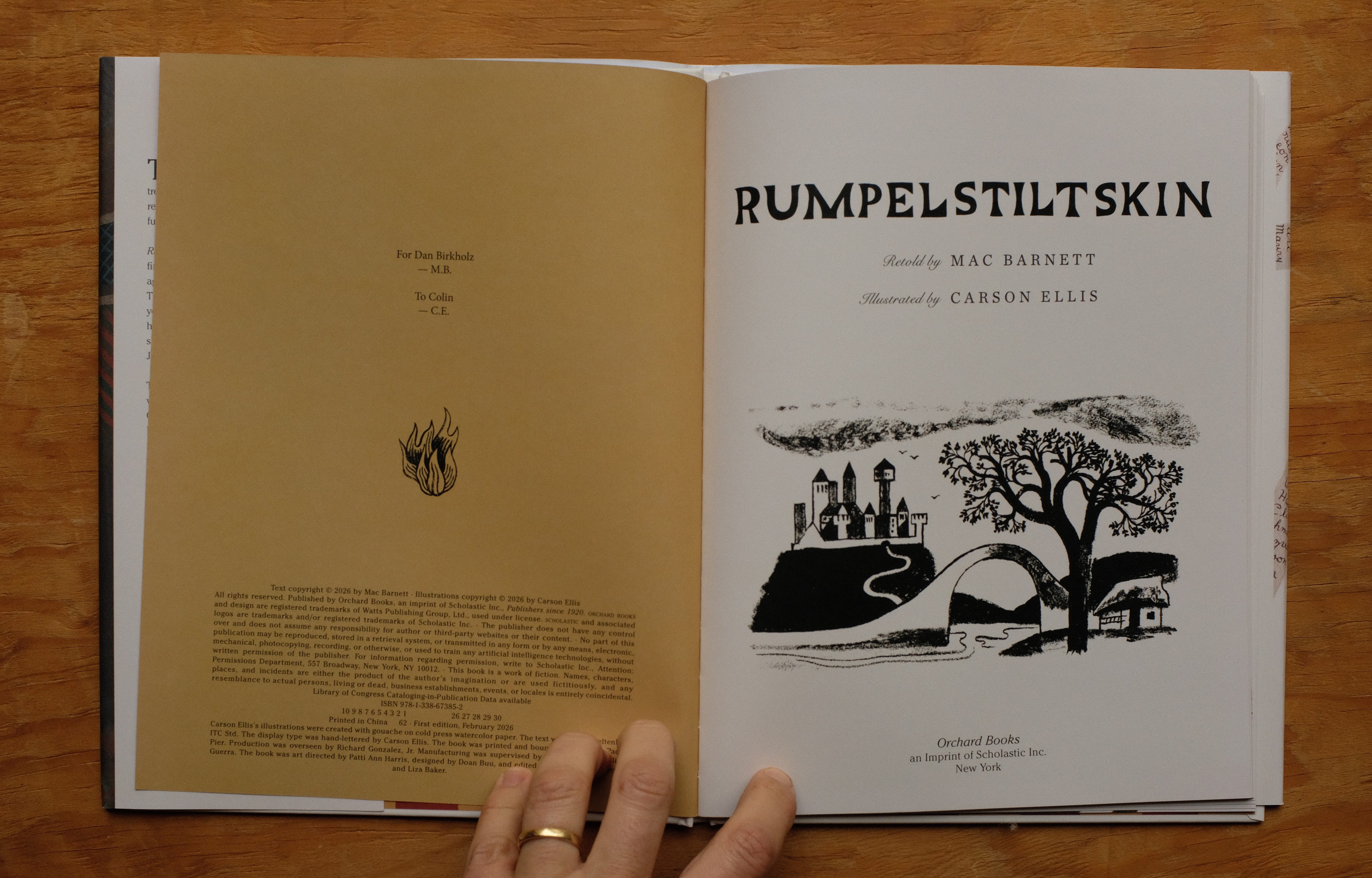
JON: Mac.
MAC: Yes, Jon.
JON: You were charged, initially, with writing, in your way, a number of fairy tales. Yours to choose.
Was this on the list from the start?
MAC: Yes! I was asked to write three fairy tales, and pretty quickly settled on this one.
JON: Was this a big story for you? Little you?
MAC: Yeah, it was always a favorite. It’s a really weird one. And full of evil and danger. It’s mysterious and funny and scary. There’s magic and life-and-death challenges and riddles and tricks. All little-me’s favorite fairy-tale stuff.
Carson said the other day that the story is full of villains, and I think that’s a great point.
CARSON: So many villains for one story!
MAC: It’s named after the villain!
Someone asked us over the weekend if we could think of any other stories named after the villain, and Carson and I were kind of flummoxed in the moment and couldn’t really come up with anything.
CARSON: I still can’t.
MAC: On the flight home I realized that it’s common in horror and monster stories.
JON: Oh yeah. Jaws.
The shark’s name was Jaws right.
CARSON: The Thing.
JON: Jaws the shark.
CARSON: The Blob.
MAC: The Babadook.
CARSON: Creature from the Black Lagoon. Or whatever that one is called.
JON: It’s also neat that its named after him but he doesn’t show up for a little while.
CARSON: Yeah, and you don’t know that’s his name until the very end.
JON: Right. First-time read must be wild.
CARSON: Like, WHAT IS A RUMPELSTILTSKIN?
JON: WHY IS THIS CALLED THAT IT SHOULD BE CALLED “THIS POOR GIRL.”
MAC: The Three Billy Goats Gruff has such a tidy structure. It’s lean.
You and I talked about it as, essentially, a joke.
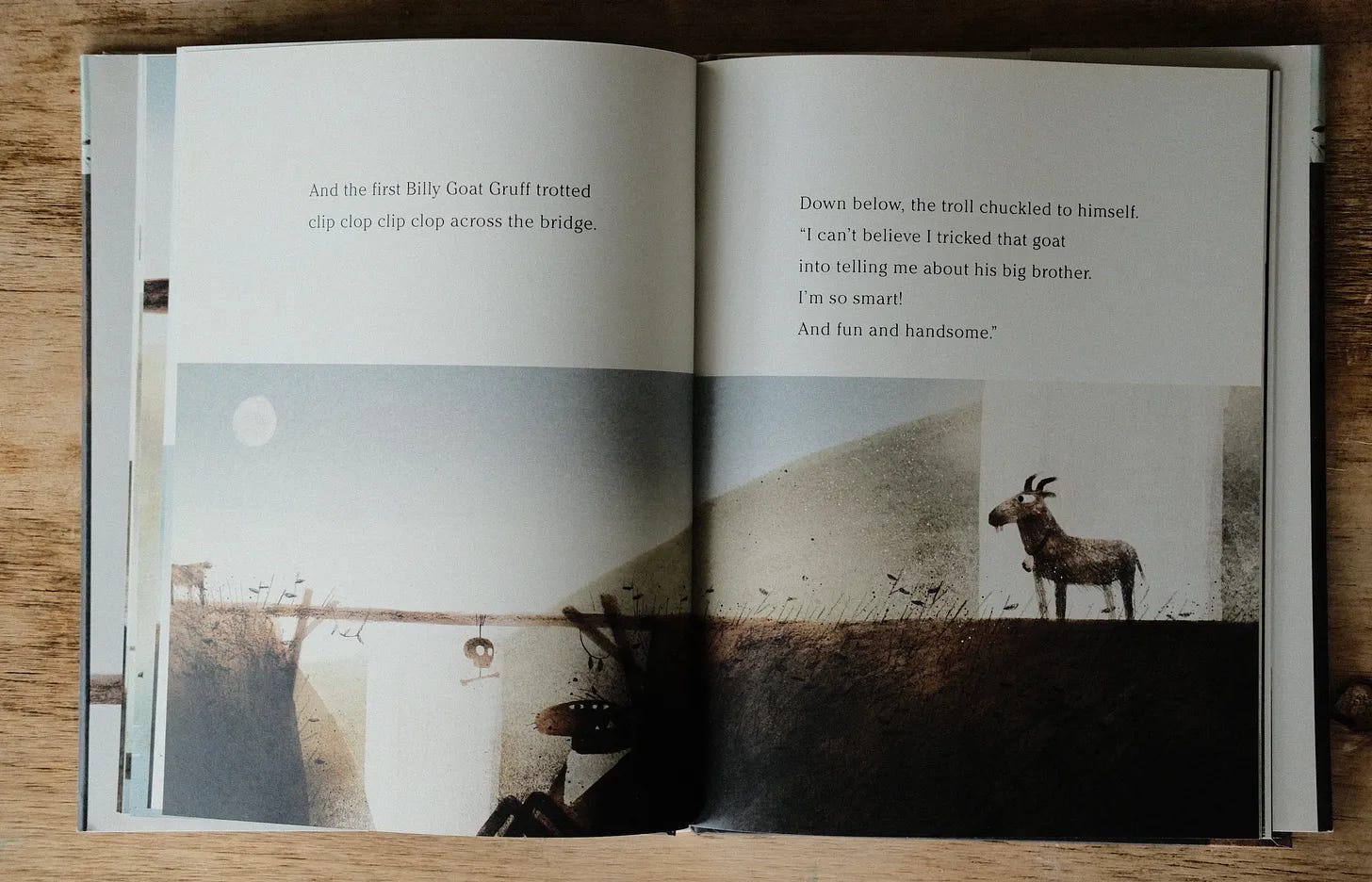
JON: Yeah. A set piece. One bridge, two hills.
Rumpelstiltskin is so much harder.
MAC: There are many movements to it, and, I think in our version particularly, many moods.
CARSON: Yes, it’s what I loved about the manuscript. It’s funny, somber, scary.
MAC: Should we outline the sections maybe first?
CARSON: Sure, do it.
JON: Yeah I wanna see you do that.
MAC: There is the first bit, where the girl’s father sets in motion a dangerous set of challenges: his daughter must go to court and weave straw into gold.
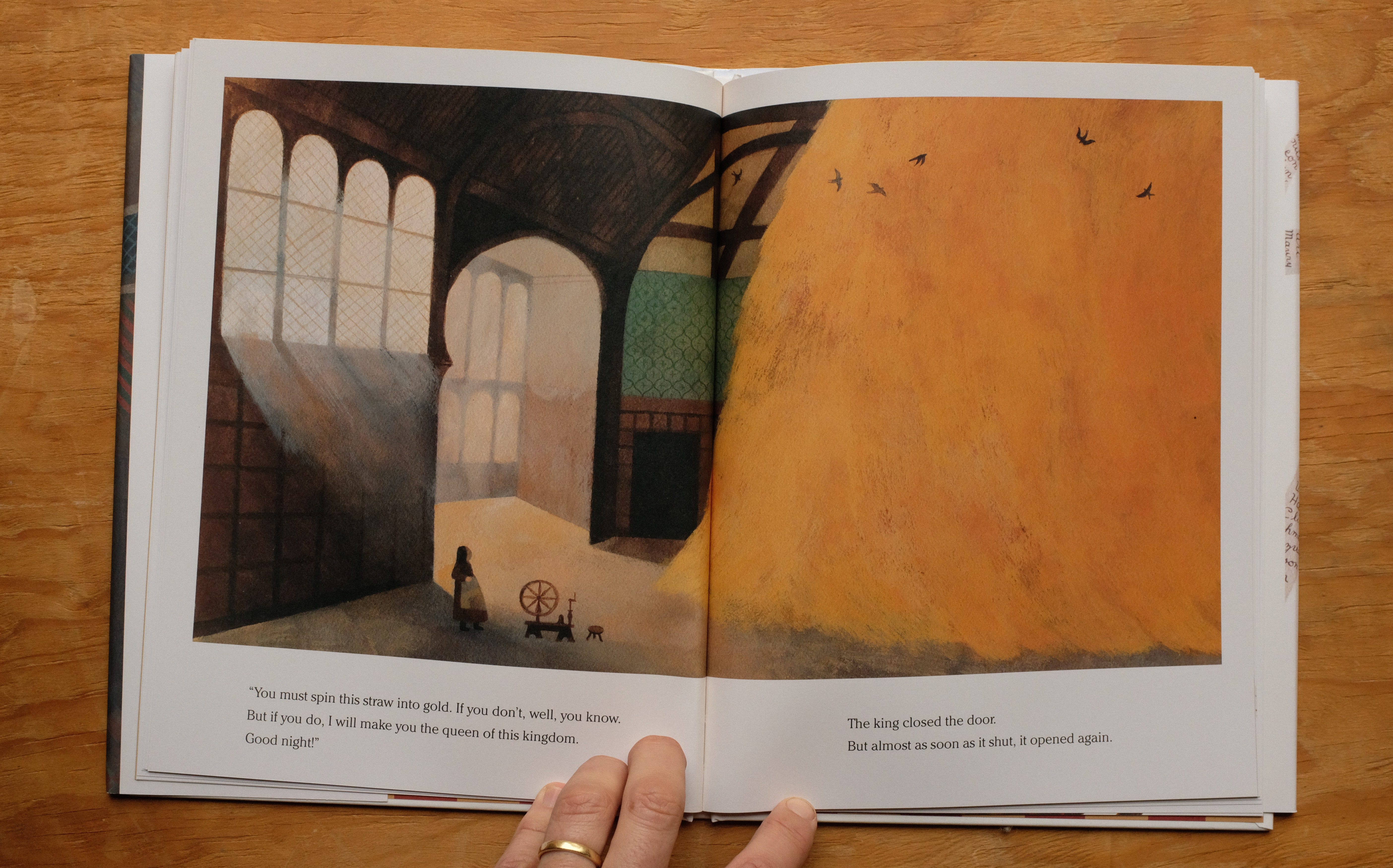
This bit has a very classic fairy tale rule of three structure, where the girl is placed, over three nights, into three increasingly large rooms, with increasingly large piles of straw.
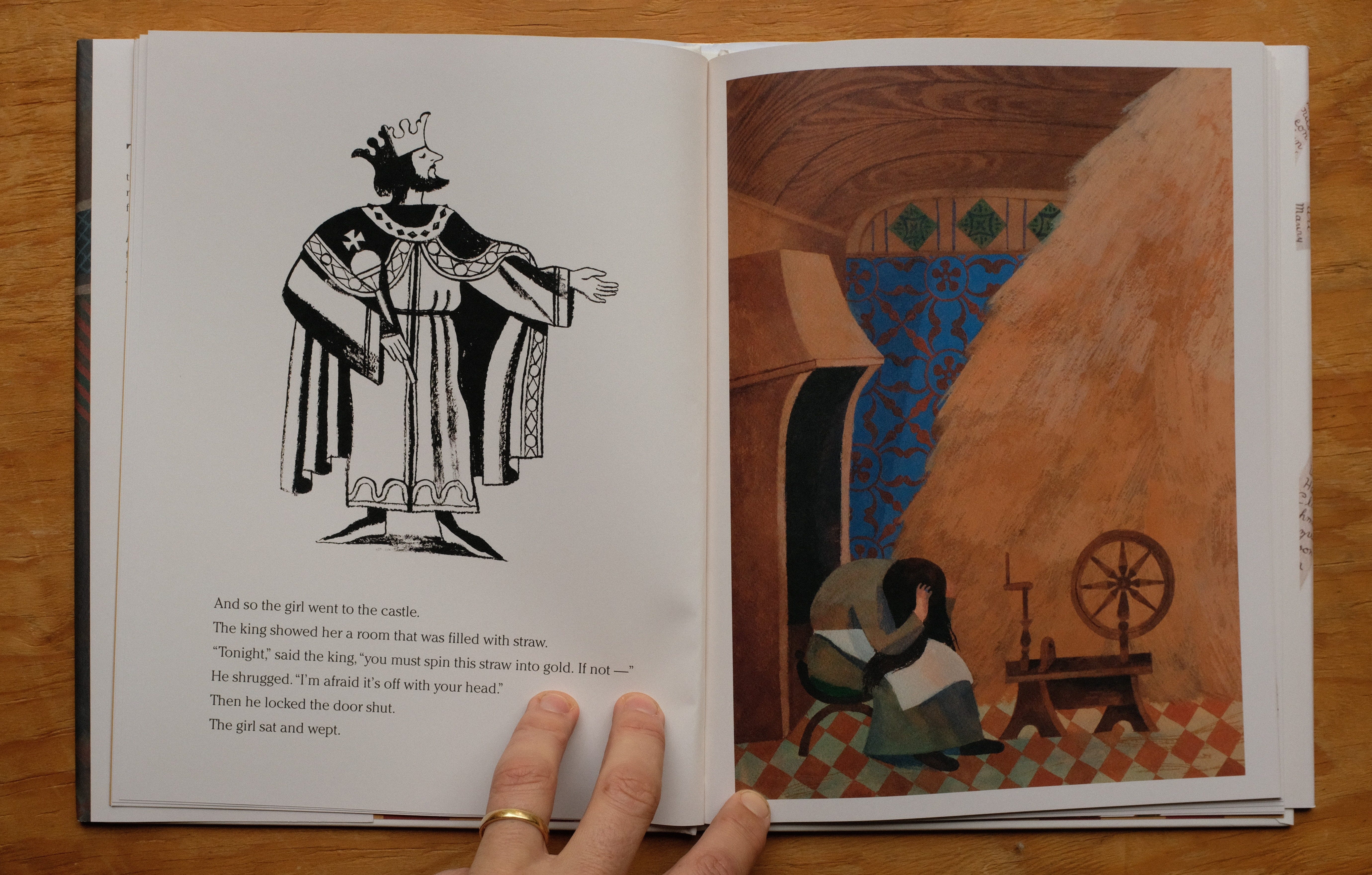
Like The Three Billy Goats Gruff, there’s this great visual premise, small, medium, and large.
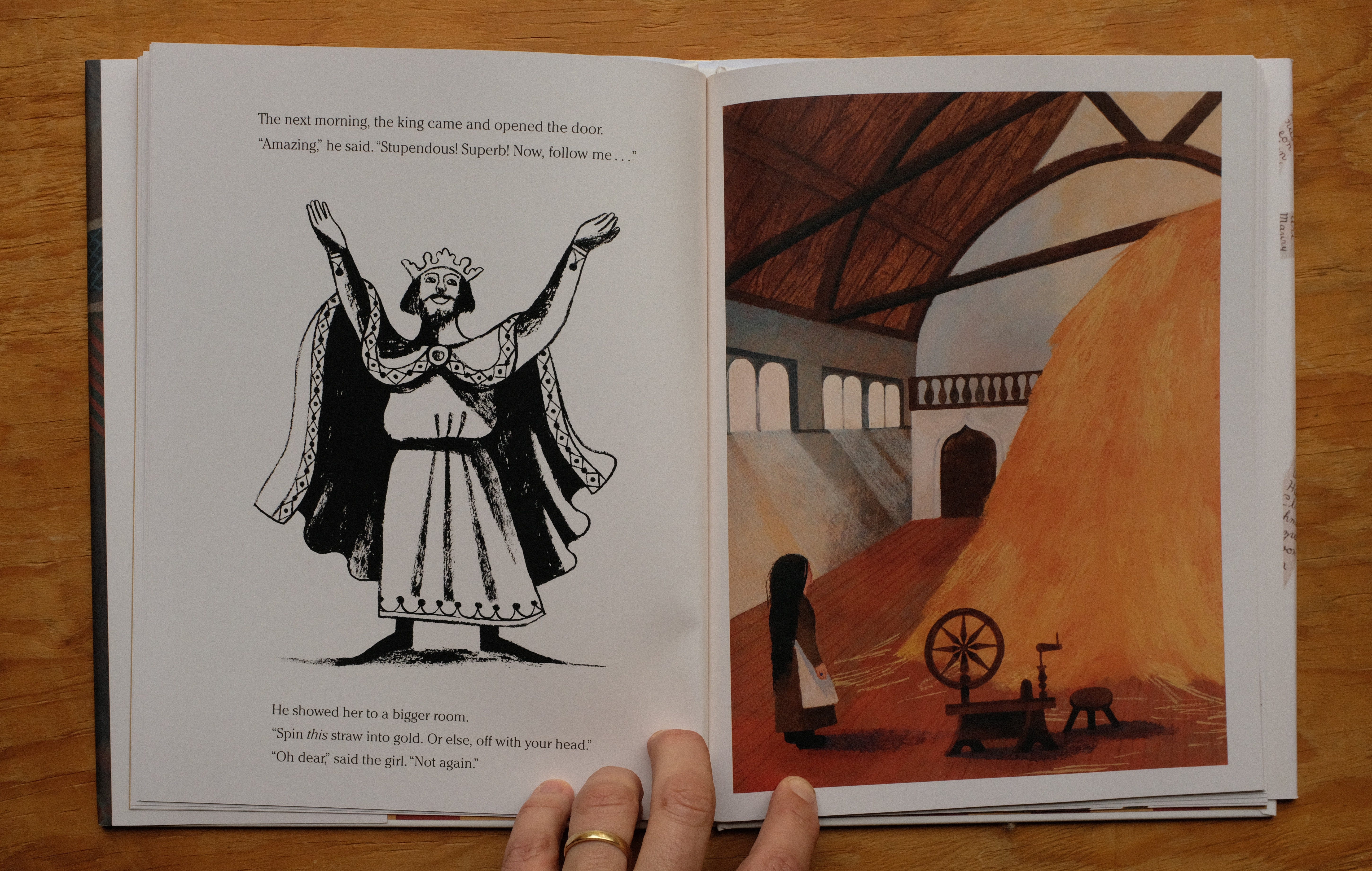
And like The Three Billy Goats Gruff, the sequence culminates with something gigantic. Although in the goat book, we exaggerate the third goat’s size for laughs. The huge haystack, though, is a somber moment. It emphasizes the enormity of the girl’s predicament.
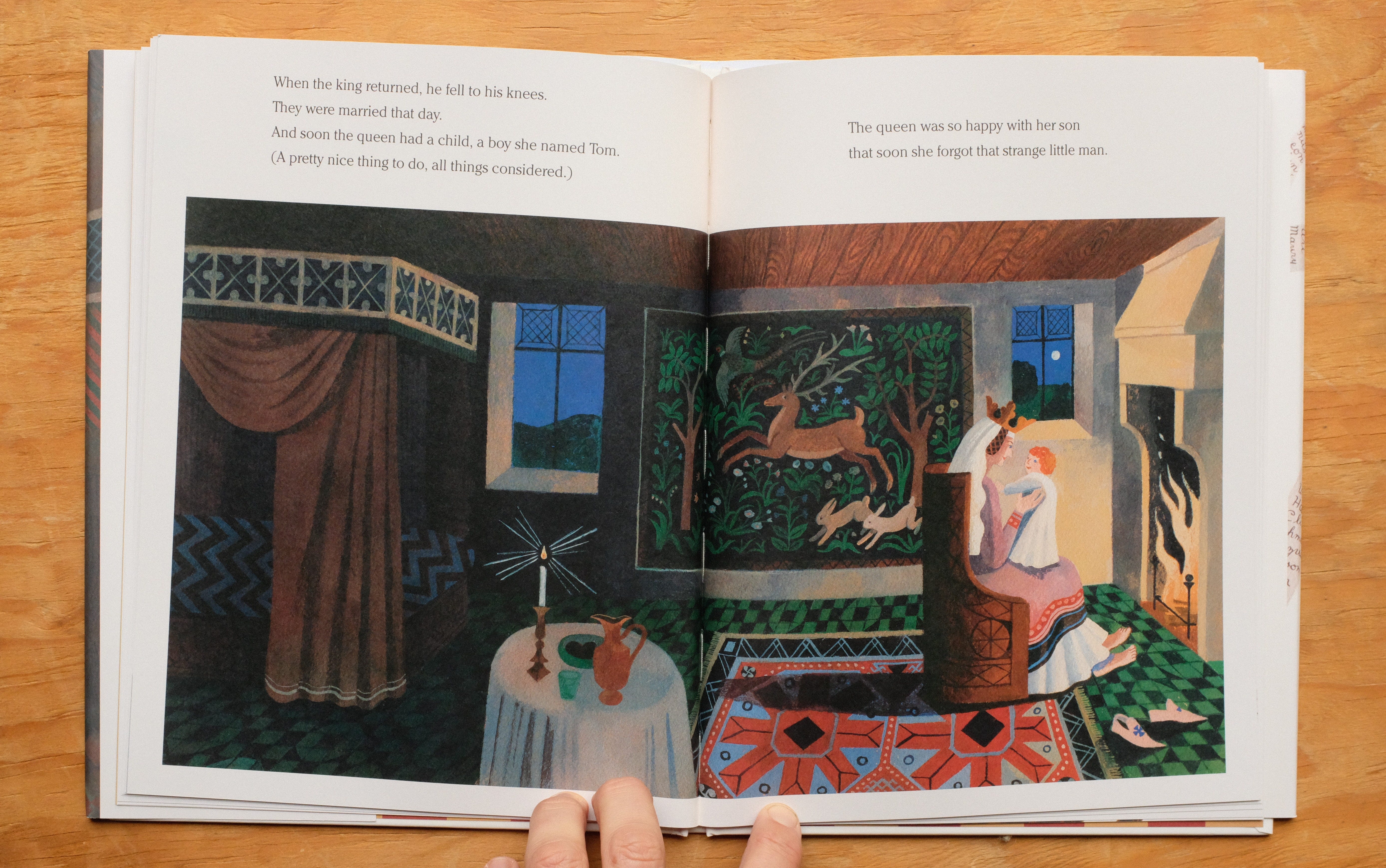
After the haystacks, there is a reprieve, a false ending. The ordeal is over, the girl has won.
Soon, though, Rumpelstiltskin returns to collect on his bargain, to take away the queen’s son. And, in a kind of mysterious moment, he relents, slightly, and agrees to a new bargain, which sets in motion a new game. The queen must guess his name.
JON: I thought you did a great carpentry job there.
The queen is crying because he’s back for her son.
Crying a lot.
And he’s like, annoyed that she’s crying so much.
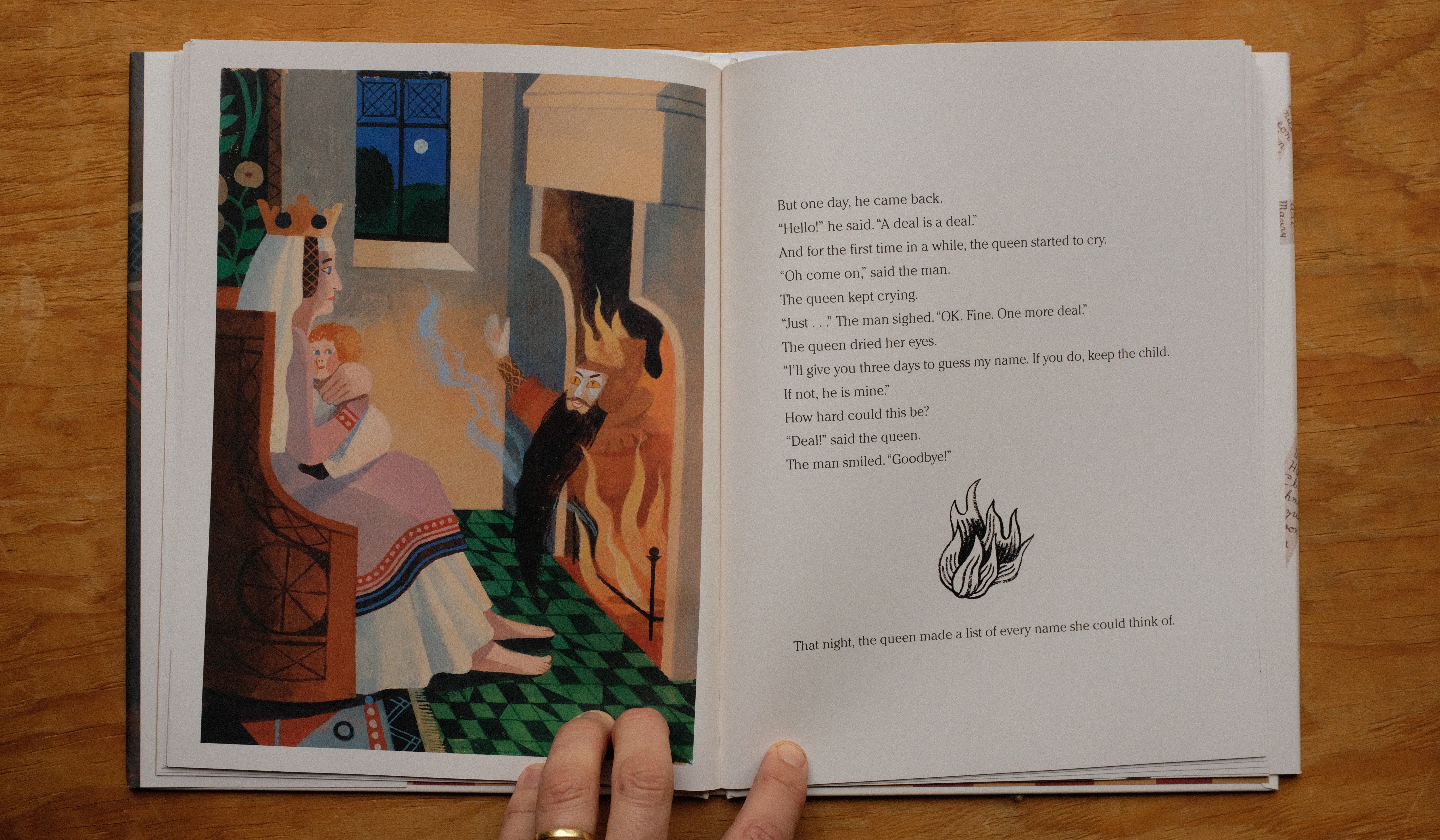
CARSON: I think he’s annoyed that she is tugging on his heartstrings.
JON: He kind of agrees to it maybe out of a tiny bit of sympathy for a crying lady and also to just kind of make her stop crying in the moment.
CARSON: Like, he doesn’t want to feel bad but he does in spite of himself, and that’s annoying.
MAC: Yeah, and the deal he makes with her is wild: If he wins — if she is unable to guess his name — he doesn’t get anything that he hasn’t already won.
Feels like he should have gone double-or-nothing. Go for the second born.
CARSON: Maybe he’s a gambling addict.
MAC:
You know, a lot of times people describe the characters in fairy tales as psychologically flat, but that’s so often not true.
CARSON: Rumpelstiltskin has dimensions. More, ostensibly, than the protagonist.
MAC: These characters do strange things, and the story provides no interiority, so we are left to divine why they do these things. Which is actually psychologically quite rich.
JON: That is something you have both really pulled off here. Stylistically you both found an amazing balance between formal and informal, that allows all this emotional stuff to show, while looking and feeling like something much less expressive.
CARSON: Thanks, Jonny. If it feels formal it’s probably because I was thinking a lot about illustrations for 19th century fairy tales that I love by people like Edmund Dulac and Ivan Bilibin.
I like the way so many fairy tales are set in the Middle Ages, but they’re set in Middle Ages as imagined by Victorian people. The medieval world that we were introduced to as kids — that’s still swimming around in our heads — with princesses in those cone shaped headdresses with veils and turreted castles — is the really specific 19th century version of that time.
So I was conjuring that, like everyone has been since the 1800s.
It was hard to figure out a visual language that made sense for both the funny scenes, the scary scenes, and the really sad ones. There are a few really sad moments.
JON: Were there any outliers there? Like where you’d found a look that suited almost all the moments you wanted to show but some were trickier to fit?
Or did you even find yourself choosing moments that fit the look after a while? Like “that would be great to show but it wouldn’t fit what I want the overall book to do.”
CARSON: Yes, the name-guessing scenes — which are hilarious. I wasn’t sure if this serious, laborious way I was approaching the art made sense for those.
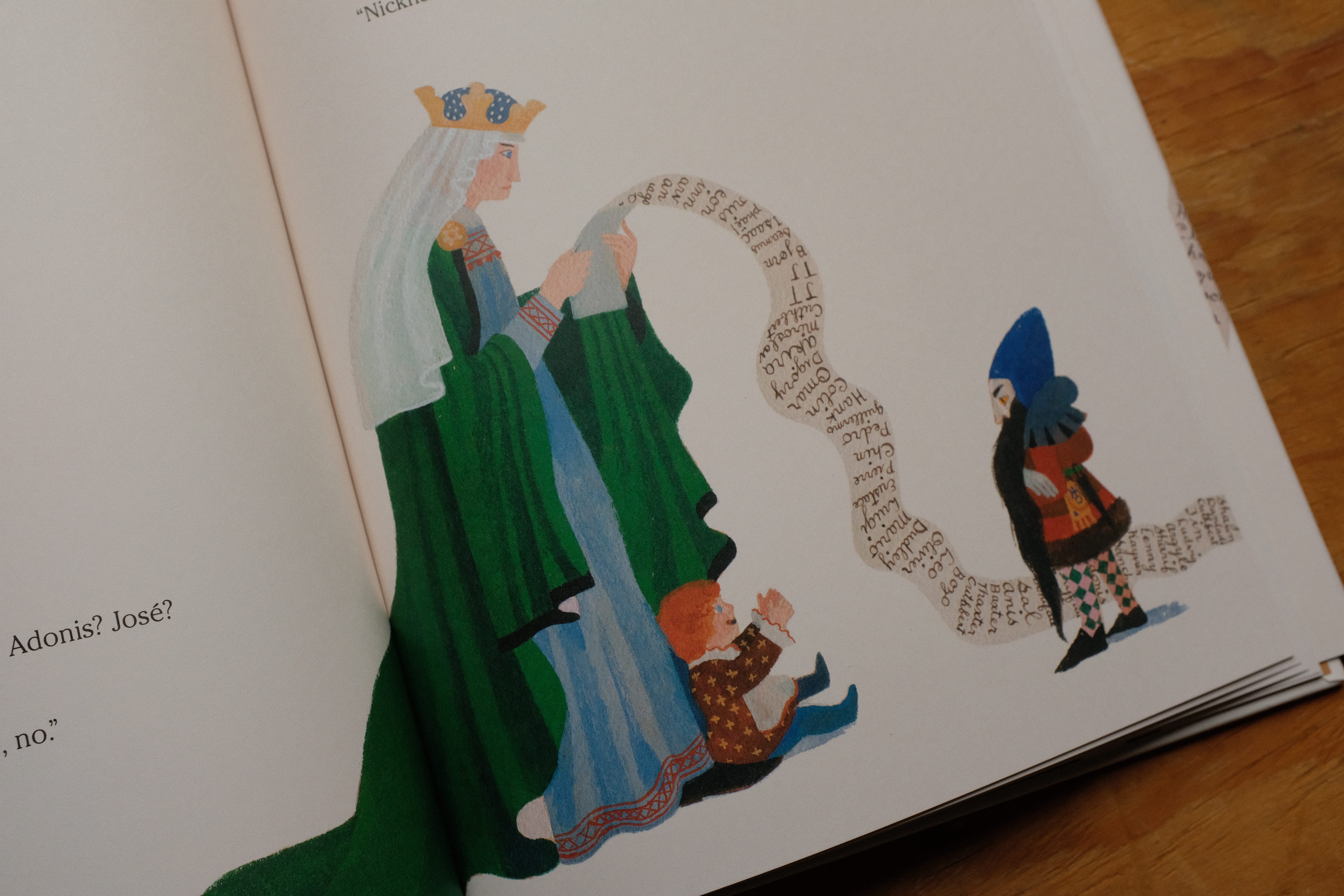
As for the second question, whether I find myself choosing moments that fit the look I’m going for — I am always doing that. It’s how I illustrate books.
JON: Hahaha cheers to that last thing.
CARSON: High five, Jonny.
MAC: Ooh, let me ask you this, Carson.
CARSON: Yessss.
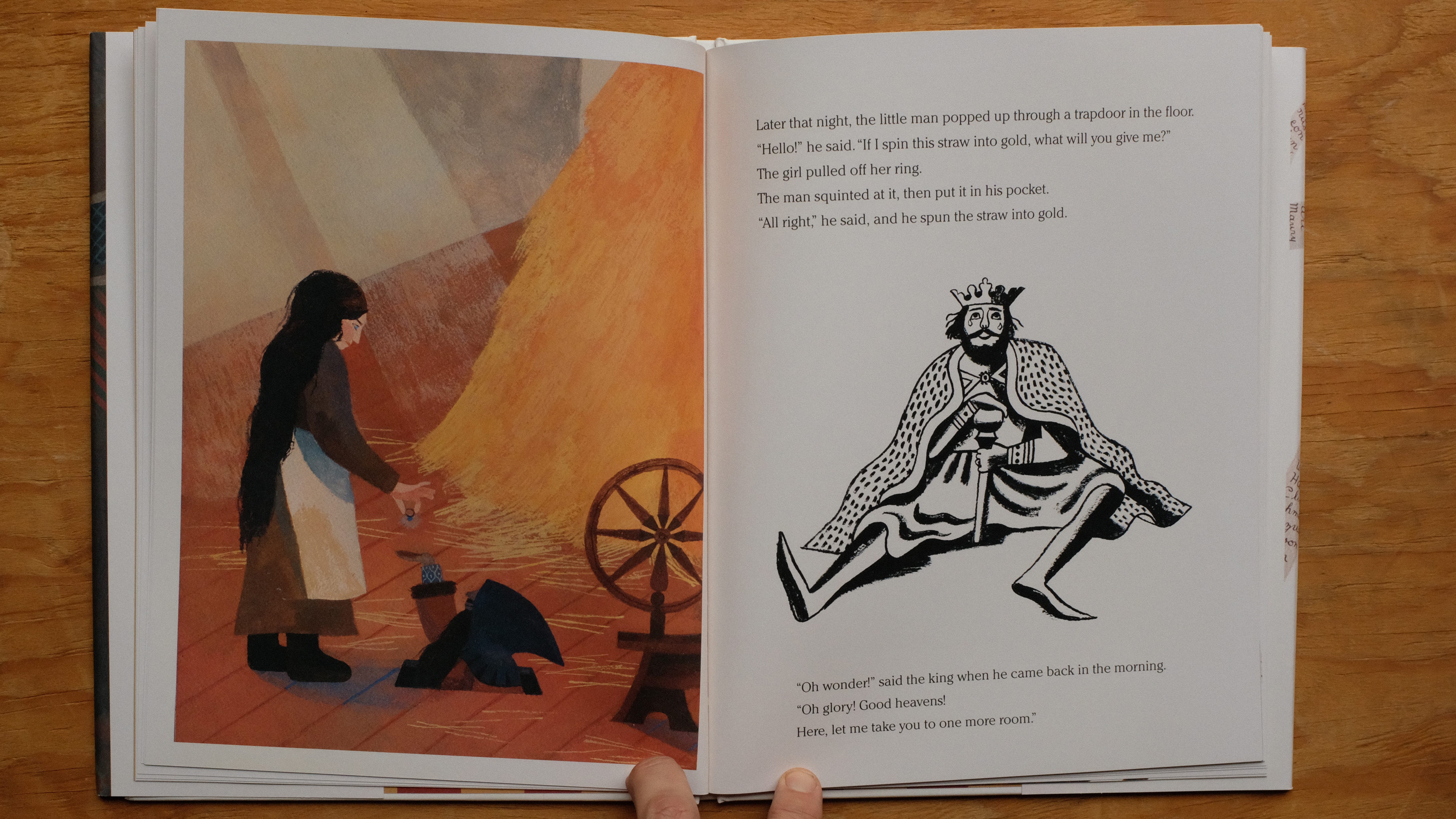
MAC: So broadly, you’re illustrating in two modes here: there are full-color painted pieces and black-and-white drawings.
CARSON: Yup.
MAC: Talk about why you do that.
CARSON: I knew I wanted the art to be painted in color. I wanted it to look a little like the renaissance portraits and landscapes and tapestries that I love. I wanted to do a lot of research, to look at a lot of books — and then to funnel all that admiration and excitement into this book. My vision from the get go was laborious paintings.
JON: Hahaha two Carsons talking to each other about the book: “What if it’s like…a lot of work.” “Oooh yeah!” “Like, a LOT of work.” “YEAH.”
CARSON: But there were moments in the book where I just wanted a vignette to tell a smaller story that wouldn’t compete with the paintings. Something on a facing page. Initially these were also in color but they felt too heavy on the page.
I liked them a lot better as ink drawings. And I felt like I could be funnier in ink?
And this mix of black and white and paintings seemed fitting to me. Kind of classic.
JON: One of the moments you did it is my favorite spread in the book, both on the text and the illustration side.
But it’s not a funny one.
MAC: I know which one it’s going to be.
CARSON: I think I do too.
JON: It’s the one where she’s showing her baby around the woods and she finds her dad’s house.
MAC: Knew it.
CARSON: Me too.
JON: Look, I never promised to be unpredictable.
CARSON: You know that’s the moment in the story that made me want to illustrate the book.
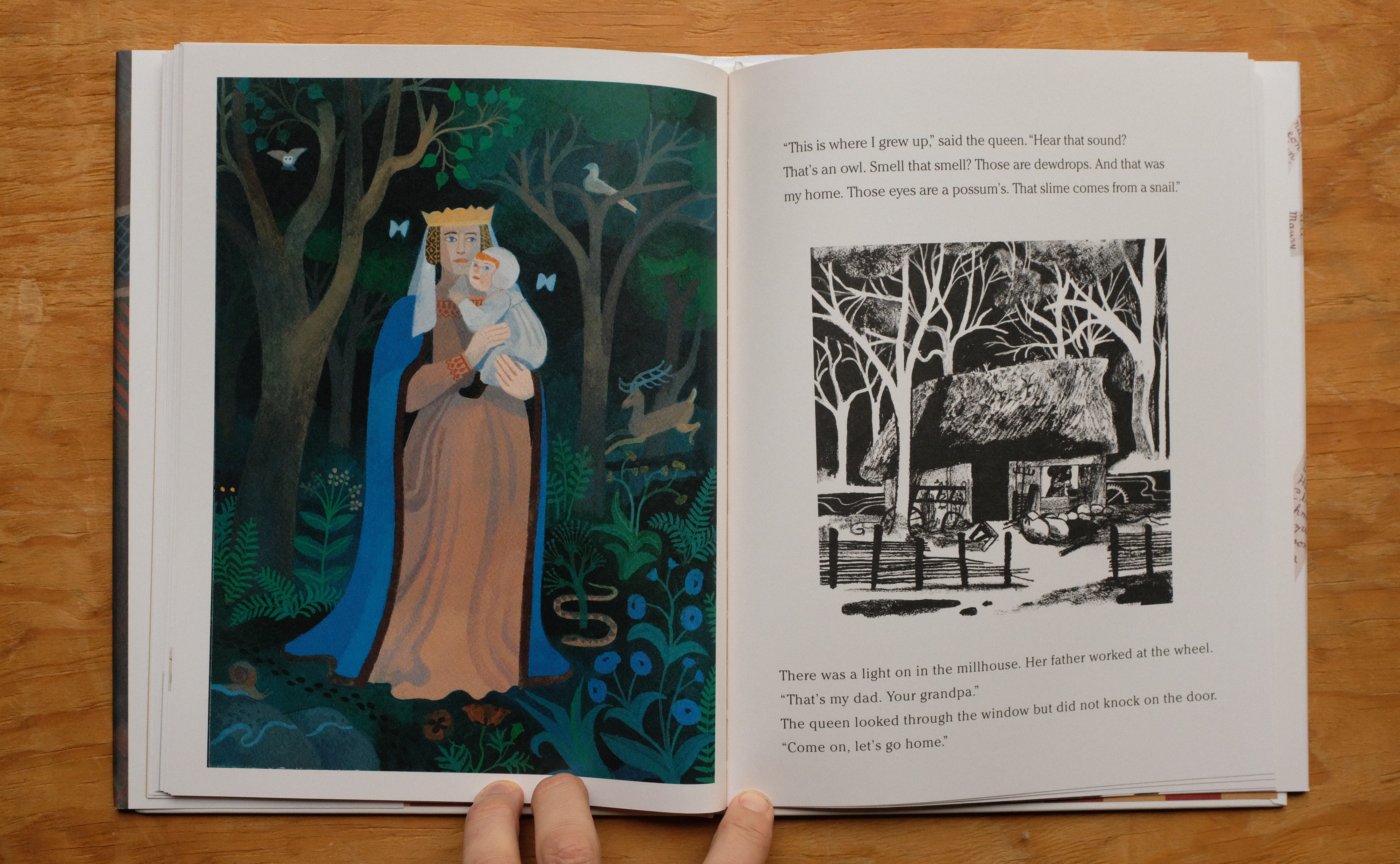
JON: You both nailed it extremely hard.
It’s so full of restraint, from both of you, and just absolutely heartbreaking.
CARSON: I think it’s so beautiful. The way the story swings from funny to despondent to this super poignant moment.
MAC: Yeah, maybe we should walk through this section a little bit, and some of the choices here.
CARSON: Let’s do it.
JON: I had a thought, when you were talking about the sections.
MAC: OK.
JON: That this section is kind of the fourth one.
Or maybe the fifth?
But it’s after the false ending, and after the names.
CARSON: It’s like a weird somber moment out of time.
MAC: Right, we wrap up the names.
Two spreads of exhaustive name-guessing.
JON: If our brains are used to three tidy acts, we’re out at sea by now.
MAC: And the queen reaches this hopeless moment — she’s out of names.
JON: She’s hopeless, we’re hopeless.
MAC: She has three nights to guess his name, and at the end of night two, she has exhausted every name in the world.
It’s a desperate moment.
JON: Then it’s like a nocturnal dream.
CARSON: It is.
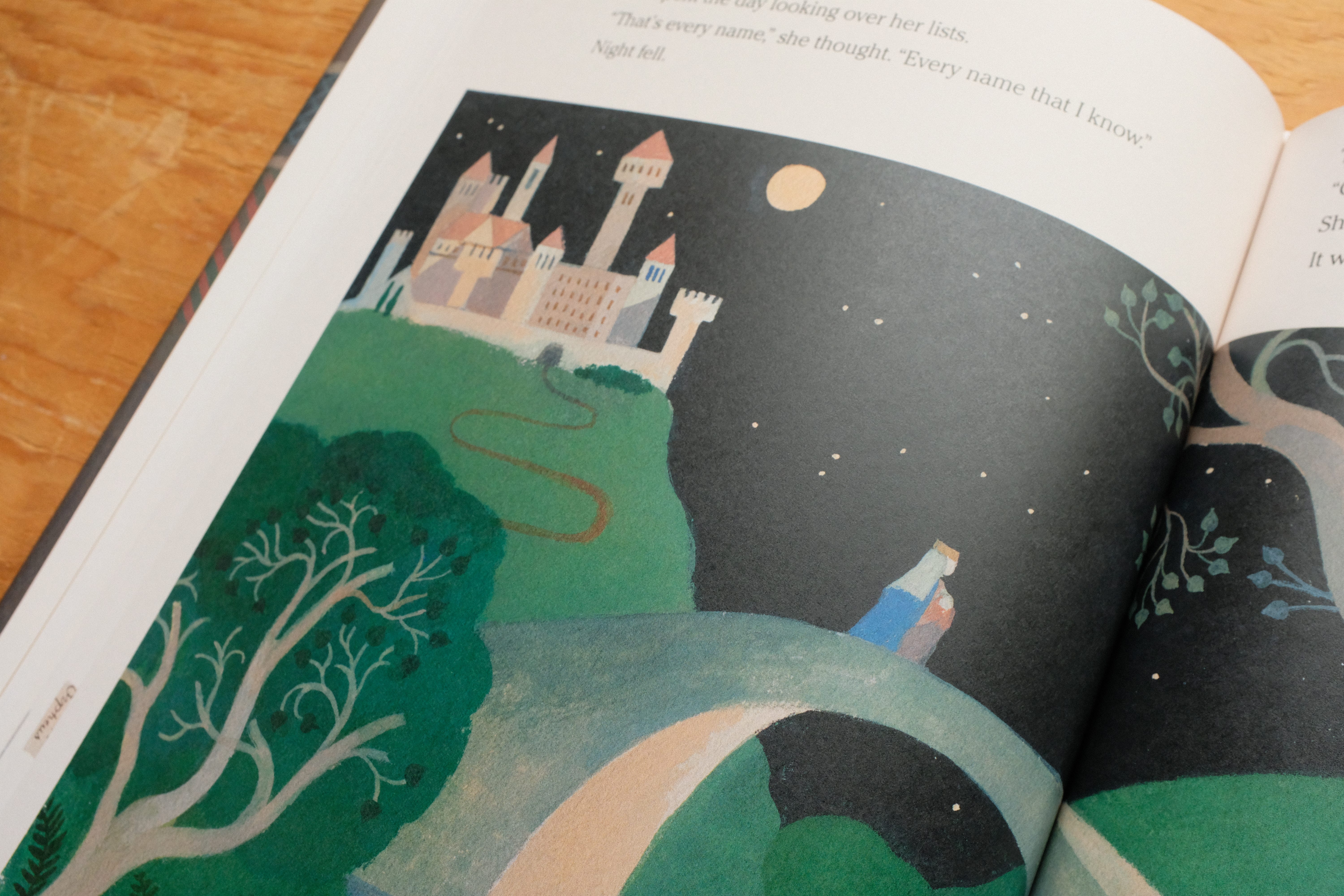
MAC: This next section is the one big thing I added, story-wise.
JON: Was there a particular thing you thought you wanted to enhance with it? Was it the dad in the window or did that take you by surprise in the writing of the section?
MAC: In the “original” version set down by the Grimms, the queen gets a report from one of her guards, who she has sent out to collect names, and who overhears Rumpelstiltskin singing in the forest.
But I wanted to send the queen into the forest herself.
CARSON: Because in the beginning you establish that she is a forest person. She loves the woods.
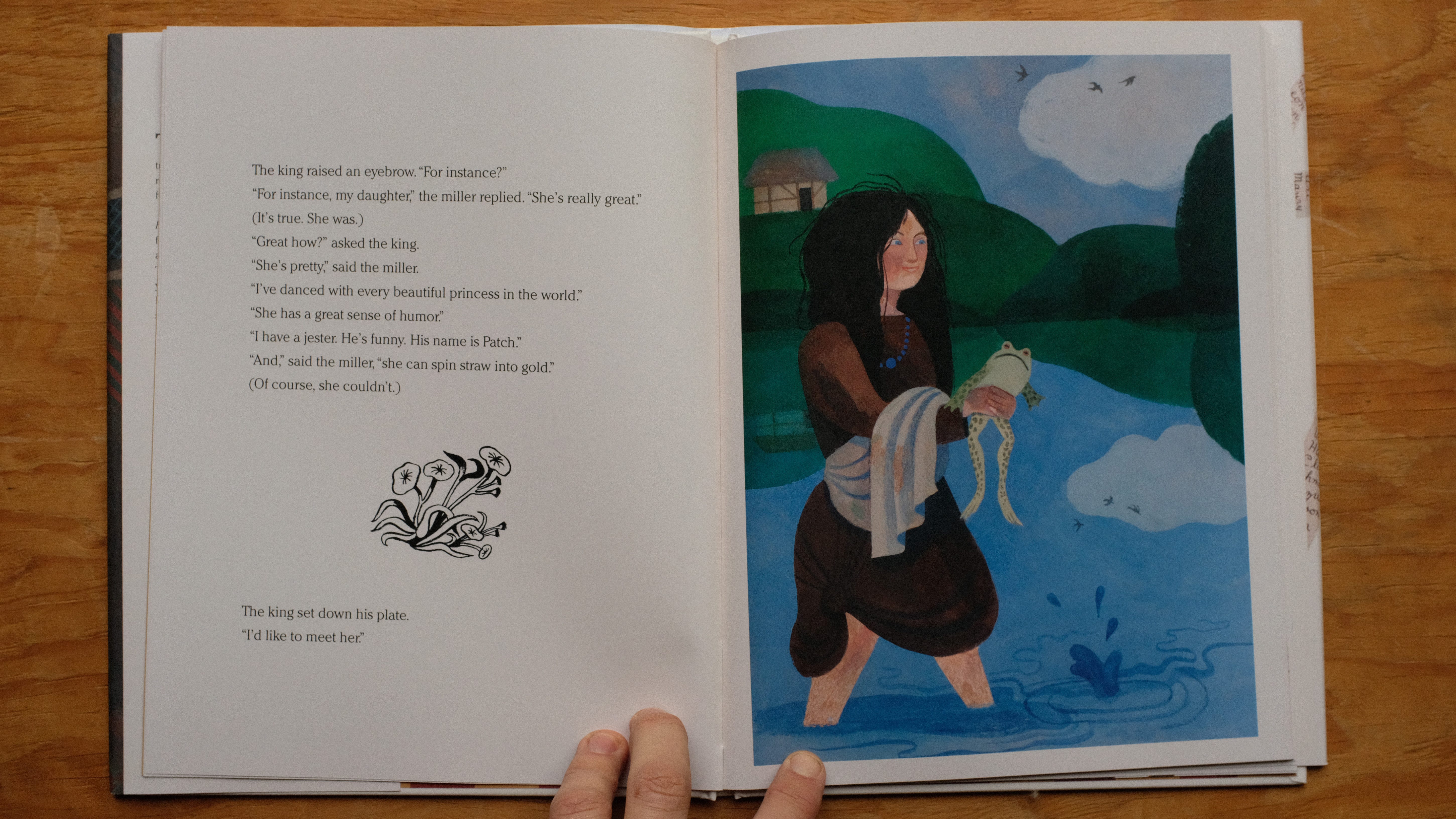
JON: Yeah. it shows, devastatingly, what a great mom she would be, and we’re reminded, even though she’s all fancy now, of who we met in that (second-favorite) spread where the dad is describing her to the king and Carson shows her ecstatically catching a frog.
MAC: I think the initial impulse was, this is her last night with her son.
CARSON: So sad.
JON: Right.
MAC: She wants to show him where she came from, and by extension where he comes from, hoping that he’ll remember when he is taken away from her.
And Jonny, you’re right. That moment outside her cottage was something I found in the writing.
JON: It feels found. In the best way.
MAC: I knew she would visit her house. That she would want to leave this huge castle and say look, this cottage is my home.
And then I was just thinking of her father, this man who completely failed her, who has ruined her life, and now has ruined her son’s life.
She would say, here is your grandfather.
But she would not let her grandfather meet her son.
JON: Like she would find the cottage on this walk, and then you as the writer are like, “Wait. No way. That guy doesn’t get to see them.”
CARSON: And he doesn’t. Which is satisfying. But anyone with a parent also understands the sorrow of that.
MAC: And it seemed important to me that we show him working away in there at the mill, alone.
JON: Yeah. This is what he’s got.
Nothin.
MAC: We had to see him punished, by which I mean living with the inevitable consequences of his actions.
Carson, you drew this scene three ways.
We might even be able to find those…
CARSON: Yeah, I have them here.
I first painted the miller’s cottage, and I didn’t like it because it felt like it drew too much attention from this somber moment in the forest.