

The Very Hungry Caterpillar
Jon and Mac consider: worms, the generative tension between tidiness and chaos, why we feel affection for this caterpillar, brightness, science vs. poetry, a toy you can read, a book you can touch


More deep dives on great picture books are here.
We recommend picture books here.
Read posts about the craft of making picture books here.
The Looking at Picture Books Shop is here.
Last week, we recommended some picture books about transformation in preparation for this week’s deep dive on perhaps the most well-known kids’ book on metamorphosis.
If you’re interested in reading even more about the life and practice of Eric Carle, The Eric Carle Museum of Picture Book Art has some great resources online.
As usual, Mac and Jon had this conversation over text.
MAC: Hi Jon.
JON: Hi Mac.
MAC: Today we’re looking at The Very Hungry Caterpillar.
JON: We are lucky guys.
MAC: Here is the cover:
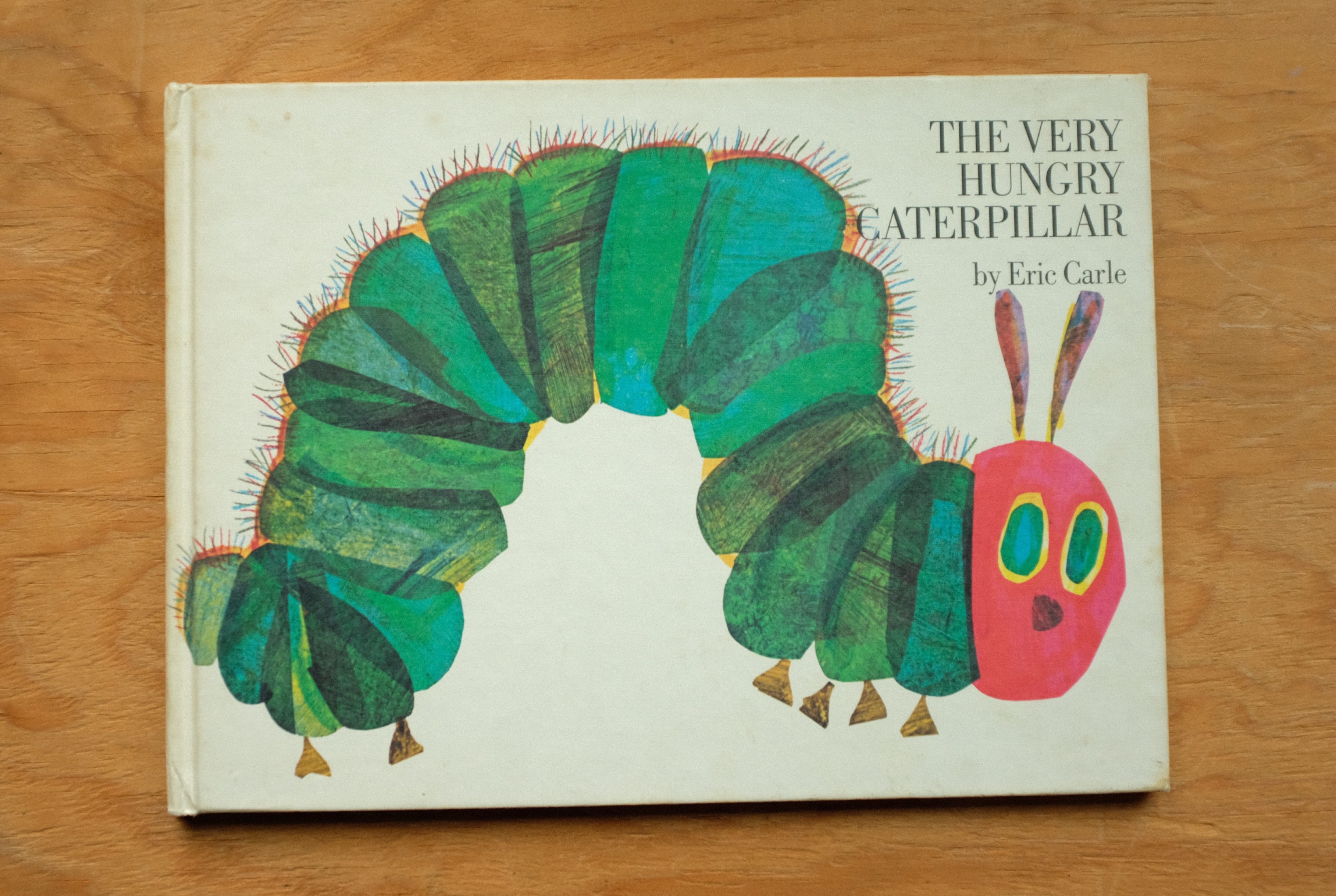
JON: Still slaps.
MAC: Look at that caterpillar.
He’s a star.
OK, here is Carle’s first cover concept for the book that eventually became The Very Hungry Caterpillar: A Week with Willi Worm.
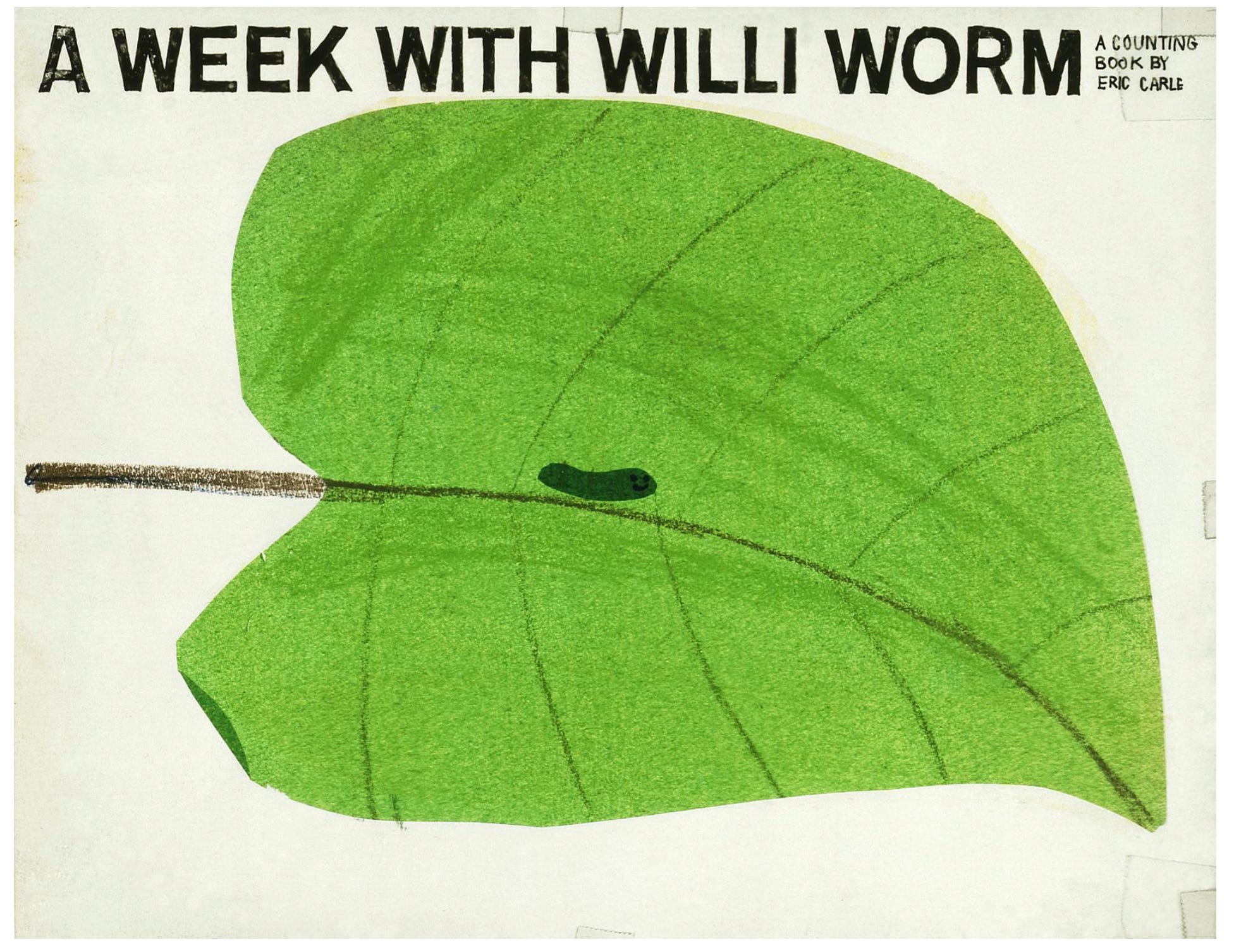
JON: Gotta say, I love this cover, too. With all my heart.
MAC: Yeah, before we get into anything else it’s important to say that this cover absolutely rips. Like when you hear, “Did you know Where the Wild Things Are used to be Where the Wild Horses Are?”
JON: Yeah but that was like a 2x12 trim and it really did sound kind of insane.
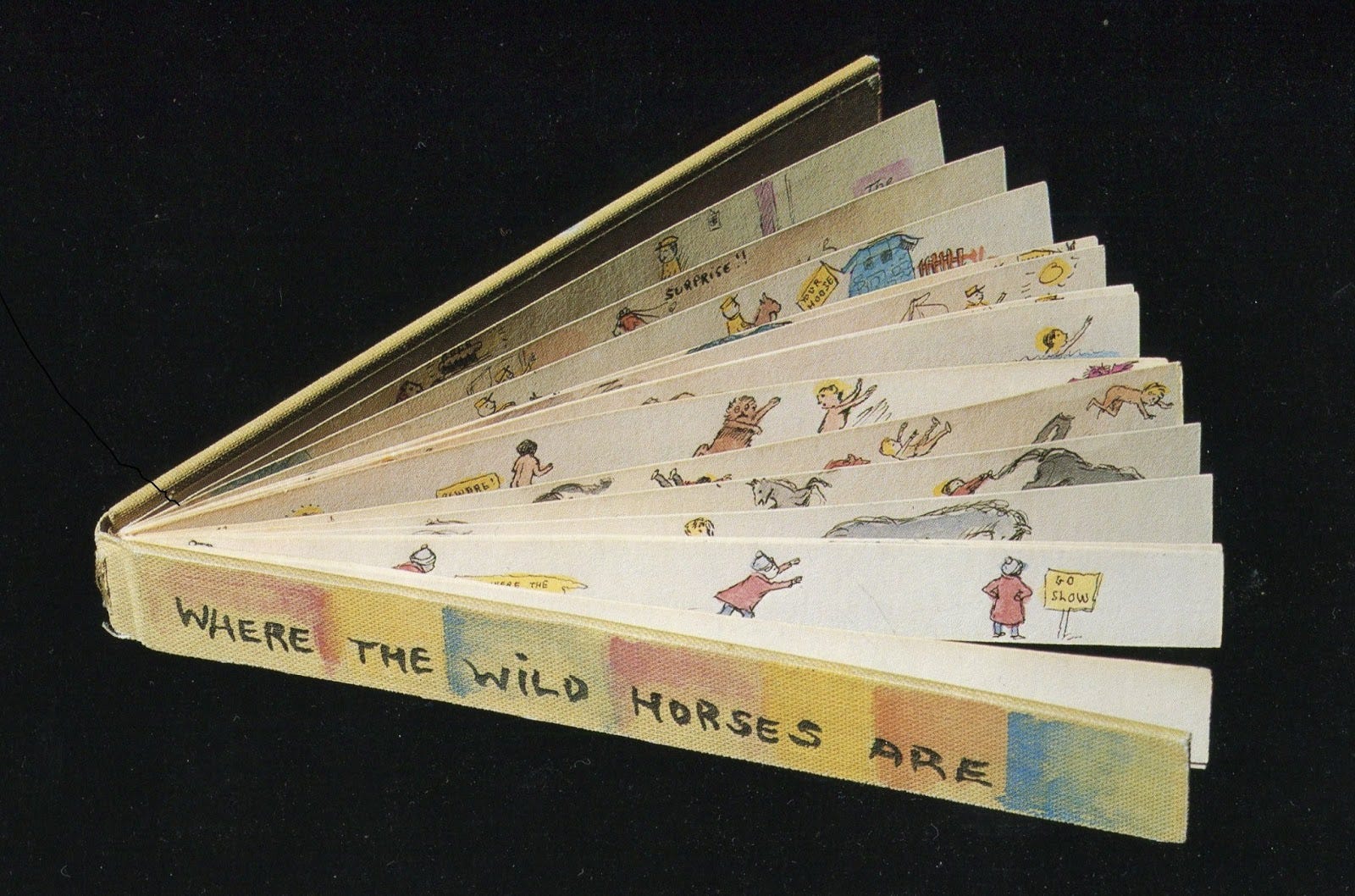
MAC: You’re like, “OK, Sendak was on his way somewhere.”
JON: “You gotta shake the dust off etc.”
MAC: And then you see this Willi and it’s like, “Can you believe that one of the most iconic picture book covers almost never existed, and could have been this cover, which would have also been an absolute hall-of-famer?”
JON: Yeah. I remember seeing it and then reading how it never was used and it’s like a diamond lying in the street that everyone just talks about. “You see that diamond lying on the sidewalk on 3rd? Been there for years. Anyway...”
MAC: Anyway, his editor, Ann Beneduce, nudged him toward making it about a caterpillar instead, which was clearly a good call.
JON: Her issue was the “worm” part right? That people don’t like them? Or that it’s an unappealing word?
MAC: Right.
MAC: “Worms aren’t selling.”
MAC: But it’s interesting to see what Carle changed and what he kept.
Look at Willi’s face:
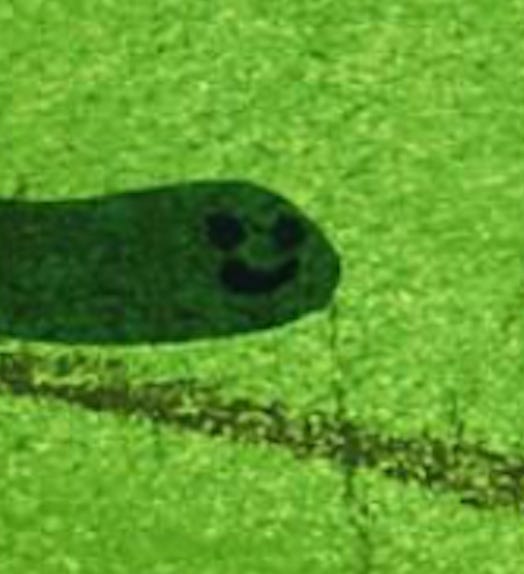
JON: I love him so much.
I want more than a week with Willi.
MAC: For the cover of A Very Hungry Caterpillar, he loses the Willi.
JON: He loses naming him at all!
Steps have been taken already to distance the caterpillar from us.
And yet, what a guy, still.
MAC: Wait, hold on. Are you saying as a character design?
JON: Yes. Mainly the eyes.
MAC: Because this is a big thing I wanted to talk to you about!
Yes. The face.
The caterpillar has a bug face. Face-wise, he’s kind of remote.
JON: Yeah! Unreadable!
MAC: A movie executive would chomp on a cigar and say, “give him googly eyes.”
I am thinking of a particular movie executive, who told us if we wanted to make a show about the Shapes books, you had to make Circle pink.
JON: I remember.
We’d probably be typing this from our respective yachts if we’d done that.
MAC: But this caterpillar is one of the most beloved characters in children’s literature.
So why are we so attached to him? Some of it is what he does. His appetites.
But why is the character design so successful?
Because we don’t know about his appetites on the cover.
JON: Well we kind of do, because the title tells us about them.
MAC: Good point.
I forgot to read the words.
JON: Pretty clearly.
MAC: OK OK.
JON: With an emphasis, even.
A whole line just for “very.”
MAC: Well, I’ll say — and this is mostly just ass-covering — there’s a difference between being hungry and the kind of eating this caterpillar is about to do.
My theory is that our emotional connection to the caterpillar is based on color and shape, and not face.
JON: Yes. I think that was maybe a large part of Carle’s thesis actually. Or at least his preference. This cover is exuberant. It is the most explosively happy thing you’ve ever seen. It can barely contain itself against its constraints.
Carle is stoked.
MAC: Literally — he barely fits on the page.
JON: Yes.
JON: And the cover, or at least the title, does present a problem. He’s hungry — very hungry — so let’s see what happens there. But I think that emotionally capable eyes, or a face that you could read like Willi’s, would actually get in the way of what we’re feeling here. It would complicate it. The blankness of the eyes tells us that we’re actually not going to be hit too hard by this guy, emotionally. This book is going to be gentle that way.
MAC: OK, can I ask a possibly stupid question?
JON: I would say there are no stupid questions but that’s not true.
MAC: Is that his nose or his mouth?
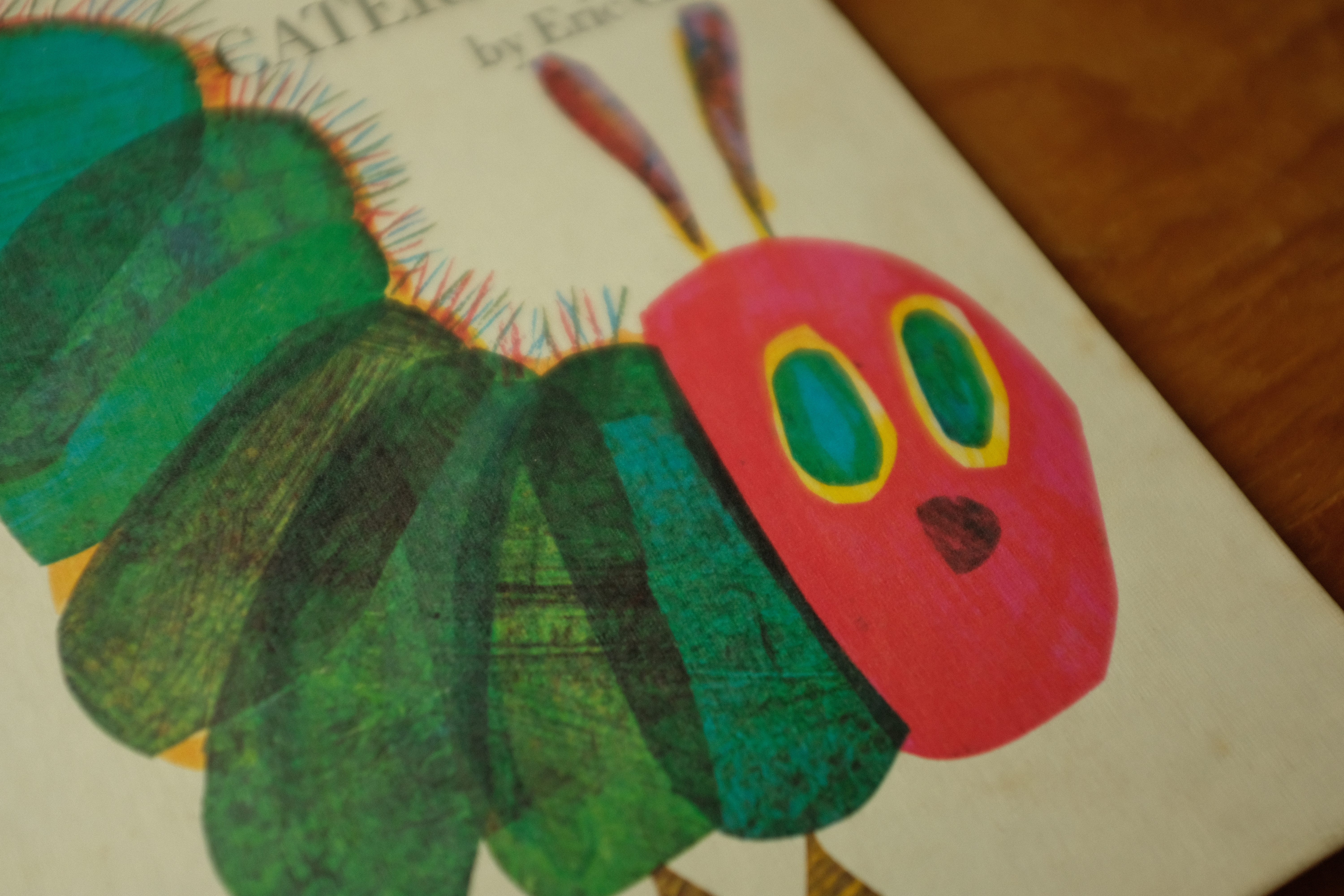
JON: Oh I always thought nose. Doesn’t his mouth show up somewhere?
It’s like a snowman nose.
MAC: But what if it’s an open mouth, like he’s ’bout to chomp?
There is mouth inside, but I don’t think there’s nose inside.
JON: Hmmm.
MAC: I think the face is “cuter” if it’s a nose. But I’m leaning mouth!
Sound off in the comments, etc.
I like his little hairs.
JON: The hairs I think are really important!! They are crayon, or at least what looks like crayon. Kind of rough and waxy. Kids recognize those hairs. Carle was so generous like that. You recognize all of these things — the paper, the colors, the lines. It’s all stuff you’ve touched and made yourself by the time you’re old enough to see this book.
MAC: Which is not very old.
Carle explicitly thought of himself as a bookmaker for very young children.
JON: Carle was always zeroing in on how young kids made things. He used materials they would recognize, and even to a certain extent limited his way of using them to things they could do. Ripping paper, cutting kind of rough shapes.
It’s important to remember that he was mainly, before children’s books, a designer. I still think he’s one of the best designers in history. And a designer, at least the way I think about it, is often an “arranger” rather than someone who generates things from nothing.
Carle’s work is like: what if you use only what kids use to make a book, but you put that through one of the best designers to ever do it.
The tension between a hastily torn piece of paper against some super expert typesetting and planning is the excitement in so much of this, right from the cover, and all the way through. The spontaneous joy of when you first made anything put against the precision machinery of book production. Carle is what happens when you’re insanely good at both.
MAC: Speaking of which, before we move on from the cover, can we look at this bit?
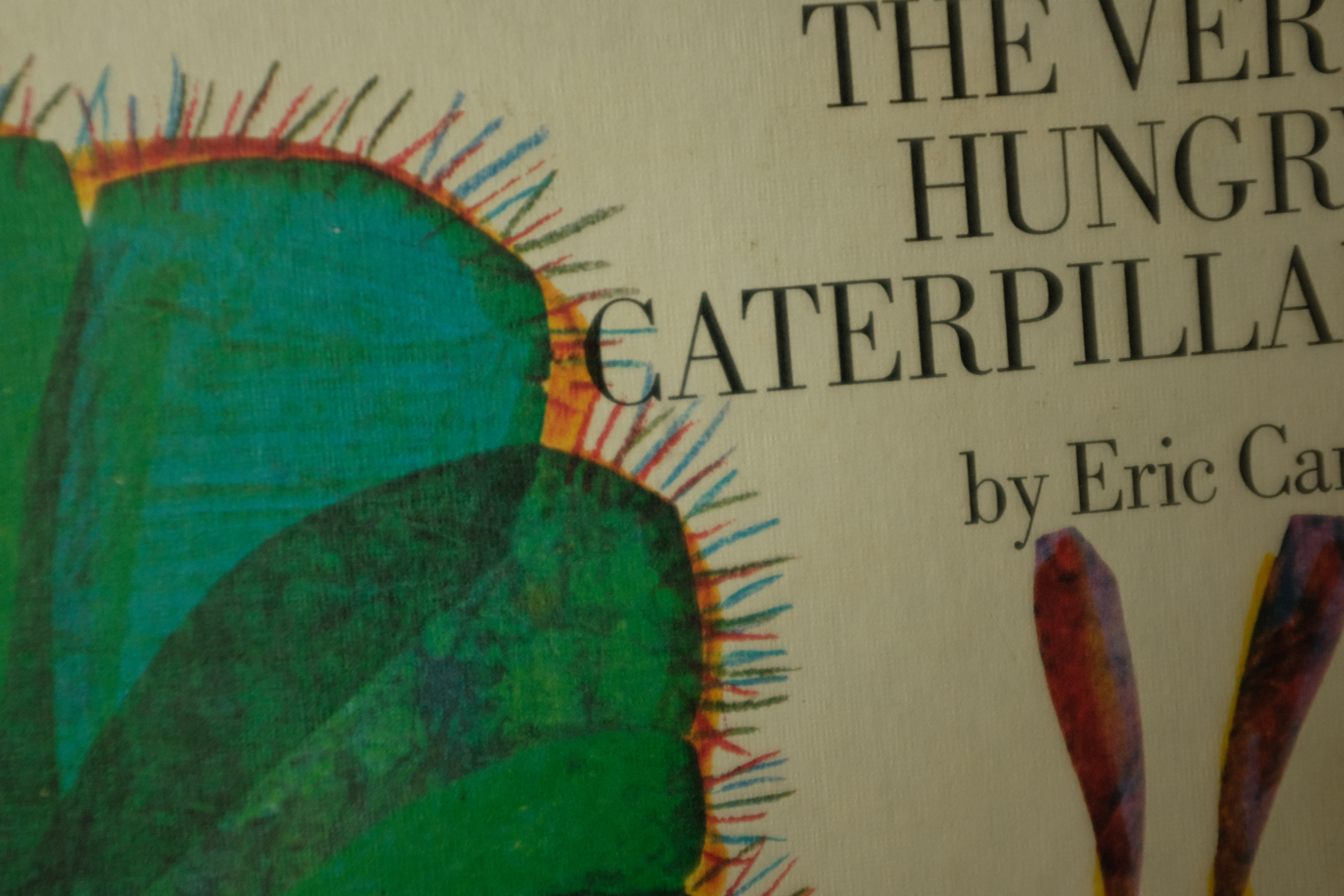
That C overlapping with hairs. (Is it tangenting???)
JON: So badass.
Also the antenna just about to hit “by.”
MAC: In this book and in so much of Carle’s work there’s this tension between extremely fastidious, dare I say German, layouts and his exuberant and improvisational picture-making process.
JON: I think that was, all of it, kind of the point. Carle knew the value of all of that rigorous design. He’d studied and understood it, and also knows that a lot of it comes from the requirement to be clear and legible, both things that books for young readers ought to have. But once he’s done with that part he is also angry enough at all of it to throw some caterpillar hairs over top of it.
MAC: Let’s open the book.
JON: I guess.
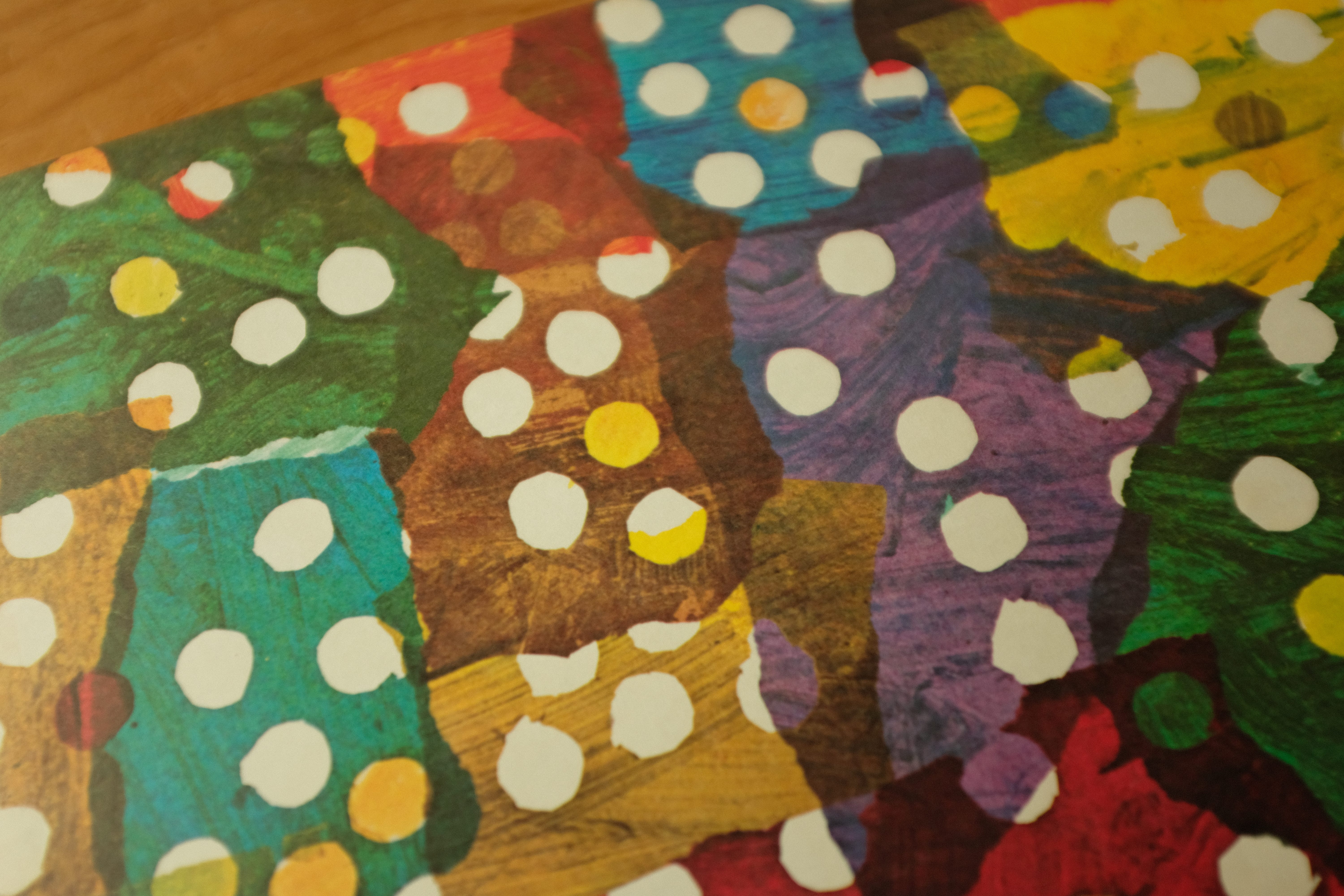
MAC: The endpapers introduce hole-punching, which is both this book’s big formal innovation and also most of the plot.
JON: Right, but importantly, this is abstract. These shapes he’s punching holes in aren’t representative of anything literal.
MAC: And then the title page:
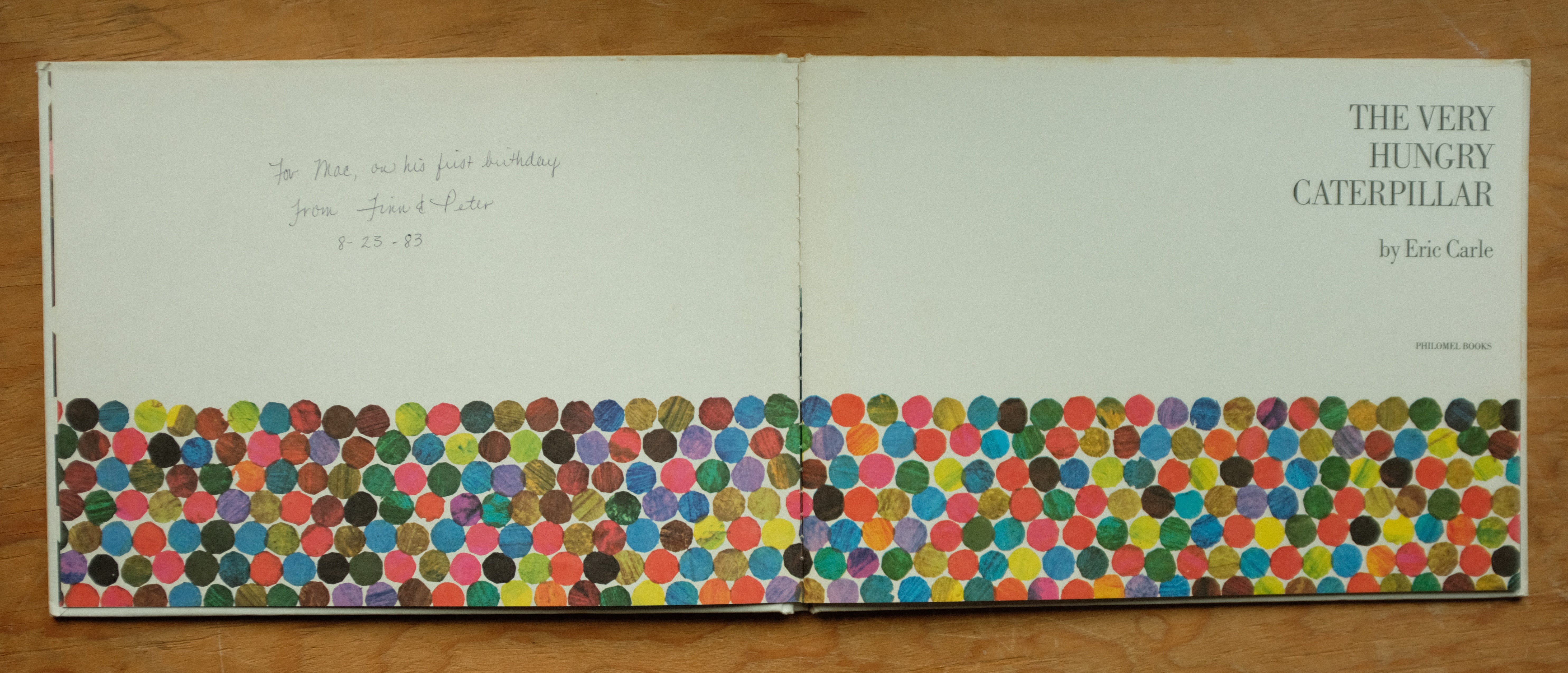
It’s all the holes! Arranged to make a solid ground plane.
JON: And what’s interesting is that this is still abstract. He’s having fun with the holes he’s just punched, but he’s kind of teaching here. This is how you’d run an art lesson. You start with messily painting a bunch of papers, no stakes, just having fun. Then you say, “ok now we get to punch holes in everything we did” — again, anyone can do it, super fun.
Then you say, “now what can we do with the holes we punched?” “Let’s put them into rows!”
And then once the dust has settled on all this, you would say, “ok, so now we know how to make shapes and punch holes out of them. What’s a story you can tell with that?”
He’s an amazing teacher.
MAC: Here’s the dedication page.
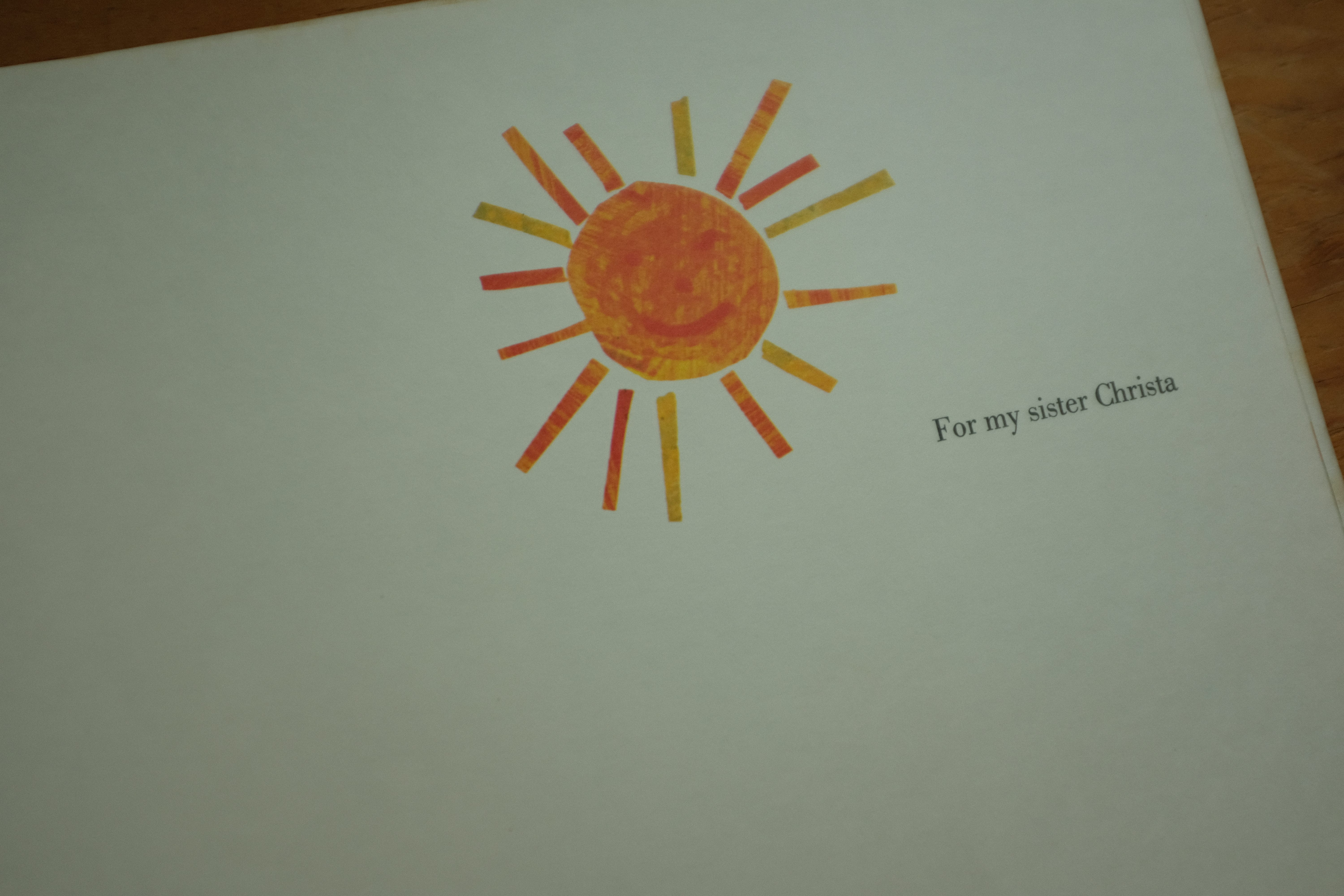
MAC: A smiling sun. It’s notable that this sun is the first character we meet on the interior because 1) we meet the sun before the caterpillar, 2) the sun has an expressive, anthropomorphic smiley face, the exact kind of friendly visage that Carle actually took away from his hero, and 3) when we turn the page and actually start the book...
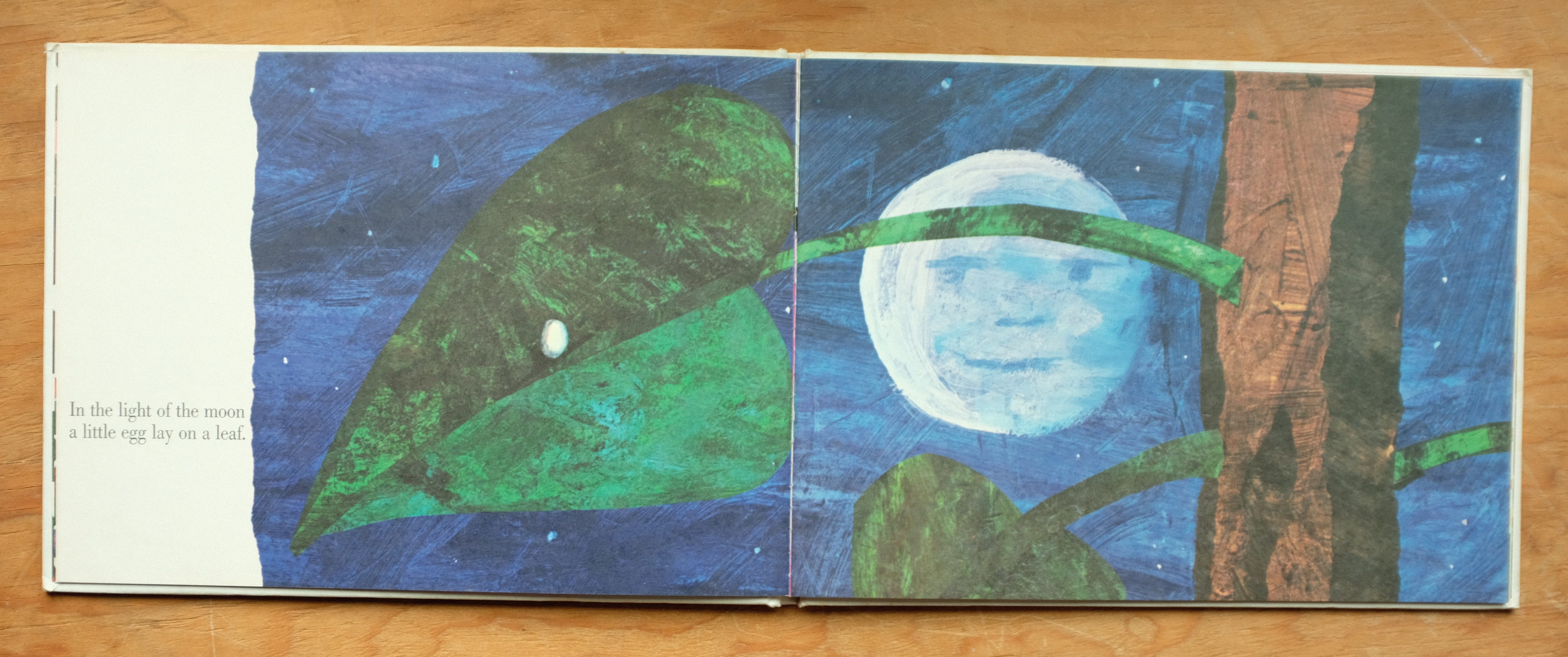
It’s nighttime.
And we still haven’t met the caterpillar by the way! There’s just a little egg on a leaf.
ART PROCESS QUESTION FOR YOU, JON!
JON: I AM READY.
MAC: Is the egg a piece of white paper laid on top of the leaf, or is the white an absence where the light table is shining through.
What I’m getting at is, does the caterpillar also start as a hole in a piece of paper?
JON: It’s a good question.
MAC: Thank you.
I thought so, too.
JON: There are at least two things going on, I think. (If anyone familiar with Carle’s methods follows us on here, please sound off as much as you’re legally able.)
There is an overlap on a lot of the pages that suggests a backlit surface. Meaning, the paper pieces he’s using are somewhat translucent but the best way to show that is by backlighting them once they are arranged. I do this too sometimes, and it is such a fun effect.
What that means is that the lighter something appears in the final illustration, the fewer layers there are on it, and a hole in everything would read as white, which is, I think, what’s going on with the egg here.
However.
It appears that the moon is not achieved this way, that he or she is painted on with white paint.
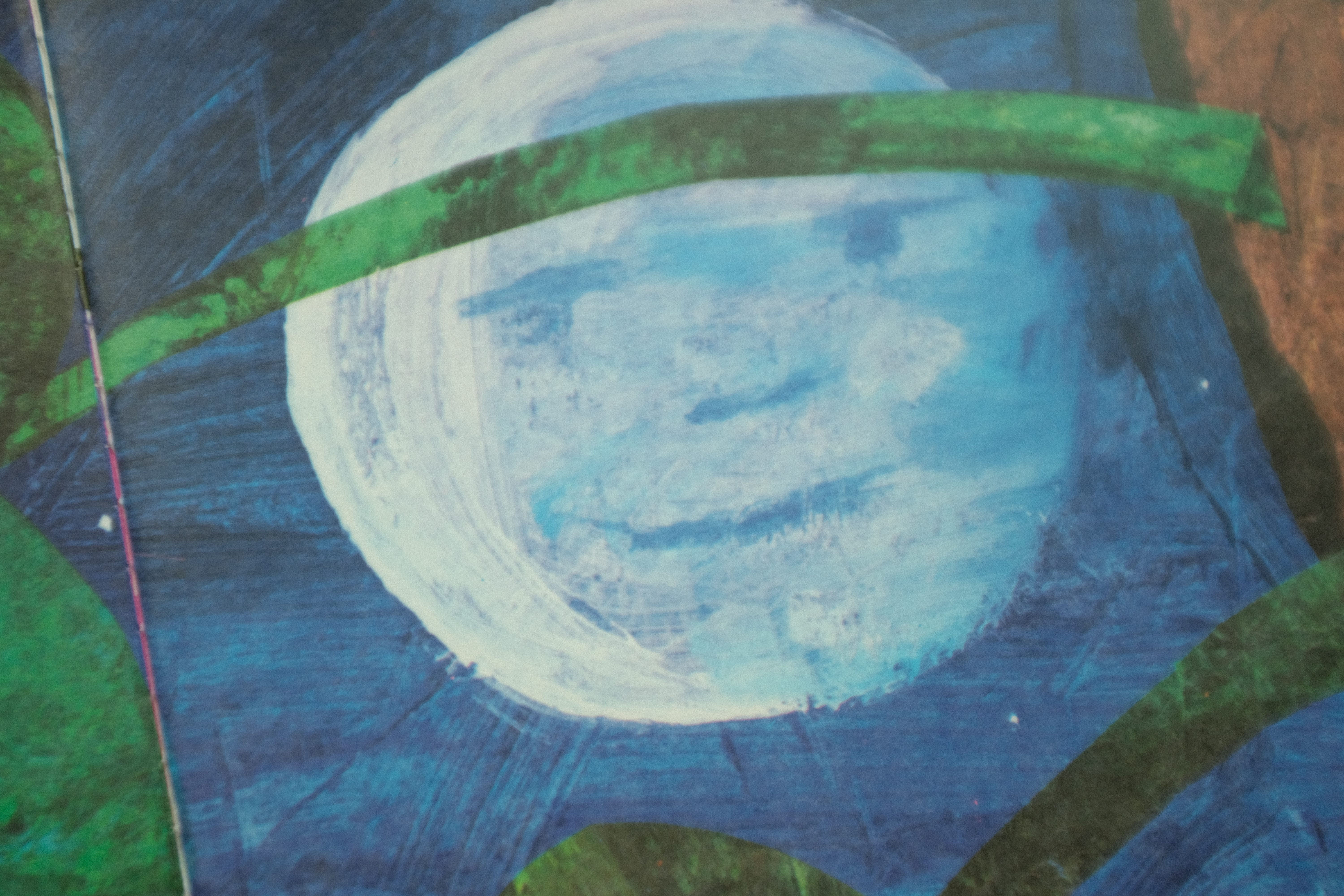
That’s trickier than it sounds, because it would be hard to photograph both a backlit white hole and white painted moon at once. White paint on a backlit piece of paper wouldn’t read as white in a photograph.
So again, if anyone has info, inquiring Substackers would love to know.
MAC: I mean that’s cool but I am more interested in the egg.
JON: Sigh.
MAC: I just think it’s so great that in this book where the main visual motif is holes in paper, with a main character whose whole thing is putting holes in paper, that pushed at the outer boundaries of late ’60s industrial printers’ abilities to punch die-cut holes in paper, our hero begins as a hole in paper.
Probably.
Could be paint.
Doesn’t look like it though.
Looks like a lil cigarette burn.
JON: That’s probably what it is.
It was a different time.
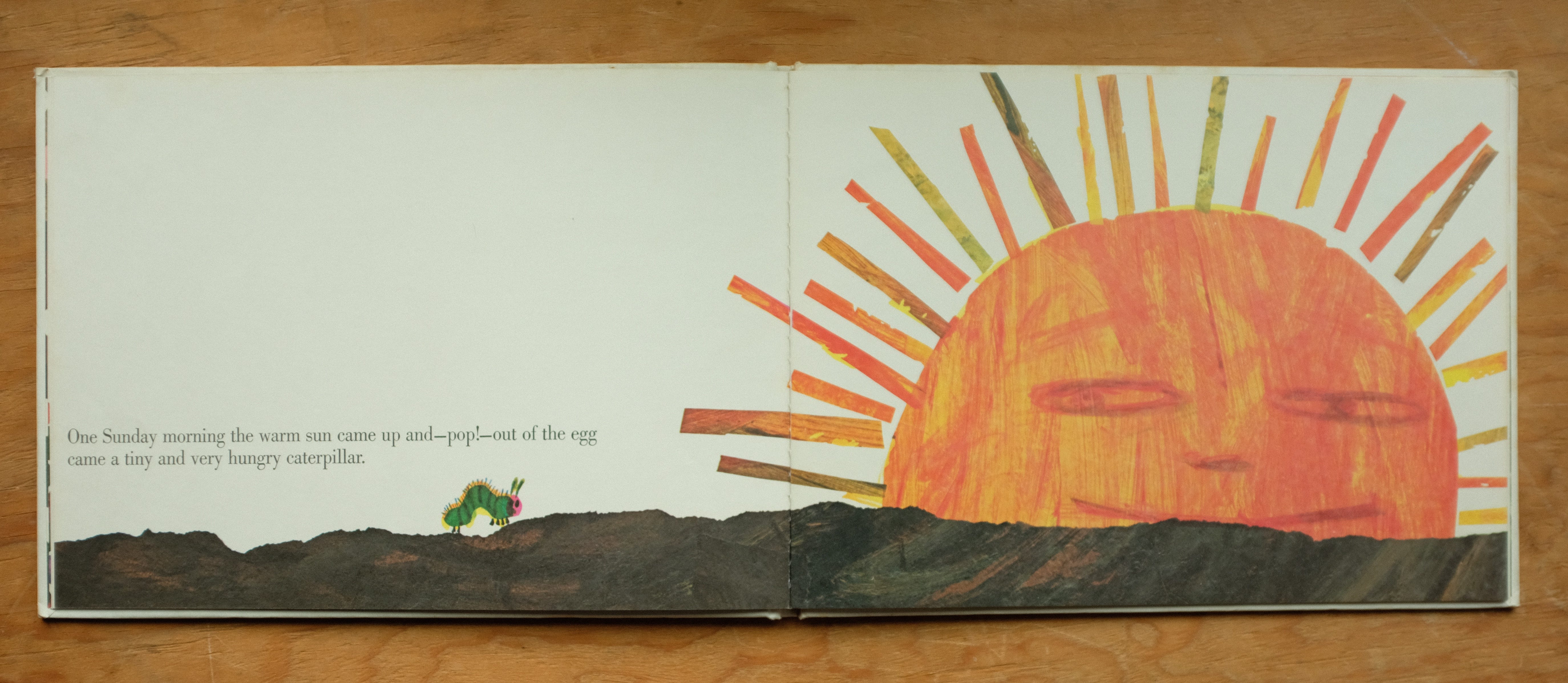
MAC: OK the caterpillar finally showed up.
I’ll say another reason we get emotionally attached to this guy: there’s such an appealing sense of movement in his design.
JON: Yeah he’s not just a tube. He’s movin along.
I would’ve done tube for sure, to my detriment.
MAC: And the detriment of children all over the world.
JON: Those are the stakes.
MAC: The text supports the sense of this little guy on the move: “the warm sun came up and — pop! — out of the egg came a tiny and very hungry caterpillar.”
He pops right into the story.
Also interesting that he’s created by the sun.
We start with the moon, but that first spread is very still. The moon is looking on benevolently, but that whole spread feels like the moment before the moment.
And then the sun rises — an absolutely massive sun, whose rays cross the gutter, and the story begins.
The sky, rendered blue at night, is now just white space.
And look at the sun’s face.
Here it was on the title page:
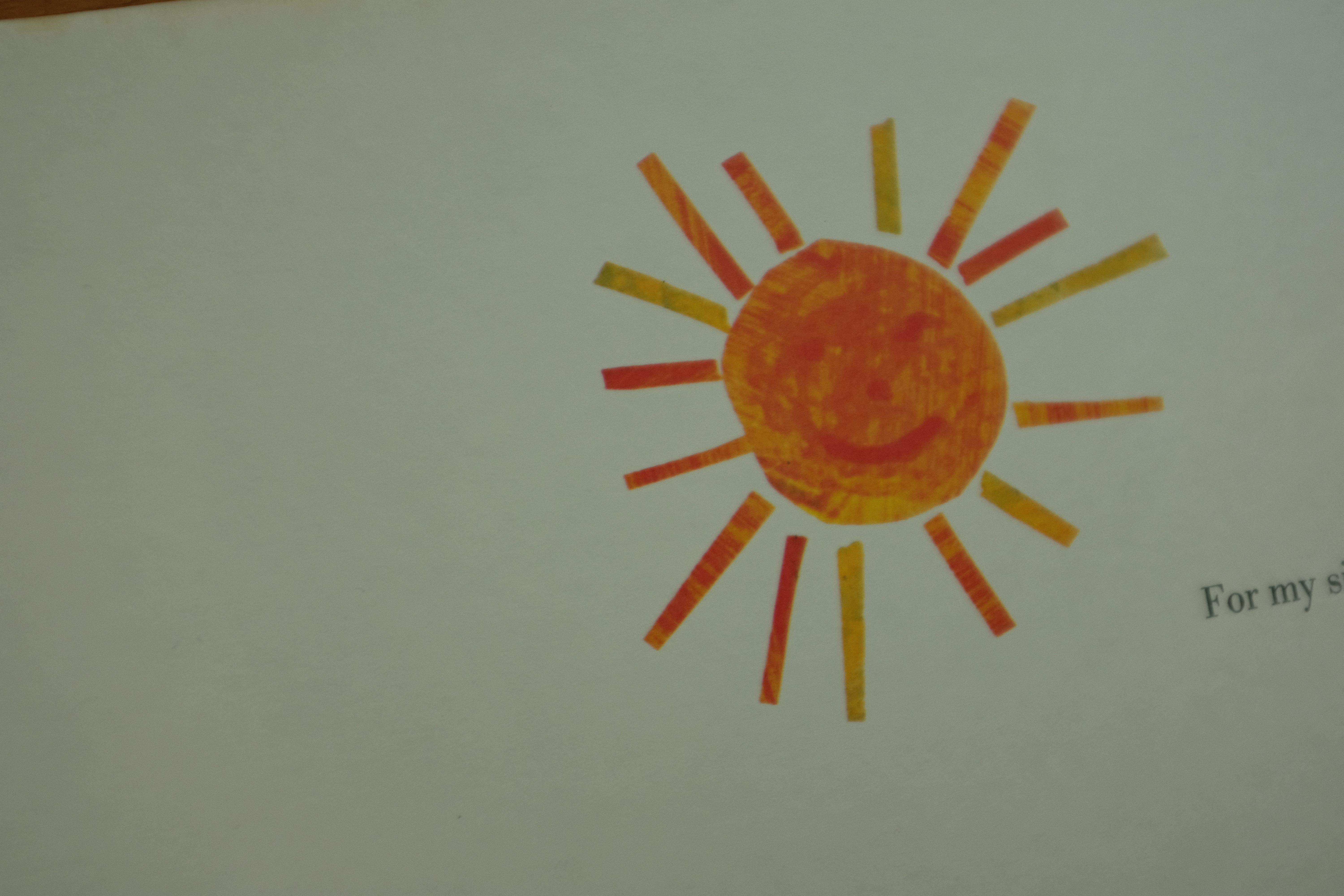
JON: Little window-drawing happy face.
MAC: And now look at it:
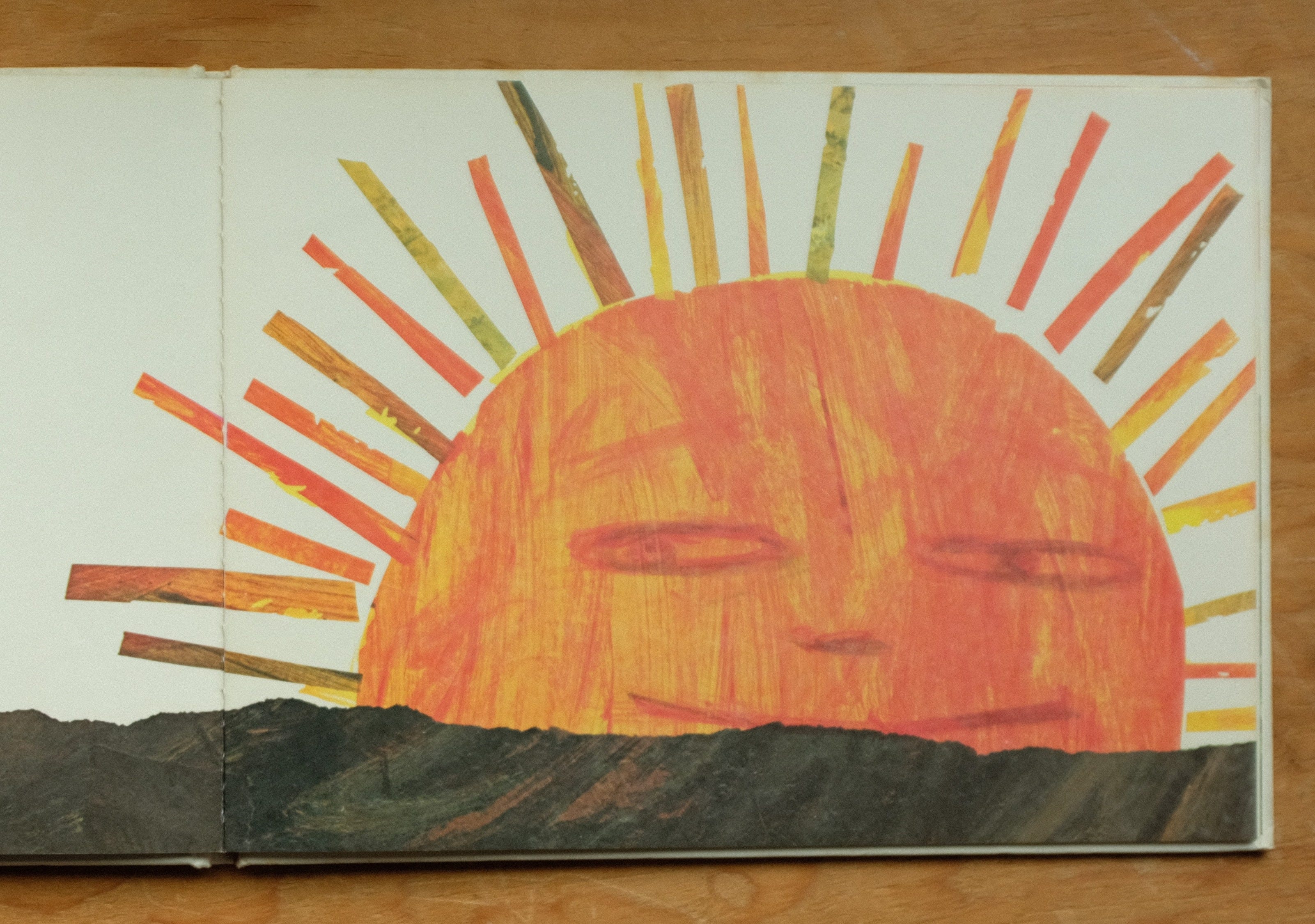
JON: Yeah he’s got a lot more going on here.
MAC: And look at the caterpillar’s face:
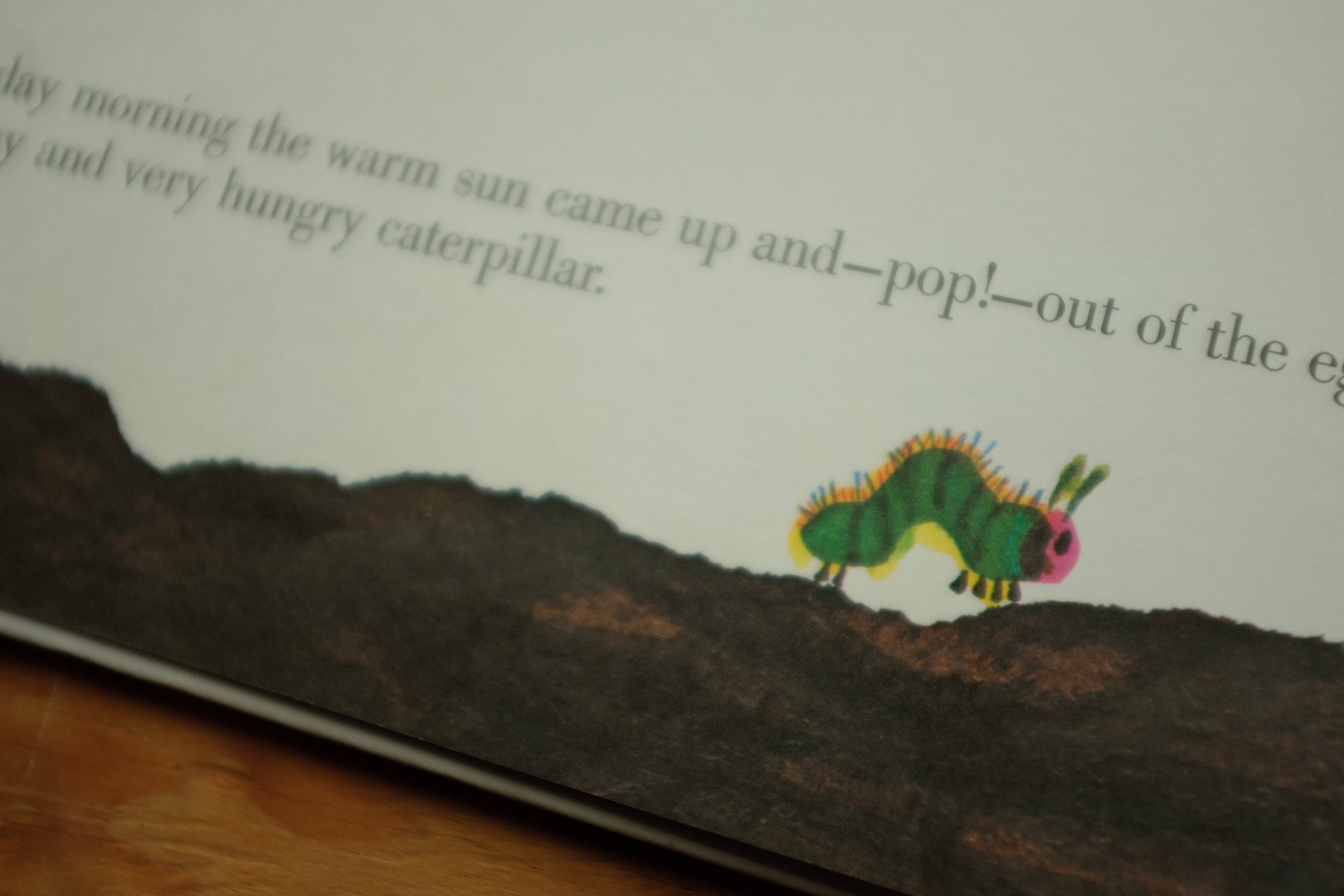
JON: Impenetrable.
MAC: And yet I am already in love with this little guy!
From a distance.
JON: I mean, he doesn’t have a lot of room for emotion or range, but that’s a choice too.
He made him too small for any facial detail and his methods are too rough to allow for it, also. Everything’s too chunky for that kind of detail, so you don’t really go looking for it, as the viewer.
He’s just kind of down there all little and that’s enough.
MAC: No, I regret zooming in!
JON: Yeah you’re not sposta.
MAC: The storytelling is so efficient.
There’s that Vonnegut rule of writing: “Every character should want something, even if it is only a glass of water.”
✅
All the caterpillar is is want.
JON: It’s a useful rule! It’s the kind of rule I used to go “phhh” at and then after eight drafts of a story that weren’t working I’d try it and go “oh.”
MAC: Spoken like a man who titled his first book I Want My Hat Back.
✅
JON: Look there’s a slight chance Kurt Vonnegut was on to something is all I’m saying.
MAC: We’ll be keeping an eye on his career!
JON: Kid’s got promise!
Can I talk about Eric Carle and the sun.
MAC: OK.
JON: OK.
In so many of his interviews, he is preoccupied with warmth. It seems to be mainly what he wanted to create. It almost feels like stories and characters and lessons were secondary to it, or maybe “in service of warmth’s creation” is a better way to put it.
When he was very young, his family moved from the US to Germany, where his mother was from. It was a hard move, and he got sent to school in a pretty harsh system. Whether he knew it when he started making books or whether it clarified later, a lot of what he wanted to do was simply make that time easier for kids.
There’s a quote of his from an interview where he says, “All my books are aimed at four-to-six year olds. That period when you leave home and go to school. Sometimes I feel I can nail it down to one day, that day when you leave the warmth and protection of home and go into the unknown. I just want to make that day a little bit easier.”
MAC: Well.
That word, warmth, feels like a skeleton key to so much of Carle’s work and this book in particular. Not just in the prominence of the sun, but in his use of color, the playful formal innovations, the joyful pictures of food, this bumbling and bouncing caterpillar.
It’s all very warm.
JON: Even that method we mentioned earlier, photographing paper over a light table. The effect is warm. You almost expect the pages to feel warm when you go to touch them.
MAC: Like a lot of great children’s writers, he’s got such a direct line to his own childhood. He says — “Sometimes I feel I can nail it down to one day, that day when you leave the warmth and protection of home and go into the unknown” — but you get the sense that really he means “I.”
(I said “you get the sense” but I guess I meant “I get the sense.”)
But yeah, Carle is clearly remembering a day, or at least a feeling, that he had when he was four.
And his impulse is to comfort the child in the unknown, to beam some warmth.
JON: Yeah. And he’s not doing this because he doesn’t have the capacity for darkness. He landed in Germany as the Nazis were coming to power. He was conscripted as a kid and forced to dig ditches for the army and saw Russian prisoners working alongside him executed. His dad was a German soldier captured and sent to a Soviet work camp and came back irreparably broken. This isn’t a guy who is like, “everything is sunshine so I’m going to paint sunshine.”
He’s seen the bottom.
And his move is to spend as much time as he can generating light. It’s worth noting that this came out in 1969. Where the Wild Things Are came out in 1963. Picture books were getting dark and complicated, at least in some areas, and had been for a while. It just wasn’t what Carle wanted to do with it. At least not that way.
There’s a really humbling honesty to it, I think. It acknowledges, somehow, the amount of time and space these books actually have in a kid’s day. He wants to make a gentle moment. He’s not out to change their lives, he knows the books don’t take very long to read. But as long as you’re in one of his books, he wants you to feel warm.
Anyway, this caterpillar is super hungry.
MAC: So here comes the big spread:
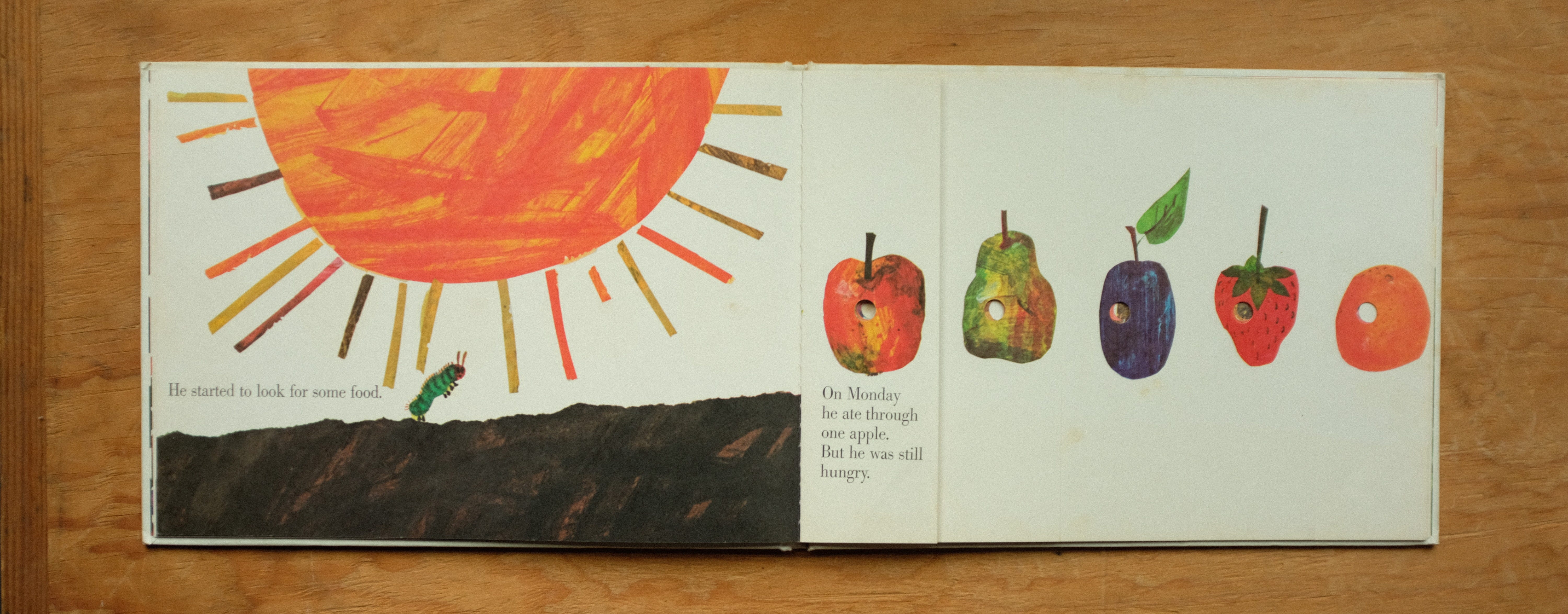
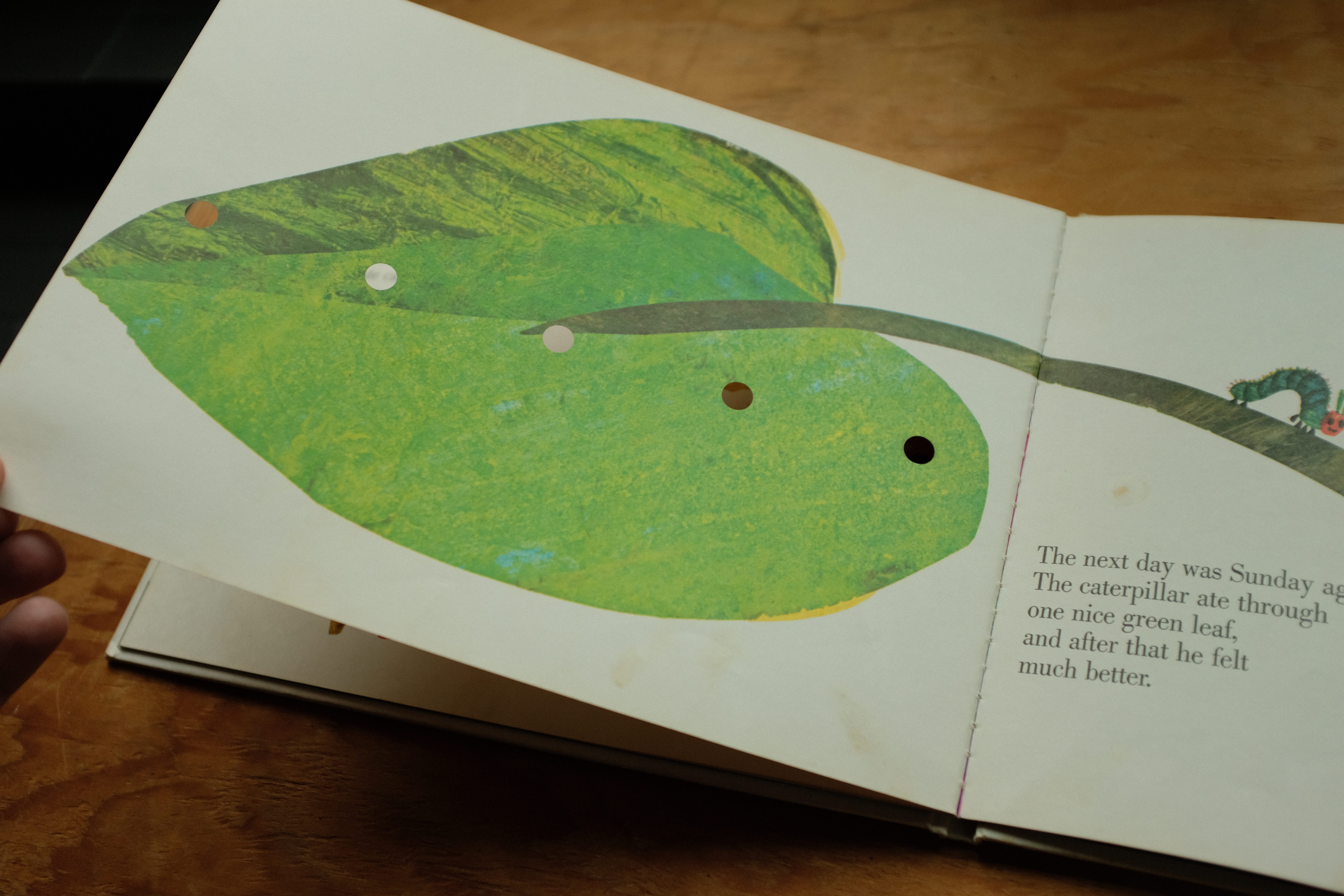
So this one spread is almost half the book. The story of The Very Hungry Caterpillar is told in 11 spreads, and five of those spreads are actually this one spread, which was at the time and I think still remains, a marvel of bookmaking.
I am going to try to explain the mechanics of how this works clearly and simply.
And almost certainly fail.
JON: Yeah good luck this thing is crazy.
MAC: Basically what we’re seeing here aren’t flaps. It is four successive pages trimmed short. Arranged this way, each trimmed page reveals a portion of the next page.
There are die-cuts: actual holes punched into the book.
The text teaches you that the hole is a place where the caterpillar has eaten through a piece of fruit. “On Monday he ate through one apple.” And then it beautifully prompts a page turn: “But he was still hungry.”
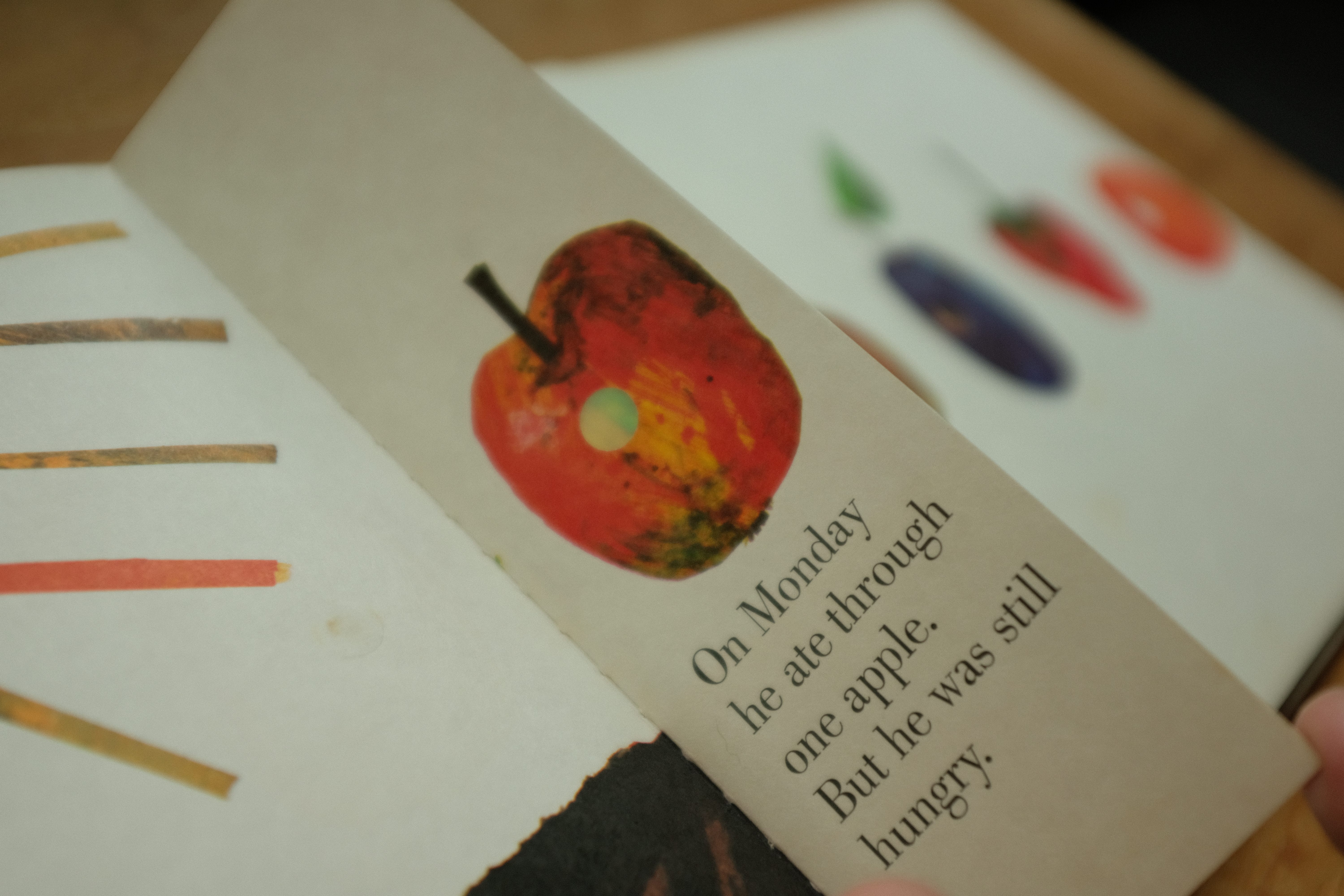
And then, and this really does feel like magic, what seemed to be one pear is two pears.
Each with holes.
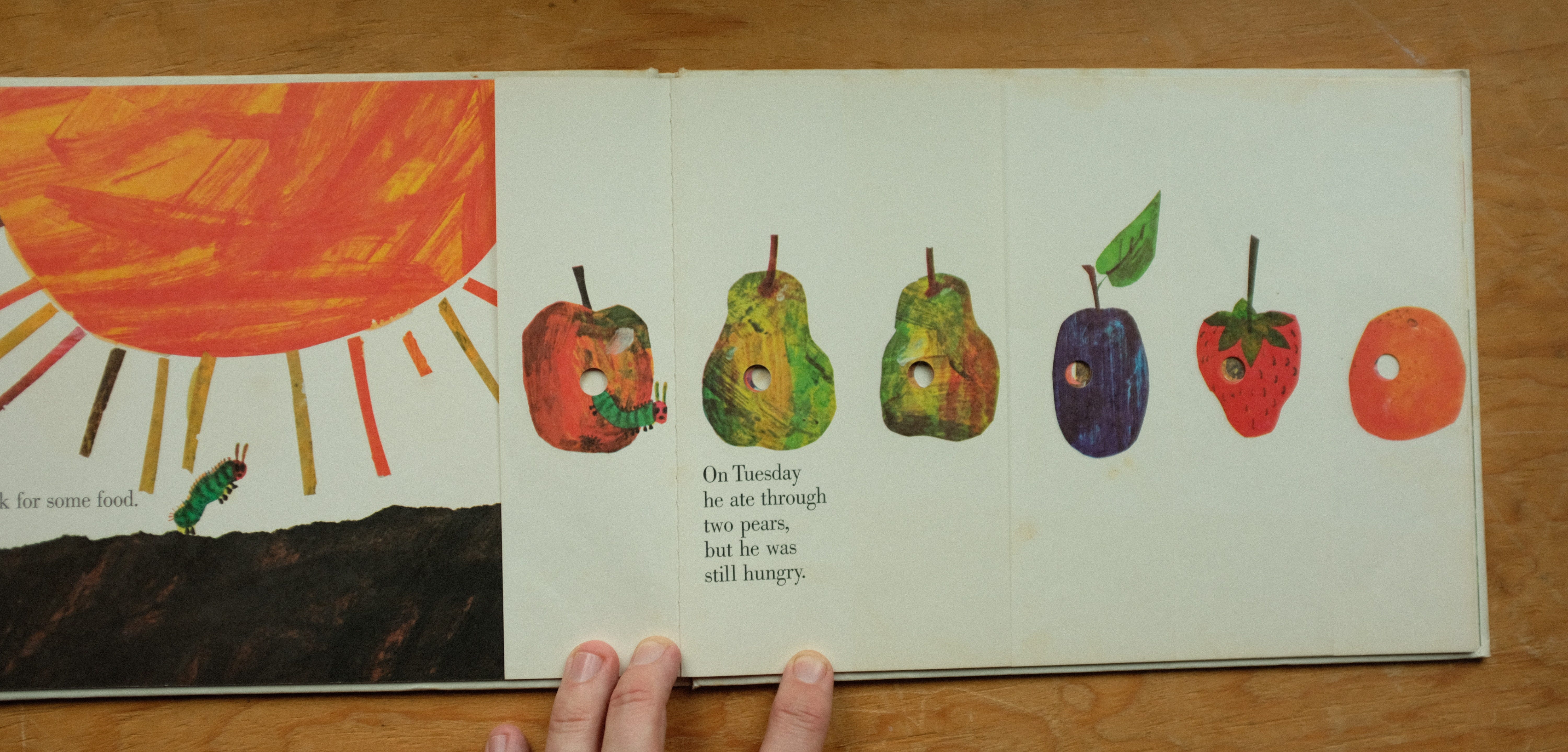
On that narrow verso, the caterpillar emerges from apple.
And then by the time your eye crosses the gutter he’s already made it through two pears.
Then three plums, and so on.
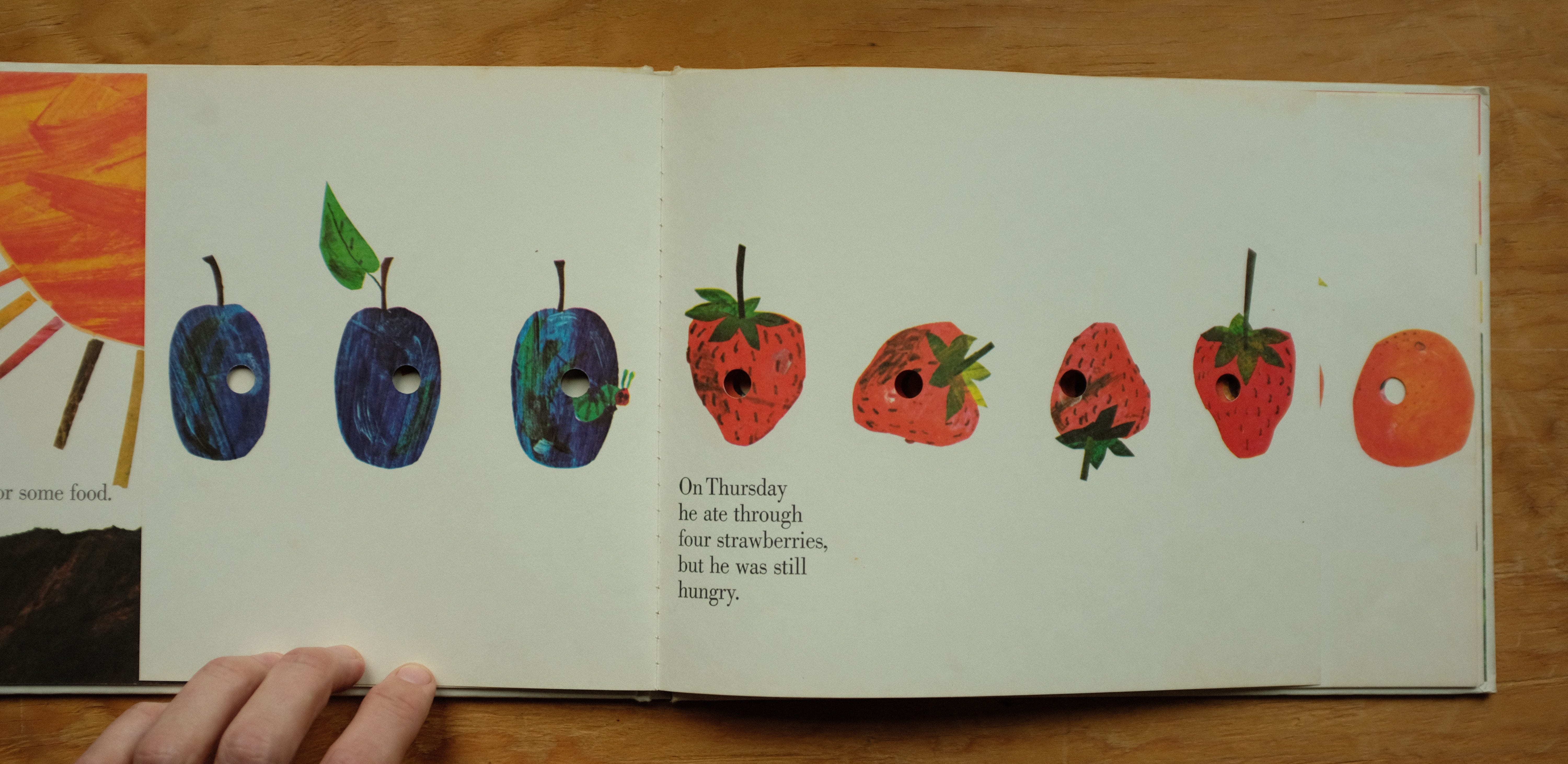
This was an incredibly complex feat of bookmaking. The first run was printed in Japan because American printers couldn’t handle it.
Someone should do a dissertation about how the picture book has pushed innovations in industrial printing processes. Wanda Gág and typesetting, Carle’s caterpillar. Just be sure to thank Looking at Picture Books. And toss a QR code in that bibliography.
JON: We mentioned this a little before too, but worth reiterating that the contrast here is so effective. This is book production at an insanely complex level, and the design of everything that isn’t an illustrated element is done with elegance and precision. The typesetting is gorgeous, the hole die-cuts are perfect and round. Everything is machined and exact, and then on top of that is like, an orange that was done with a giant paintbrush and cut out with an X-Acto knife.
There’s both a reverence and an irreverence to it. There’s an irreverence to books generally here, I feel like. He’s cutting up and punching holes in a book. He’s not coming at picture books as hallowed ground.
MAC: It is also incredible that something so complicated to make is so elegant and intuitive to read.
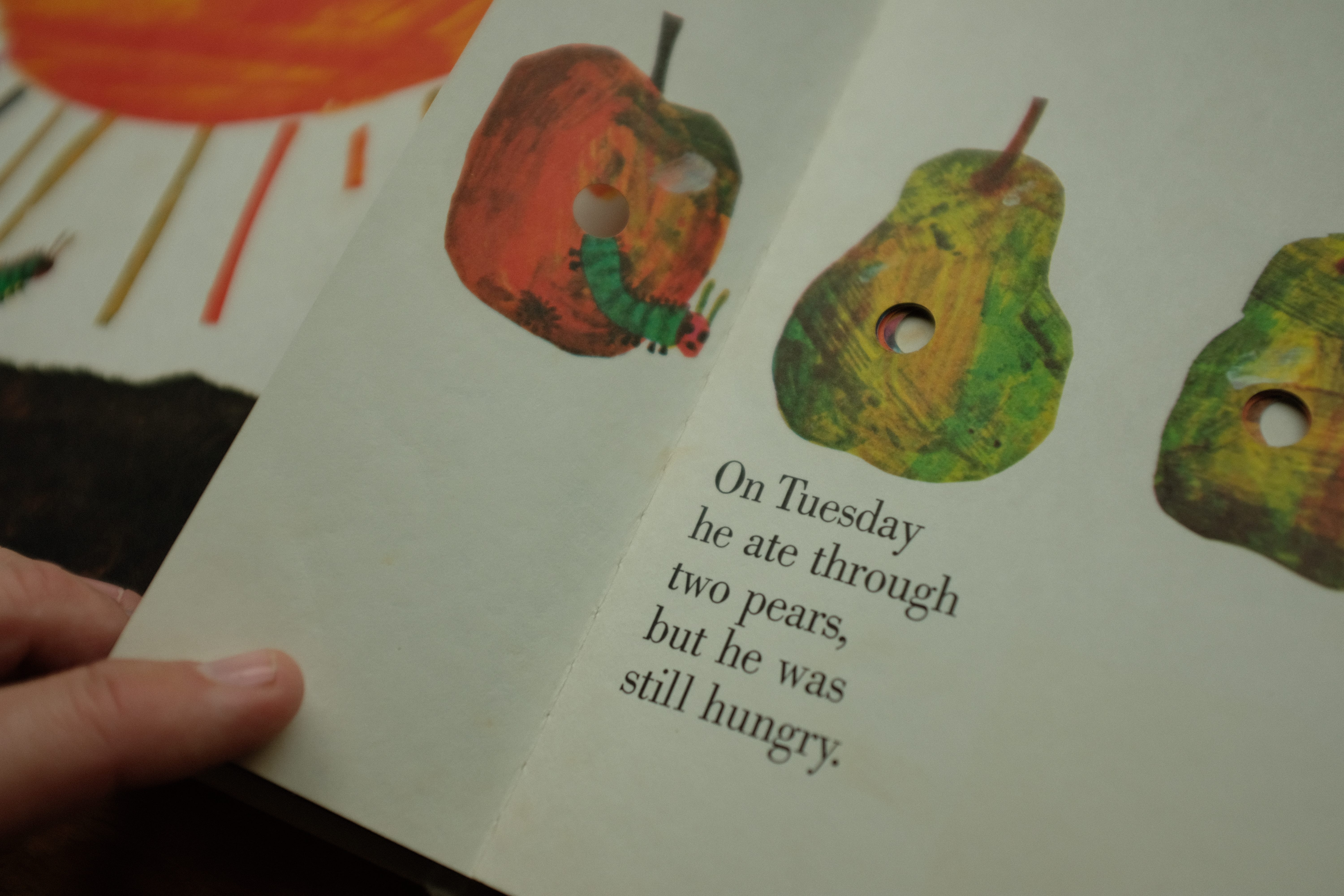
JON: Yeah. This should be a mess, and yet every kid of every age gets it.
MAC: A lot of the time, playful formal stuff — flaps, gatefolds, moments when you turn a picture book sideways — can end up feeling intrusive or confusing to the reader.
You open up a big gatefold for some stunning climactic moment, and then before you move on and turn the page, you basically have to fold a map with a library full of kindergarteners looking on.
JON: “DON’T TOUCH IT. You’ll rip it. I have to do it.”
MAC: You get the feeling that the people making the book are having more fun than the people reading it.
Not the case here!
The kids’ book scholar Leonard Marcus has an interview where he asks Carle about this:
Q: You have also talked about wanting to make books that are also toys.
A: That impulse comes from the observation that up to a point a child is more tactile than verbal: holding hands, holding his or her bottle or rattle, and being held is what matters to them at first. School comes later, and with school comes sitting still and focusing on the words in books. So I thought there should be something between the warmth of being held and of holding on to a toy, and the more abstract experience of book learning. There should be a bridge between — and that is what I’ve tried to create in the form of a book with holes in it, for example, a book that is partly also a toy.
It is a toy you can read, and a book you can touch.
JON: The way a good toy teaches you how to play with it, what it’s supposed to do, that’s more the way this book progresses than a classical story. There is a story, it got off to a two-page start, but then it turns into a toy for a while.
It’s like a toy with story pathos.
MAC: Yeah. Carle is such a precise designer, and when he talks about making his books he tends to focus on process and form, but you can see in his answer up there (and in the books) that design and emotion are inextricable for him.
The publishing term for stuff like these holes and trimmed pages is “novelty.” A “novelty book.” But for Carle it is a way to impart “warmth of being held.”
Warmth again.
And this is a different interview from your warmth quote.
JON: Right.
MAC: And then we have the end.
JON: As he tells it, when his editor suggested “caterpillar” he immediately said “butterfly!”
It could be that, as a storyteller, he might not have had an ending on the Willi version that he loved. Like he might’ve had the cover, and the holes and the progression and everything, but maybe not an ending. Maybe Willi the worm just slept it off.
MAC: But the caterpillar transforms.
There’s a funny thing in one of the interviews about the cocoon.
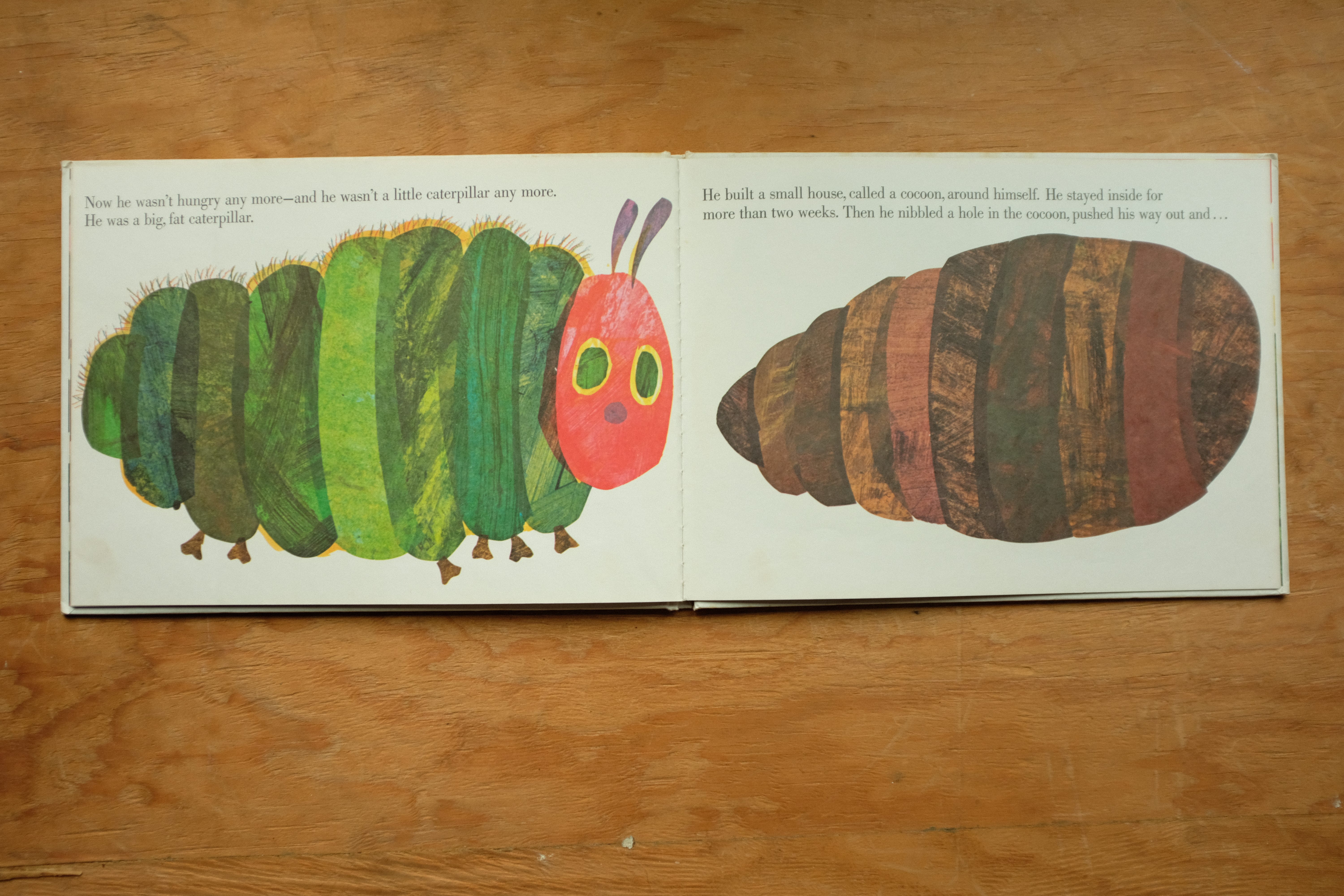
JON: Yeah, I guess caterpillars technically go into a chrysalis?
Not a cocoon?
MAC: Yeah, and some people got mad about this. Unsurprisingly.
This kind of thing happens a lot in kids’ books. People have these hobbyhorses and they get really mad when they show up in a picture book.
The Chrysalis People.
JON: Here’s the quote: “When I was a small boy, my father would say ‘Eric, come out of your cocoon.’ He meant I should open up and be receptive to the world around me. For me, it would not sound right to say ‘Come out of your chrysalis,’ and so poetry won over science.”
Take that, Chrysalis People.
MAC: And we go from that cocoon to the final spread, an absolute smash of a two-pager:
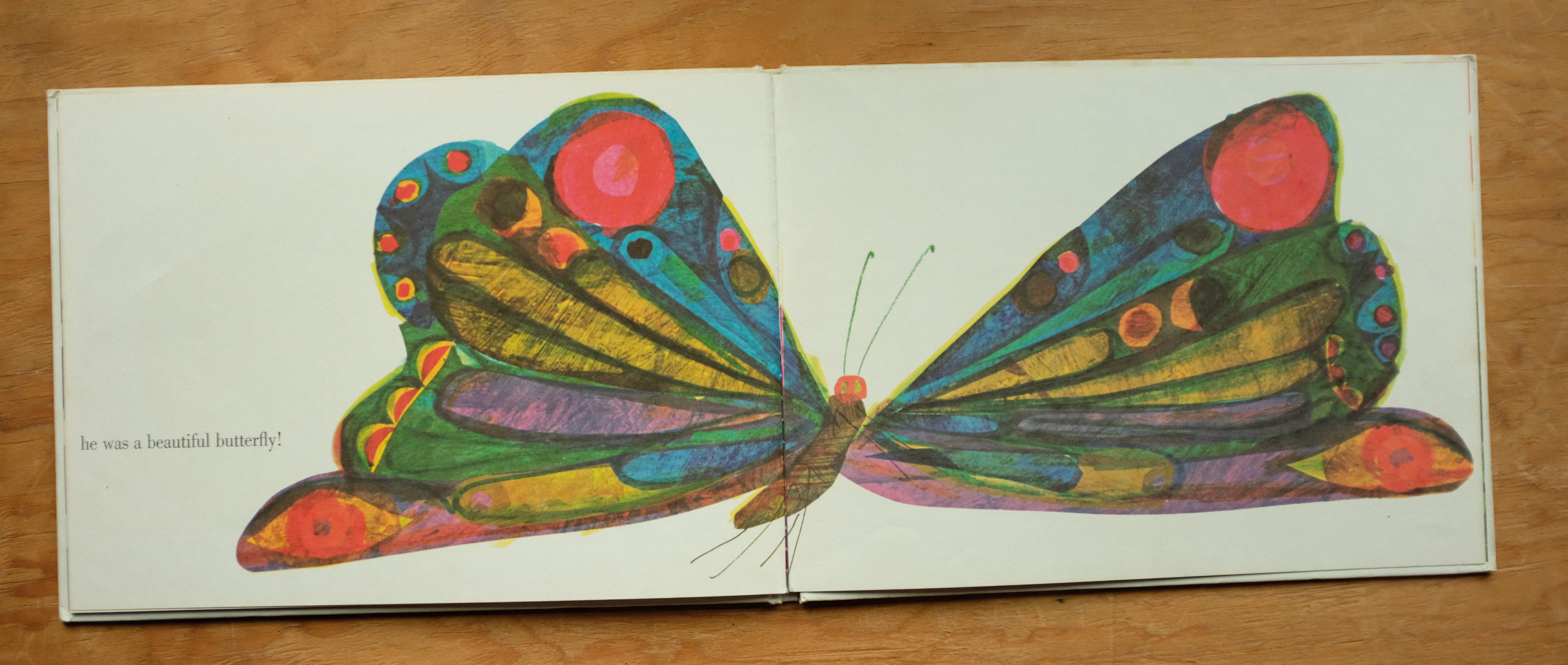
Again, there’s so much emotion here, but most of it is coming from color and shape and even the butterfly’s placement on the page.
JON: It’s really great that this is the last page. No final spread with him flying away, smaller on the page. I’d have been tempted to do that. This is just this huge crescendo. Using all the colors of all the fruits and things that he ate. They are all mixed in and are all used here in this huge thing he’s become.
MAC: Can I say something though?
Something that’s probably stupid?
JON: I suspect you will regardless.
MAC: This was absolutely the right move. It is a spectacular ending, in the truest definitional sense of “spectacular.”
But — and this was also true when I was a kid — I miss the little caterpillar.
JON: It is extremely sad, which is complicated right, because you’re looking at this euphoric image.
MAC: Yeah, maybe Eric “Mr. Warmth” Carle would disagree, and this is just what happens when two guys like us read a book like this, but I think that this exuberant ending is also suffused with not a small amount of melancholy.
I suspect Carle felt it too, though.
He knew that he had a big, capacious, multivalent book, something whose meaning couldn’t be pinned down. There a quote from a great Guardian profile, where Carle recalls a librarian who told him what his book means:
Right after the Wall fell, I was signing books in the former East Germany and was invited by a group of young librarians to have lunch with them. One said the caterpillar is capitalist, he eats into every food one little bit and then the food rots away. Wasteful capitalist. Interesting. I think that if you’re indoctrinated, that’s how you will see it.
A good warning to all us readers, who are indoctrinated in our various ways.
JON: Yeah, it’s kind of what we love about the simplicity this audience and form can encourage. The actual message, to people who are inclined to look for one, is murky.
On the one hand we have this colorful, light-filled thing told in the gentlest tones and quotes from the man himself about how all he wants to do is make things a little easier for his audience on that first scary day. But this period he’s talking about, that hard, hard first day when you leave home, even if it goes as well as it can, is still a sad day. It’s the end of something. You won’t go back to that early special tender time.
I guess the moral is: don’t eat anything.
And never go to school.
Regarding the physical ways children interact with this book-the holes are too small for adult fingers to fit into but just right for toddlers. On the final page, the butterfly wings (not its body) are divided by the gutter so that when you open and close the book, it looks like the butterfly is flying. What an ending.
Hey Jon and Mac!! Associate Curator at The Eric Carle Museum here. We took out the 1980s version of the first spread—the little egg on the leaf—and with the help of our preparator and one of our registrars, identified more into Carle’s process. The tiny egg, in fact, a hole cut into the leaf!! It seems like Carle layered the leaf over the first collage layer (dark blue background). There’s even a small notch where the blade went! He then took white paint and “corrected” the egg to make it look slightly more egg-shaped.