

Working On Picture Books: Your Truck
Jon's new board book is out this week


Deep dives on great picture books are here.
We recommend picture books here.
Read more craft posts here.
The Looking at Picture Books Shop is here.
This week, Mac and Jon discuss the craft of the board book series. They had the following conversation over text.
MAC: Hi Jon.
JON: Hi Mac
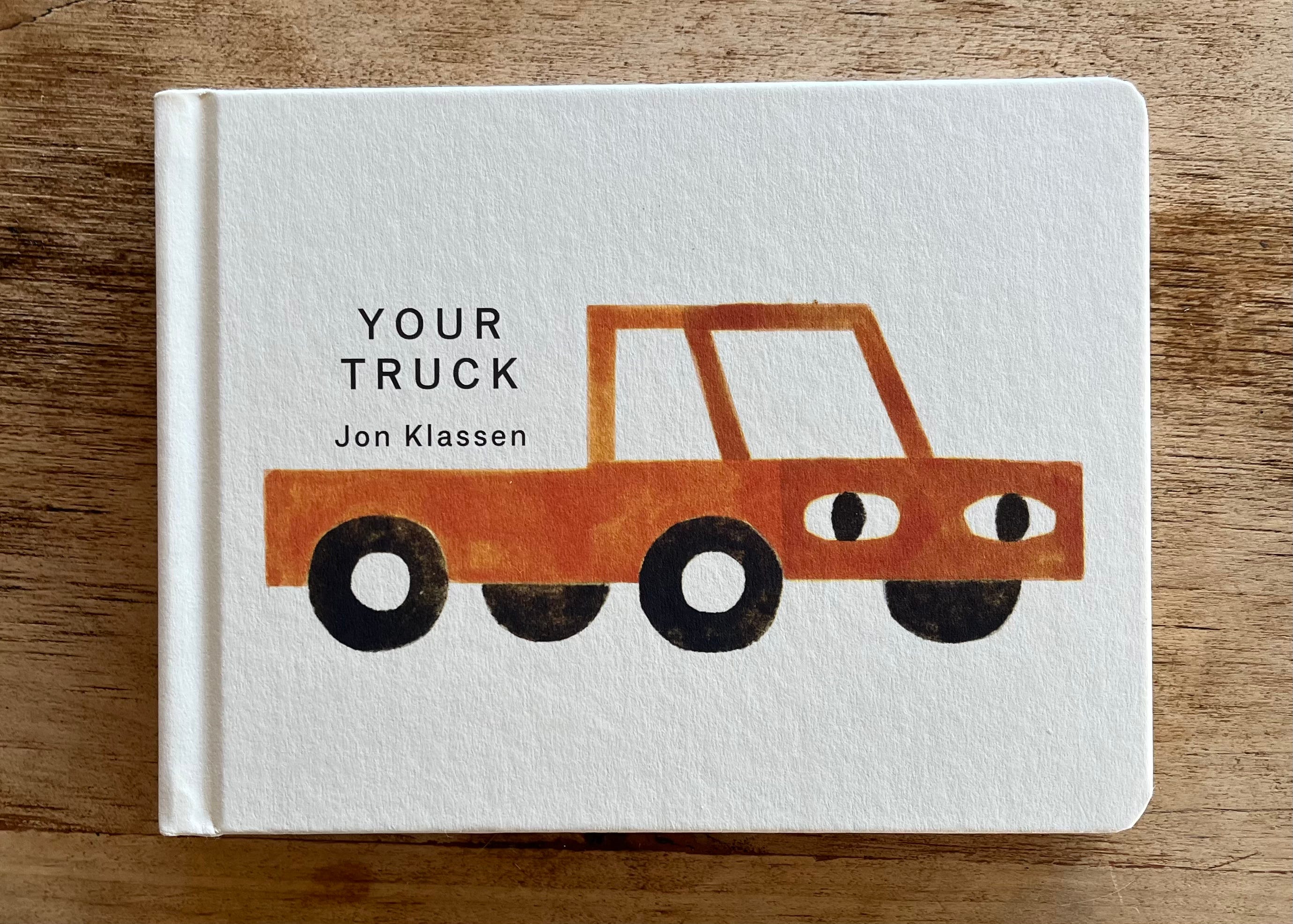
MAC: Jon, you have a new book out this week.
I don’t know why I’m telling you that.
JON: Given what you know of me, I’d say it’s actually not totally out of line to tell me that.
MAC: I did see that your “publication day” Instagram post was a day late.
JON: I was in the car with my whole family driving from YOUR town to my town on the day it came out.
MAC: Well your aggressive CAPS LOCKING is a great segue.
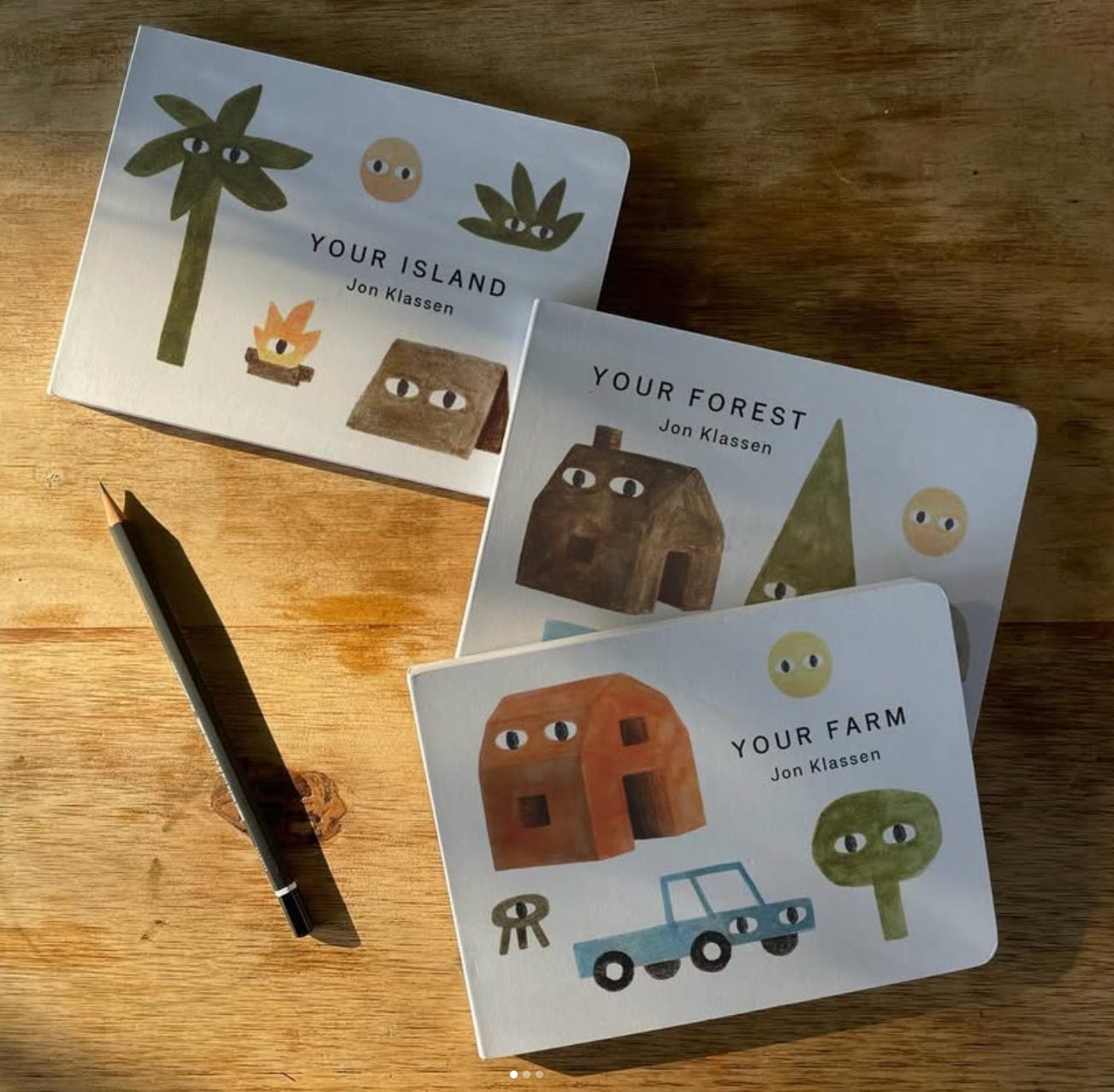
Because the new book is Your Truck, a board book that is a follow-up to the Your Places series. Your Island, Your Forest, Your Farm. Which I’m now hearing as YOUR Island, etc.
JON: “YOU have it, kid.”
“This island is nothin but trouble.”
MAC: I want to get into how you made this book, in a way that might be helpful for writers and anyone else who is interested in how board books are constructed, but first do you want me to do the hard sell?
I can do the hard sell for you.
JON: Given what you know of me, I think you’d better do the hard sell.
MAC: You can buy Your Truck wherever fine board books are sold, but we always recommend supporting your local independent bookshop, or even my local independent bookshop, East Bay Booksellers. They ship!
JON: Oh I could’ve done that.
I thought you meant like, say nice things about it.
MAC: Oh well that maybe will come up naturally.
JON: We can try.
MAC: All right, I want to talk about making a series.
You are somebody who likes things that come in sets, but I think that your excitement about sets comes first from a design perspective. Is that fair to say?
JON: Ummmm yes.
Or at least that’s the part that’s clearest first.
MAC: I’ve heard you many times get excited about how a series works as designed objects — the physical book.
You talk about how “your little guys” will look next to each other on a shelf.
JON: Yes.
That is what they are.
MAC: “This book may be called Your Truck, but it will always be my little guy.”
JON: And, if we’re honest, how they look on a shelf together will be most of their life in the house, right? You will read them, sometimes, but the pie chart of time “being read” and “looking handsome on the shelf” is pretty clear.
It doesn’t mean you shouldn’t take the interior and the story and all that seriously, but we’re kind of in the business of story and furniture design.
I have this two-book series of mystery stories that S&S did a million years ago. I bought it before I even started doing books, I think. But I remember it knocking me out that they did it so both books would go together on the shelf.
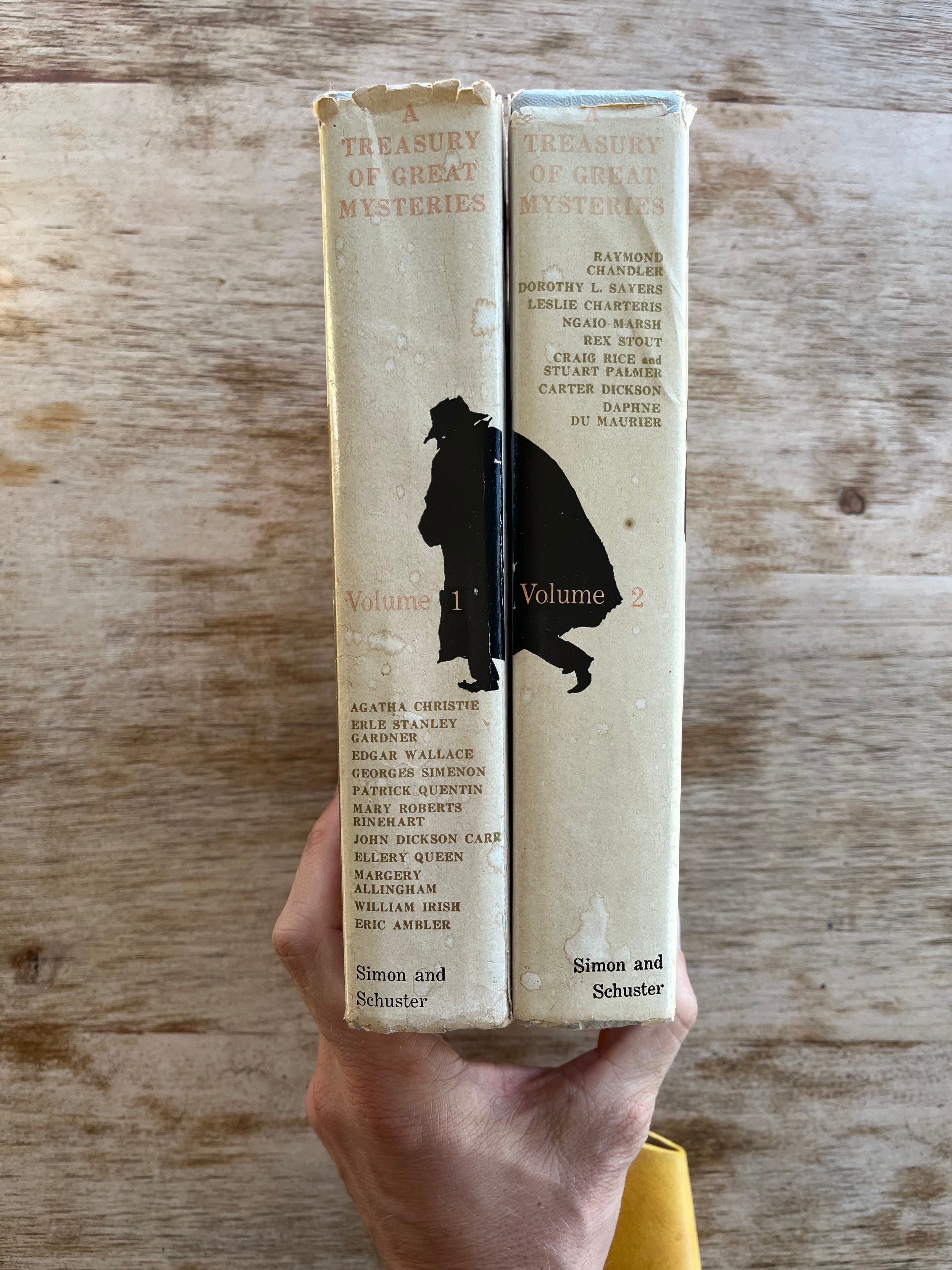
You want to put them together so bad, and keep them there. Whenever we get a box set of board books for the kids, they just love assembling the set in its box. Little guys.
MAC: It’s satisfying to see the pattern, how they look next to each other in uniform.
And I’ve heard you start talking about trim size and covers and spine layouts very early in your writing process. My sense is that sometimes the narratives of later books in the series will still be sort of nebulous for you but the design will be clear. Yeah?
JON: Yeah, they will even prompt them.
I think writing in sets is actually a way for me to try and prompt more spontaneity than I come by naturally. Like, I’ll maybe have the first installment of a series fairly clear in my head, but only the general idea of the rest of them, but by then I’ll have some kind of structure that the first piece established, and within that I can feel a little freer to move around and get surprised. I find that really hard to do with a blank slate.
That’s how it was for the hat books. I Want My Hat Back wasn’t conceived of as the first in a set, but once the second one, This Is Not My Hat, looked like it was going to relate to it, a lot of the decisions were done in reaction to that first book. The value structure is flipped, the trim size is the same as the first, just turned on its side, the font is the same, etc. etc., and then the third book, We Found a Hat, was always a gradient cover in my head because we’d hit both extremes with the first two books. It was the only thing left to do, visually.
And that’s where you want to get to, so that you almost feel cornered into a decision by what’s come before, and you have to make it work.
MAC: So this is the great gift of a series — it creates a bunch of signifiers or rules. There are decisions you don’t have to make.
But it also gets to at least my anxiety about series —
Which is, when these patterns start exerting force on the actual mechanics of how the stories work, how do you make sure you’re not writing the same book over and over again???
JON: Right.
MAC: We’ve all seen this. Books that feel like they’re just being put through their paces.
There’s a hit book about a vacuum cleaner with a heart of gold.
JON: I’m in.
MAC: And then next year the sequel comes out, and it’s the same book but the vacuum cleaner is wearing a Santa hat.
JON: Easy on the Santa books, now.
But yeah.
Here’s a weird thing I’ve got with that.
I kind of like the risk of it. I have a suspicion that the worth of the thing isn’t in those beats that might be similar or even sometimes identical, book to book. I don’t know what the worth is exactly, but the fun part is, in a series — at least in this series — to see how many things you can repeat, book to book, and still make what, to you, seems like a worthwhile new thing that, by the way, would work if it’s the only one of the series the reader runs into.
Lotta commas in that one huh.
MAC: Well one way of writing any picture book story is to create a pattern, and then find ways to embellish or subvert that pattern once or twice — to surprise the reader without breaking the pattern.
Brown Bear, Brown Bear, What Do You See? is a good example of this.
The blue horse in the middle, the kids at the end.
These things don’t break the rules of the book, but they change our understanding of what the rules of the book are.
And a series provides a similar opportunity to do that kind of repetition and variation across multiple books.
JON: I think with these, with the audience being much younger, it felt like I had more permission to repeat a pattern.
MAC: You alluded to this in your tardy Instagram post:
“[The Your Things books] do look similar and are even paced similarly as the Places books, but because these are centered around a singular object, they got more sentimental.”
So tell me how the Your Places books work, how they’re paced.
JON: Each book is a collection of guys, elements in a scene — rocks, trees, houses, etc. — introduced on the spread one at a time, and collected in a group, and when the grouping feels complete, the sun goes down and they all close their eyes and go to sleep and that’s the end.
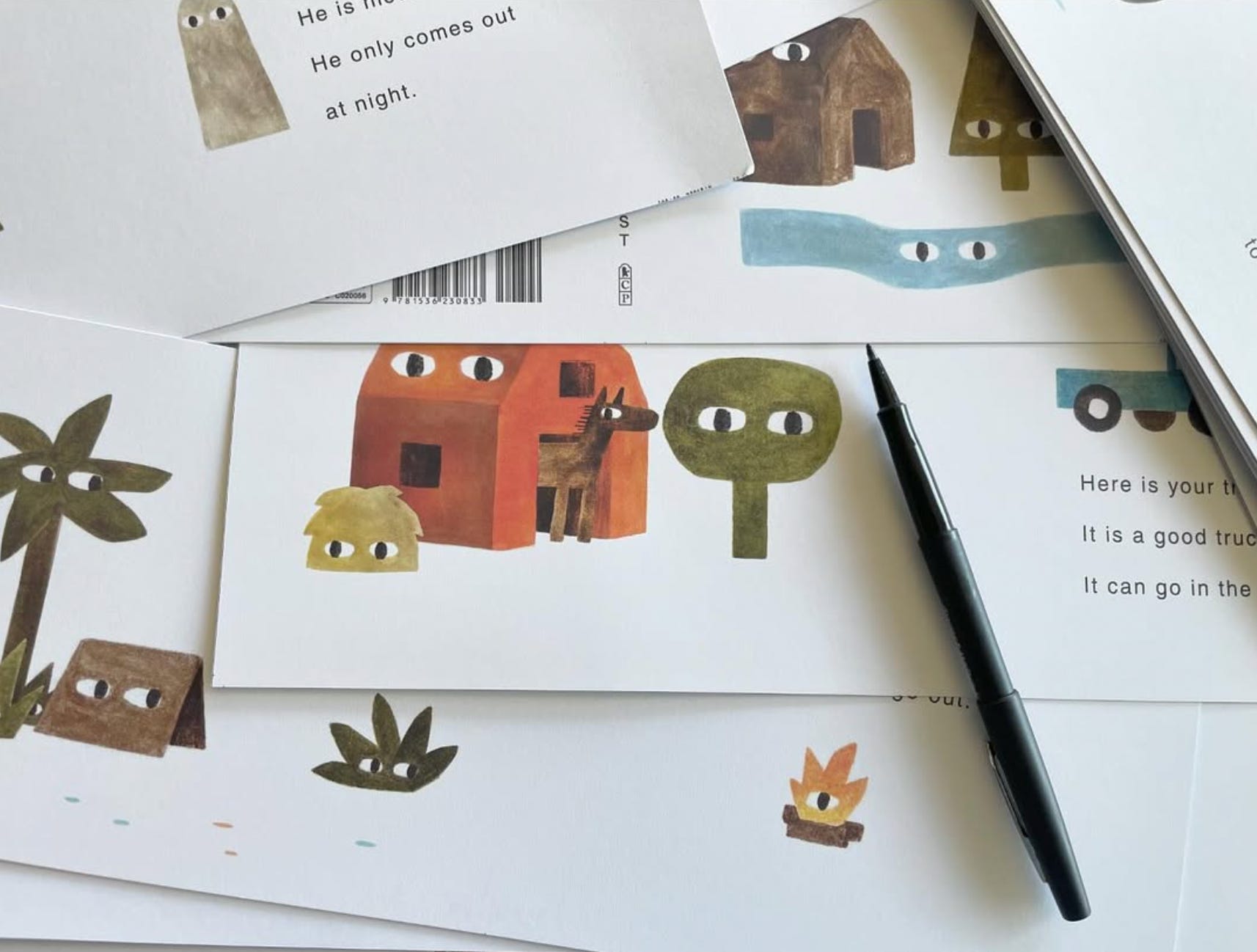
MAC: Yeah, the Your Places books begin with accumulation. On each spread, a new object is introduced. There is some calibration — the objects are rearranged or complicated in some way. There’s a completion — the place has been ordered correctly. And then the sun sets and all the objects go to sleep.
That is a structure or rhythm that you’d inherited when you sat down to write Your Truck.
JON: Yes.
MAC: And you did some of that here, right?
MAC: You introduced readers to their truck.
MAC: They got to see some different trim options —
The same truck in blue or green.
The premium audio system, weather coating.
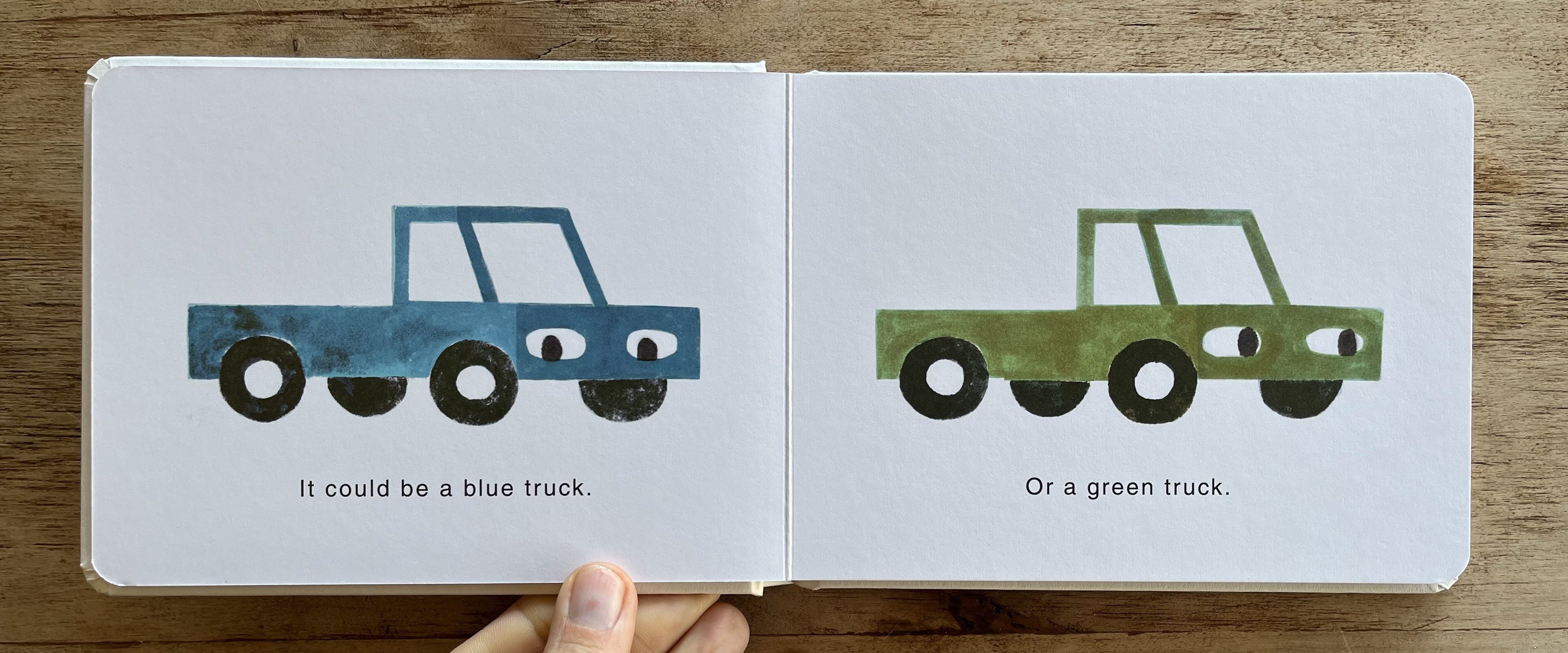
JON: That was a thing for sure. I remember when I was a kid, going to the Toronto Auto Show downtown, and seeing a Mazda Miata for the first time. I got a complimentary brochure and all the way home assembled my ideal Miata.
It was British Racing Green with a tan genuine leather interior.
Still my favorite color combo for a car.
MAC: And I will say, it’s a shame the timid attorneys over at Candlewick Legal nixed Your Miata.
JON: I think it had something to do with the tariffs.
MAC: The truck accumulates a bunch of cargo — too much cargo.
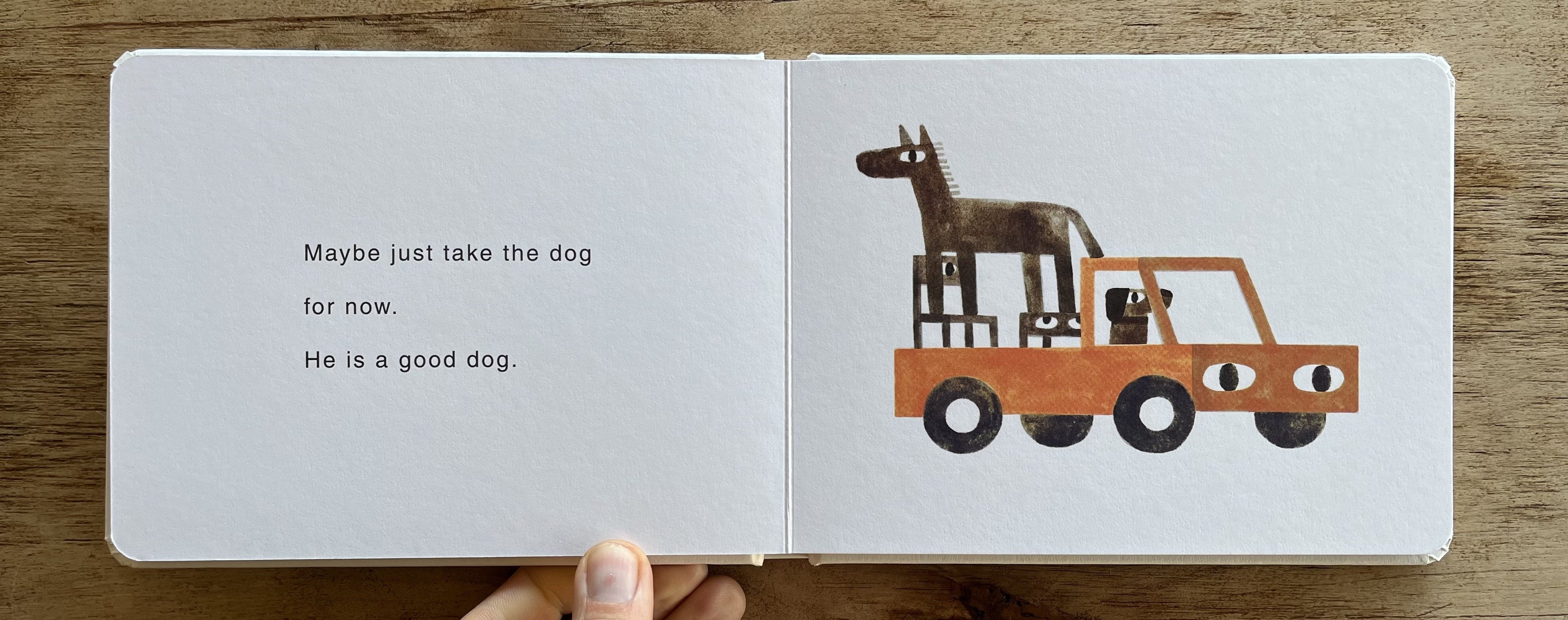
MAC: And then we get to the spreads that feel most particular to this book —
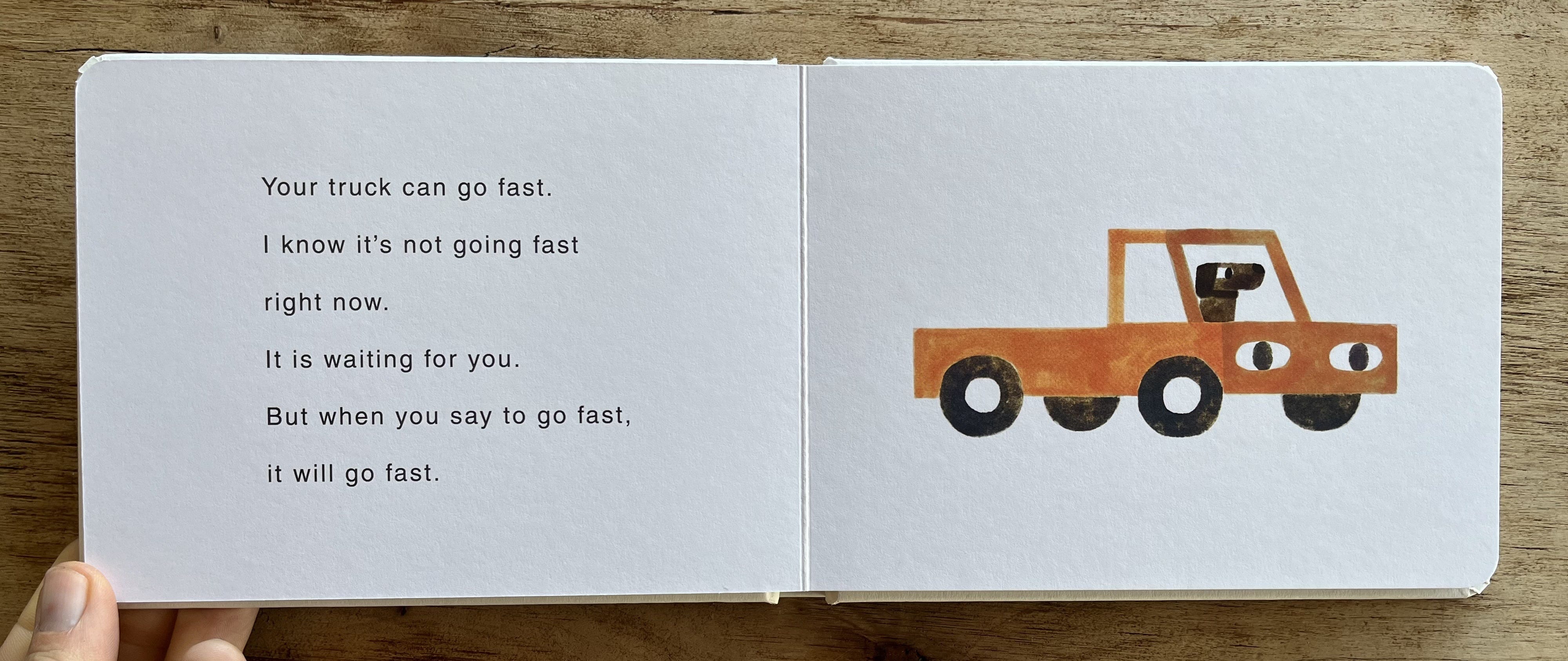
You talk about a specific aspect of the truck’s nature — it can go fast.
And then these spreads, the one that I imagine has people talking about crying in the comments of that Instagram post, the one you were a day late on:
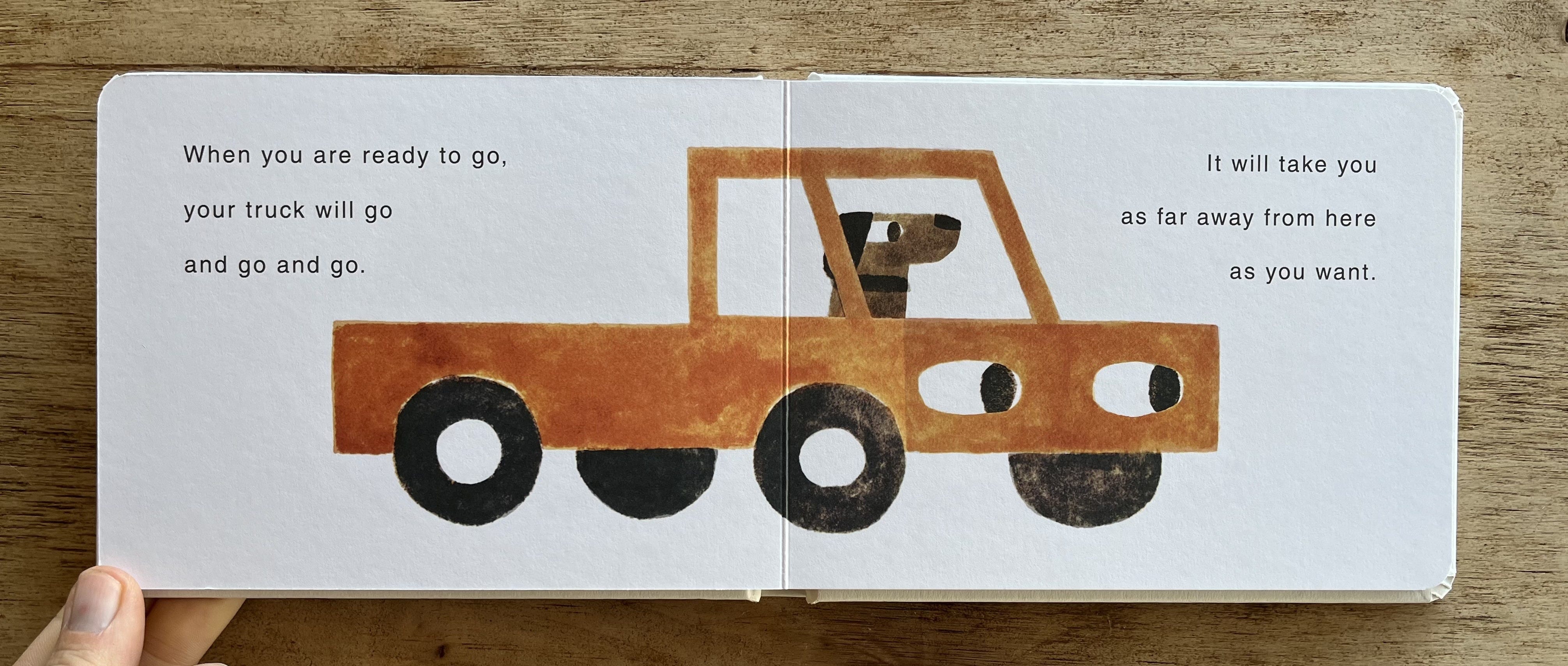
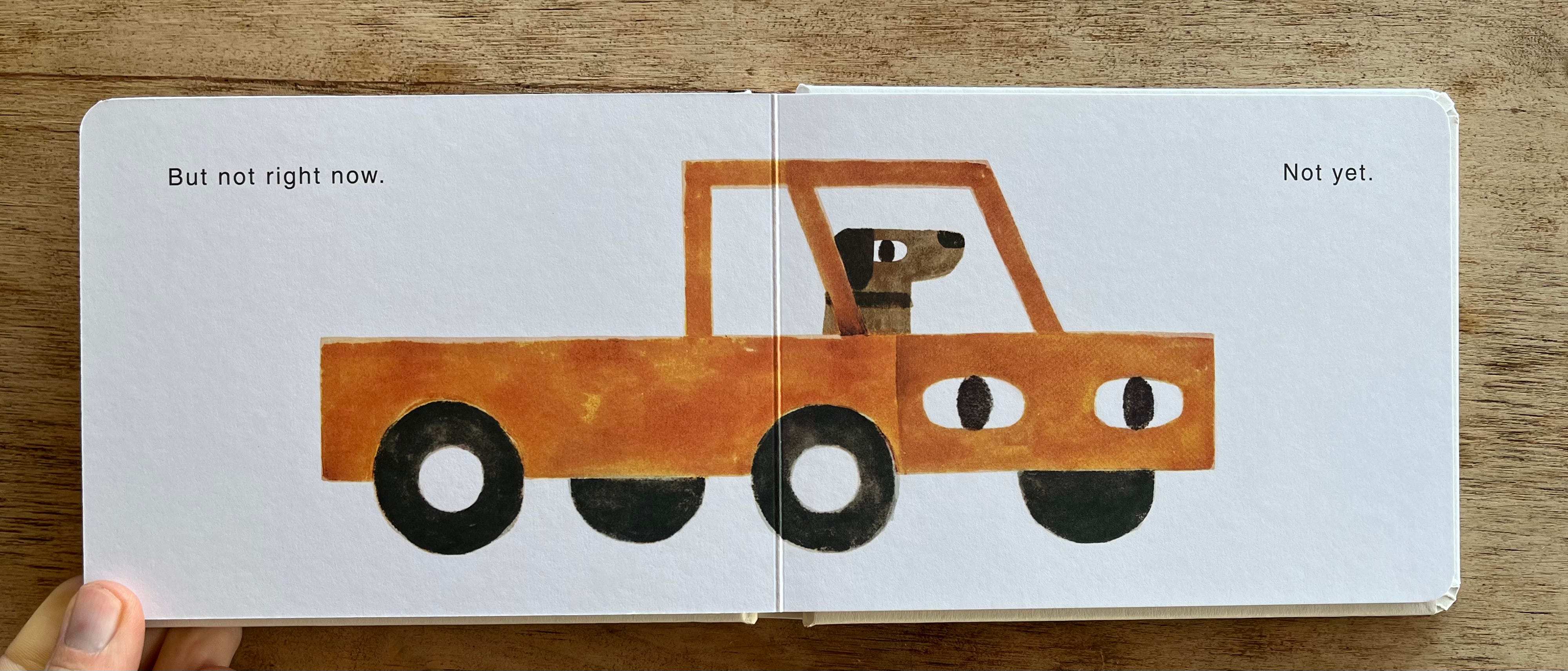
MAC: These spreads are so moving. And they’re new to the Your Things books. These quiddity spreads, where you focus on the essential thingness of your subject.
JON: It’s kind of what you hope for in a series setup. I don’t really have any place else to go here. I have looked at colors, other guys he can carry. I’m out of options and I have like four pages left, if it’s going to be the same thickness as the other Places books.
But the Places books, in their better pages, feel like an adult talking to a child that they love, so once all my ways of avoiding emotion were used up, we get to have an emotion, in the text at least.
MAC: You mean, inherently there is emotion there, in the Places books? Because the voice is that of an adult creating or giving a world to a child?
JON: Yeah, I guess? Those books are about talking in the language of promises you are making, even imaginary ones. “Here is water, you’ll always have it. Here is a house, you can live in there.”
MAC: And, in these quiddity spreads, the Things books get more explicitly emotional, right?
JON: I think the symbolic stuff got harder to avoid when it was just one object. Why does my kid love cars and trucks? Those things take you places. They take you away. Don’t go away. Not yet anyway.
MAC: Right. Although of course you’re not just talking about what trucks do, you’re also talking about a kid going “far away from here,” which is pretty heavily freighted stuff, especially in a book that will often be read by parents to a new child.
And I will say too, Jon, you did a beautiful job calibrating the writing to be capacious enough to hold a lot of different kids’ (and adults’) feelings about going far away.
And stuff like “When you are ready to go” and “as you want” are very generous to young readers (and their sobbing parents), without feeling mechanical or mealy-mouthed.
The dog helps too.
JON: Well there’s who you want to be and are hoping to be as a parent, right. The kind that is like, “Off you go into the world! I trust you! Can’t wait to see what you do while I stay here!” And then there’s the thing you’re already feeling with an infant and can only assume gets bigger where it’s just “DON’T EVER LEAVE.”
MAC: Plus also, of course, “We’re just talking about a truck.”
“Why does Daddy cry when he watches the Bills play?”
JON: Hahaha yes, it’s important to do both things, hopefully. Dad is a mess on the rug and the kid is still thinking, “I wish the truck had stayed green.”
MAC: It’s a little miracle of a book, Jon. A little miracle anyone can own, and for under ten bucks.
JON: Thank you Mac. <3
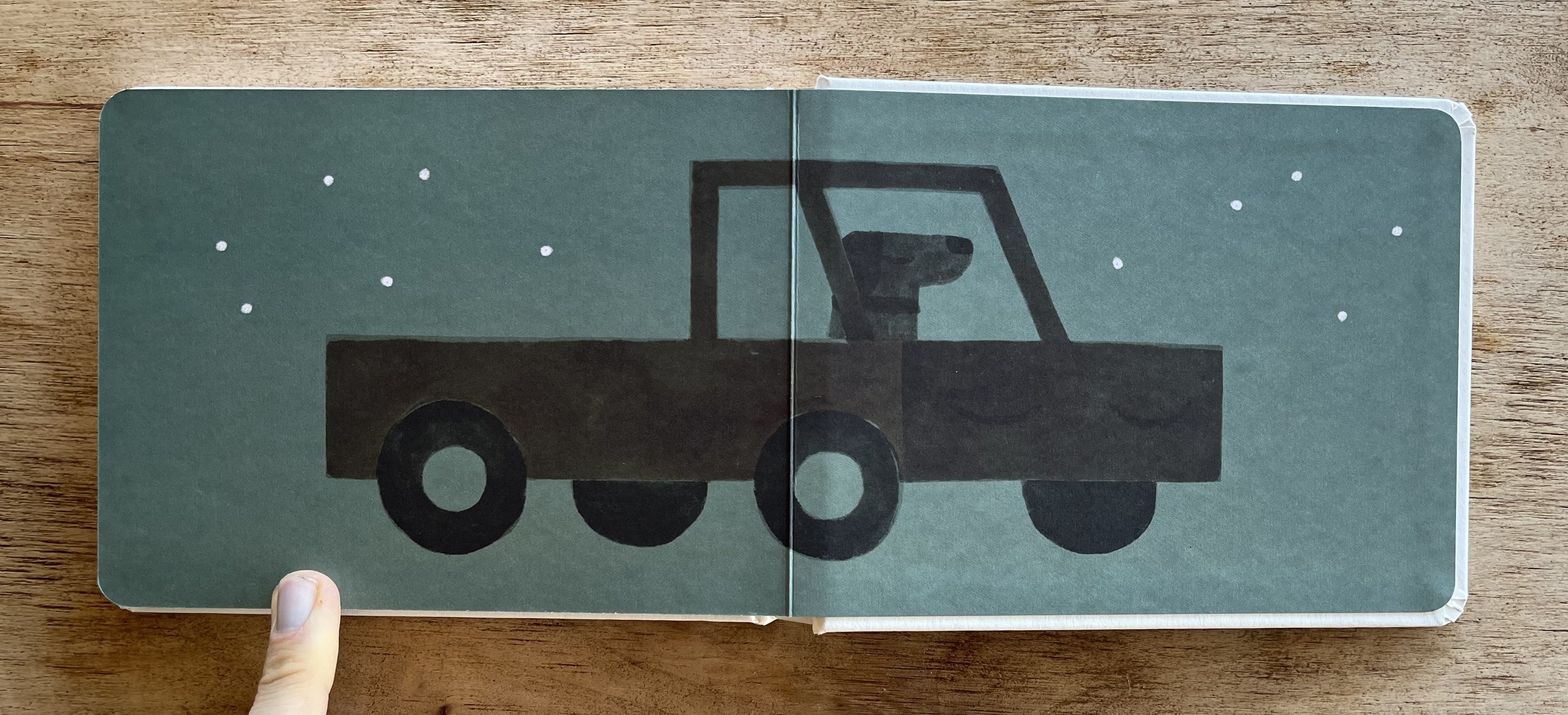
I did a bit of an eye roll at the part where Mac says folks were talking about crying in the IG comments: "Yeesh, the things people will say to get attention." Then that spread kicked me right in the teeth and my teeth all fell out!!!
Your newsletter is the best. Before reading this, I probably would have said that images are the most important part of board books since board books are made for people who can’t read (lol). But of course the board book is also for the person reading it out loud, and of course the words are extremely important too! I am STRUCK DUMB (literally, I am dumb) by the writing in “Your Truck,” especially (and least importantly) as a person who CANNOT write simple, effective sentences. It is extremely deft. I hope that word is a good enough one (although I’m not sure it is - how the heck do you guys decide on words?). Many, many congratulations to you, Jon! Thank you BOTH for sharing your delightful conversation about this beautiful work!