

The Future Book
Making a book that's funny to read out loud


Mac has a new picture book, The Future Book, illustrated by Shawn Harris (who just launched Make Some Art, a newsletter with art projects for teachers, librarians, and parents to share with kids).
If you want a signed copy of The Future Book, you can order it from Mac’s beloved local bookshop, East Bay Booksellers.
Today, Shawn joins Jon and Mac to talk about making a book that is funny to read out loud. As usual, this conversation took place over text message.

SHAWN: Hi Mac.
JON: Hi Mac.
MAC: Hi Jon and Shawn.
JON: Hi Shawn.
SHAWN: Hi Jon.
MAC: OK, now that’s out of the way.
JON: Happy Book Release Week you guys. For your book.
OK so I feel privileged because I got to see this book in many birthing stages.
MAC: Weird.
SHAWN: It’s natural, Mac.
JON: Yeah. You’re gross.
MAC: I don’t like this new group dynamic.
JON: I’m like the weird guy in the waiting room at the hospital who insisted on being there too. We all know that guy right?
SHAWN: “I think he’s, like, my second cousin?”
MAC: “Let me know if anyone forgot to bring cigars.”
“Because I have a bunch of cigars.”
JON: “I got names too.”
“And fonts.”
(I really did have fonts.)
MAC: SEGUE
SHAWN: Wow, so that’s how you guys do it.
JON: OK, I guess we start with Mac. Cause he started it.
Mac what is this book?
MAC: This book is called The Future Book. The premise is pretty simple: that the book is from the future—sent from the past to teach us all what life will be like.
Writing it, I was really thinking about constructing a read-aloud. I love reading picture books out loud, and I wanted to create, essentially, a portable comedy routine, something that would give adults that great feeling of getting laughs at storytime.
JON: Yeah, the book feels to me like something only a road warrior like you could’ve done. Every single page is designed to elicit an audible reaction from a group of kids. Even really rowdy back-of-the-gym kids.
MAC: The goal of the first few pages was to quickly establish the premise and then introduce the game of the book (and get laughs along the way).
So the first spread declares, “This book is from the future. Lots of things are different here in the future.”
(That “here” was important to me, rooting this book—and its point of view— in the future.)

The second spread introduces a rule: names of things have been swapped in the future. So you get a pair of opposites, or almost opposites.

The second spread reinforces this pattern.
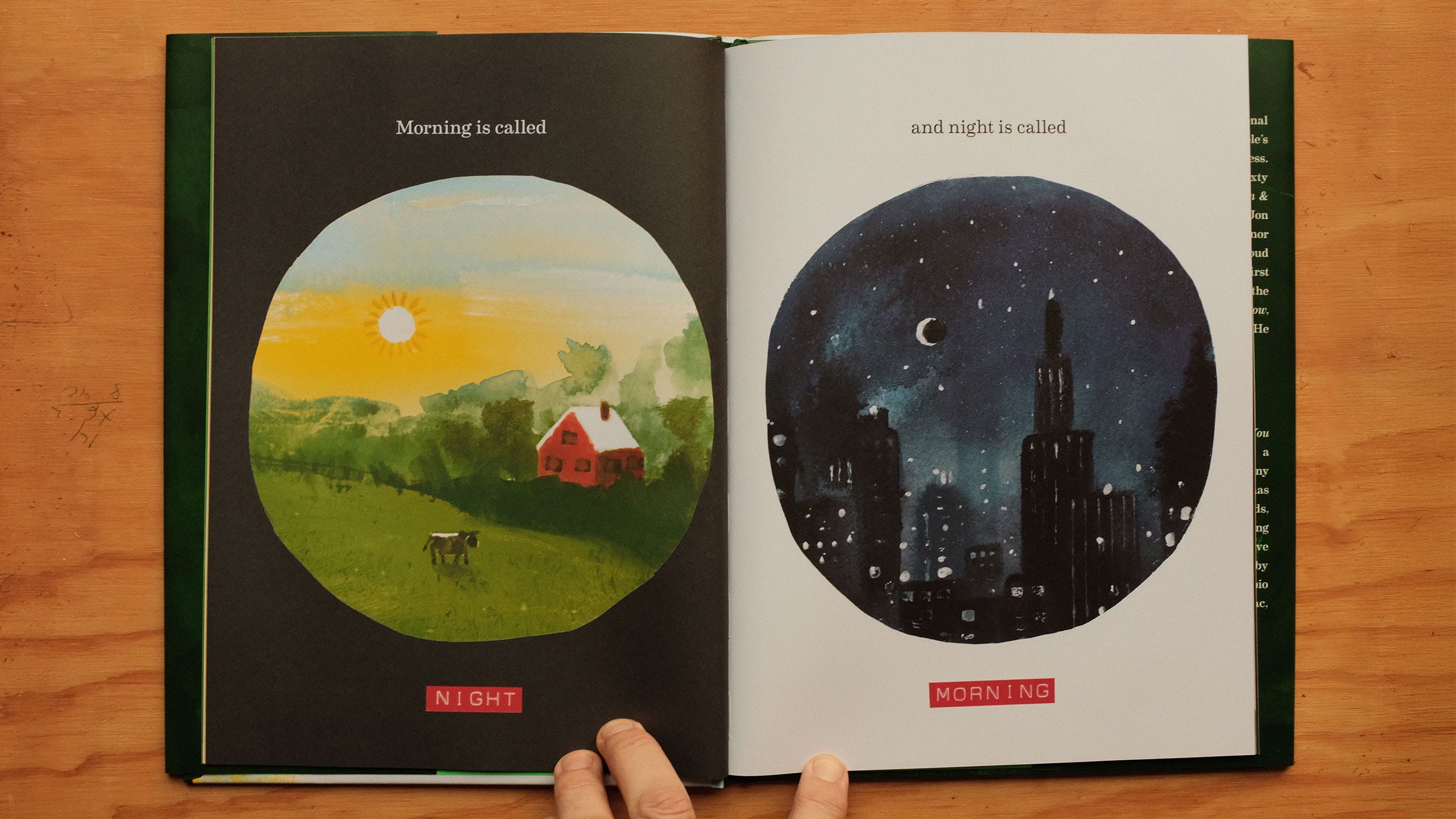
We now think we have a grip on how the future works. And so the third spread invites the audience to use that understand to fill in the blank. (Kids will usually answer the question posed on the recto out loud, before you turn the page.)

And then, when you turn the page, the book surprises us. Our guess is wrong, our assumptions are unreliable, we have more rules to learn.

JON: Mac’s a jerk.
SHAWN: This guy loves rules.
JON: “Oh you think you learned how things are?”
MAC: I really hate this new group dynamic.
JON: The visual rules are eased into here too, in the same way. The first page is just black text on blank white paper. And then literally planet earth.
MAC: Right, that blank page with text introduces the big conceit of the book as simply as possible. It’s declarative. And then on the recto, we get a circle, the earth. The next spread has circles that are the same size, in the same place, the sun and the moon. And then the next spread has two scenes, landscapes, but they are vignetted, contained in (larger) circles. The next spread is a full bleed illustration—we are finally, comfortably, in this world.
SHAWN: Yeah, the circles are doing the visual equivalent of your text, lulling the reader into accepting the patterns and rules.
MAC: And when you turn the page again, it’s a black page with white text. It feels like hitting a wall, or a trapdoor opening, which is what the joke is doing too.
JON: The label-maker idea. Was that way of separating the punchline written in the text direction or Shawn was that you?
MAC: That was Shawn.
SHAWN: I got a vintage Dymo label maker on eBay to make those!
MAC: A Berkeley, Calif., company!
JON: No wayyyy the labels are practical?? Dedication, everyone.
SHAWN: The labelmaker is chrome, and heavy.
MAC: It’s so heavy!

SHAWN: It’s like a Lincoln Towncar that makes labels.
JON: I think Towncars actually did make labels.
If you got that package.
I like how the labels on the first two things are actually ON the objects they are naming, so you teach that, and then after that you don’t have to do that anymore.
SHAWN: I wanted a real recognizable, almost cozy or quotidian way to label the stuff Mac is defining. A bunch of my job in this book is to help lull you into comfort and rhythm so that when Mac jerks the wheel, you really didn’t see it coming.
JON: Yeah and the labels, in your head, or I imagine out loud, read differently. It’s great cause they are the funny word, but the treatment makes you read them flat, which makes them even funnier.
SHAWN: I get to play the straight man next to Mac, which is RARELY my role in our dynamic.
JON: Let me tell you. The water is fine.
MAC: I think the labels also give the ridiculous words some weight, too.
The name-swapping is arbitrary and capricious, but these labels feel authoritative.
JON: Yeah, right. If you start making up nonsense words, there’s a risk that some of the tension is out after a while cause the kid is just like “well now you’re just saying whatever,” but if it’s on a label maker. A DYMO label maker, no less.
SHAWN: When the jar says “SOAP” everyone knows you don’t put nothin’ else in there!
JON: I’ve never seen a jar of soap in my life but I trust this.
MAC: When Shawn finished the book, he immediately set to labeling all his soap jars.
JON: “No severed heads in those!”
“Nothin’ but soap in here boss.”
“DAMN”
MAC: “And here I thought we’d finally found the DYMO Killer.”
“Who uses the famously heavy DYMO (a Berkeley, Calif. company) Labelwriter as a murder weapon.”
JON: Was that the approach more or less for the illustrations generally? You’re playing it pretty straight right? In terms of facial expressions and stylistic things.
SHAWN: Yes. But! I used a medium I have never used before so everything is still loose without looking wacky or anything.
JON: Man, loose without wacky is the holy grail.
SHAWN: I was really trying to paint a crowd. I just am not a master gouache/watercolor artist like, say, Carson Ellis.
JON: I think she uses gouache to make the rest of us mad. She probably doesn’t even like it.
But the interesting thing is that Mac is also playing it straight. His tone is just reporting, right?
MAC: Yeah, the narrator from the future thinks this stuff is all normal—and that we, the readers, are the weird ones.

JON: Besides teaching how the book is meant to be read, and how the joke initially works, the other thing those first few pages do is teach how similar a lot still is in the future. Seeing planet earth you’re like “OK phew, still there I guess.”
SHAWN: Yeah, we’re just interested in words, really.
MAC: Yeah, that’s the Big Underlying Joke of the book, but also maybe the hopeful and profound thing too: in the future, language has changed, and etiquette has changed, but people still shop and thank each other and eat together.
SHAWN: Not apples though.

JON: Maybe it’s because I see you guys in front of crowds of kids so often that I feel this way about this book, but it does feel like watching a really great tightrope walk. Like you take these first steps so carefully, and then you start to dance up there, you’re pulling tricks, and the pacing gets riskier and riskier, you could fall on your face at any moment, but of course you don’t, of course it actually kind of flies into outer space instead. Of course it’s great.
MAC: We really wanted to take good care of both the audience and the adult reading this book out loud.
JON: Yeah whoever gets to read it out loud is gonna feel very smart and funny.
SHAWN: I’m glad it feels like we flew into outer space, because, really, the wildest thing that happened was us putting a fish where it usually is not.
Problem: I read this book with first graders and now they all think I'm really funny. Feeling a lot of pressure to live up to this new persona. Considering retirement.
10/10 substack post, 10/10 book, 10/10 text thread, that's a 30 overall